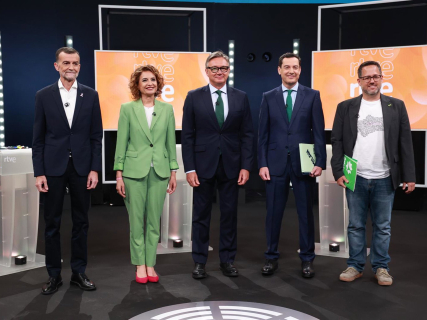

The Andalusian campaign reaches its last day this Friday, May 15, with the candidates fully engaged in closing events and with a parallel battle already clearly defined in the digital sphere. Two days before Sunday's elections on the 17th, the analysis of activity on X between May 7 and 13 shows a more mature snapshot of the campaign: María Jesús Montero maintains the first position in the global Digital Power ranking, although she clearly drops compared to the early days of the campaign, Juanma Moreno Bonilla retains the largest follower base, Vox Andalucía and Manuel Gavira concentrate some of the biggest impact peaks, and José Ignacio García Sánchez reappears as one of the profiles with the best relative performance despite starting from a smaller community.
The new report confirms something that the first measurement by Demócrata already indicated at the start of the campaign: the Andalusian digital competition does not have a single winner. There are several simultaneous leaderships. Montero dominates the aggregated index; Moreno leads in accumulated community and personal mentions; Vox Andalucía is the actor that places the most publications among those with the highest interaction; the Andalusian PSOE leads in publication volume; and the alternative left maintains an intense presence, albeit with unequal performance among Por Andalucía, Adelante Andalucía, Antonio Maíllo, and José Ignacio García.
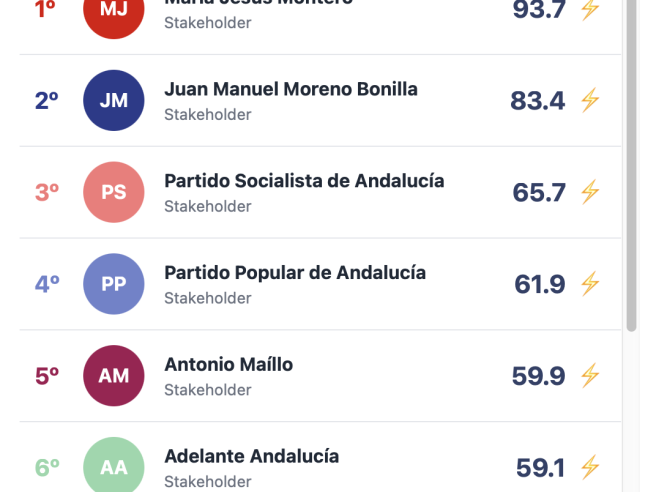
The comparison with the first snapshot of the campaign, taken between April 23 and 29, shows a relevant evolution. Montero was already leading then with 95.2 points and now remains first with 93.7. Moreno, who started with 80.0 points, rises to 83.4. The Andalusian PSOE drops from 74.2 to 65.7, although it remains third. The Andalusian PP slightly recedes from 63.5 to 61.9. Antonio Maíllo clearly improves and ranks fifth, with 59.9, ahead of Adelante Andalucía, which stands at 59.1. José Ignacio García Sánchez, who was one of the surprises at the start, appears seventh with 51.7.
The conclusion is clear: Montero reaches the closing with a global digital advantage, but Moreno has reinforced his position compared to the start of the campaign. The socialist candidate retains more aggregated centrality, while the Andalusian president maintains a larger digital structure and gains weight in the final stretch. Vox, for its part, does not lead the global ranking, but has managed to impose some of the messages with the most interaction throughout the week.
Montero maintains digital power leadership with setbacks
The Digital Power ranking places María Jesús Montero in first position with 93.7 points. The socialist candidate reaches the end of the campaign as the profile with the greatest aggregated capacity to generate conversation, mentions, impact, and political centrality on X during the analyzed period.
The difference with the first measurement is small: Montero goes from 95.2 to 93.7 points. That is, she does not lose digital command and maintains the first position in a decisive phase, although the slight drop is threatened by Juanma Moreno's rise. She also continues with the persistence of a very recognizable strategy: direct confrontation with Juanma Moreno, defense of public services, appeal to the socialist vote, and attack on the PP's management of health, education, and public policies.
Montero publishes about Andalusia from a clearly electoral tone. Her messages are based on criticism of the opposition, vindication of the PSOE, and the promise of recovery of public services. Recurring themes include public health, education - of course, the famous post about the Civil Guard -, universities, polls, proposals, and denunciation of what she defines as "empty politics of the right."

Her account does not have the most followers, but it is the one that best converts political activity into aggregated digital power.
Moreno rises and retains the largest community
Juan Manuel Moreno Bonilla appears second in the global ranking, with 83.4 points. This is one of the most important data points in the update, because it improves compared to the first measurement, where he obtained 80.0 points. In the week of May 7 to 13, the Andalusian president does not snatch the global leadership from Montero, but he does reduce the distance and reaches the end of the campaign with a reinforced digital position.
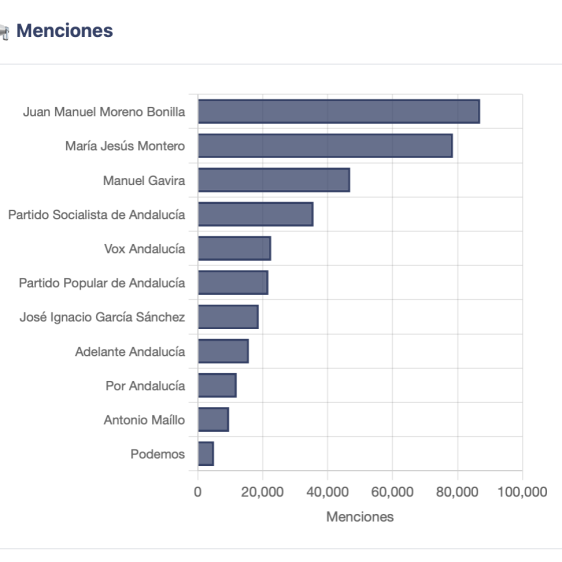
His great strength remains the community. Moreno is, by far, the actor with the most followers among the analyzed profiles: he exceeds 200,000, ahead of Montero, who is around 100,000. This structural advantage allows him to maintain digital authority even with a lower volume of publications than other actors.
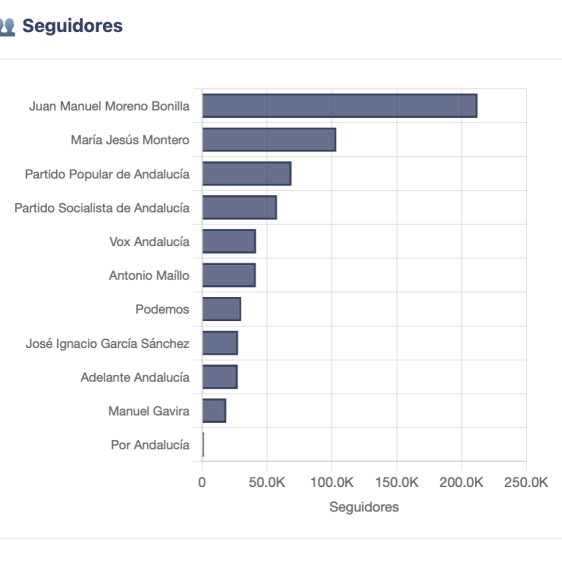
Furthermore, Moreno also leads in mentions within the analyzed period. The mentions graph places him above Montero, with a figure close to 85,000 mentions, while the socialist candidate is above 75,000. This data marks a difference compared to the first measurement, in which Montero appeared ahead in mentions. In the final stretch, Moreno becomes the most cited actor in the Andalusian political conversation, probably due to his dual role as the favorite candidate in the polls and outgoing president.
His communication maintains a presidential tone: it mixes campaign events, management, culture, Andalusian traditions, government proposals, and criticism of the opposition. Among the analyzed messages, there are references to the Jerez Horse Fair, tax cuts, government policies, and criticism of the PSOE and Vox regarding governability after March 17.
Moreno's style is formal and direct, with frequent use of hashtags and a clear desire to project stability. His profile functions as a combination of an institutional showcase, an electoral loudspeaker, and a moderate mobilization mechanism. This gives him less stridency than other actors, but more structural depth.
The Andalusian PSOE remains third, but loses strength compared to the start
The Andalusian Socialist Party appears third in the Digital Power ranking with 65.7 points. It is a relevant position, but it represents a drop compared to the initial measurement, when it reached 74.2 points. The PSOE maintains organic presence, volume, and support for Montero's strategy, although it loses some of the relative momentum it had in the days leading up to the official start of the campaign.
In terms of publication volume, however, the Andalusian PSOE is the actor that publishes the most in the analyzed period. The graph places it at the top, with nearly 170 publications, ahead of Vox Andalucía, Por Andalucía, and José Ignacio García Sánchez.
The paradox is evident: the Andalusian PSOE publishes more than anyone else, but does not lead in either Digital Power or mentions. This confirms that volume alone does not guarantee dominance. It serves to sustain presence, feed narratives, and accompany the candidate, but the index also rewards the ability to generate conversation, engagement, impact, and centrality.
The strategy of the Andalusian PSOE is consistent with Montero's: healthcare, education, criticism of the PP, defense of public services, and mobilization of the progressive vote. The party acts as an amplifier for the candidate and as an organic campaign support. It reaches the end with muscle, although with lower aggregate performance than at the beginning.
The Andalusian PP comes in fourth: less noise, more structure
The Popular Party of Andalusia is in fourth place in the ranking, with 61.9 points. It also drops slightly compared to the first measurement, when it obtained 63.5. Its position is stable: it does not lead in volume or conversation, but it retains a solid base thanks to the community, the institutional brand, and the pull of Moreno Bonilla.
In followers, the Andalusian PP appears as the third largest community in the report, behind Moreno and Montero. In publications, it is in the middle zone, below the PSOE, Vox, Por Andalucía, José Ignacio García, and Manuel Gavira. In mentions, it also maintains a relevant presence, although not comparable to that of the two main candidates.
Its digital role is less prominent than Moreno's. In a presidentialized campaign, the PP brand functions as support, while the main electoral asset is the president himself. The organic account accompanies the general strategy of continuity, management, and stability, but the emotional and political focus is clearly on Moreno.
The PP reaches the end with a low-risk digital strategy: less volume than its rivals, less organic confrontation than Vox or the PSOE, but more capacity to sustain an image of government. In campaign terms, this can be effective in not eroding the favorite candidate, although it reduces the capacity to set its own digital agenda.
Vox Andalucía publishes a lot and places the most viral publications
One of the great pieces of data from this update is Vox Andalucía. Although it does not appear in the top visible positions of the global Digital Power ranking, it dominates two very relevant dimensions: volume and viral impact.
In publications, Vox Andalucía is the second most active actor, with more than 160 publications between May 7 and 13. Only the Andalusian PSOE publishes more. In mentions, Vox Andalucía is also in a prominent zone. But where it truly stands out is in the ranking of publications with the most interactions: two of the top three publications belong to Vox Andalucía and the other to Manuel Gavira.
Vox and the Civil Guard dominate the 'top 5' publications
The top 3 publications with the most interactions show a very clear concentration of Vox's agenda. The most interacted publication is a retweet from Vox Andalucía to Manuel Gavira with the message: “He who enters illegally, out. He who comes to commit crimes, out. He who comes to live off the efforts of Spaniards, out…”. It registered 9,400 likes and nearly 3,000 shares.
El que entra ilegalmente, fuera.
— Manuel Gavira 🇪🇸 (@GaviraVox) May 7, 2026
El que viene a delinquir, fuera.
El que viene a vivir del esfuerzo de los españoles, fuera.
El que viene a agredir a nuestras mujeres y niñas, fuera.
¡A SU PUÑETERA CASA! pic.twitter.com/70G1HvyyYB
The second publication is the impact of Manuel Gavira's own post and the third is again from Vox Andalucía, with a message about the Guardia Civil, with 7,800 likes and 2,100 shares.
La muerte no es el final.
— VOX 🇪🇸 (@vox_es) May 8, 2026
¡VIVA LA GUARDIA CIVIL! pic.twitter.com/yYUz1JEBs4
It is truly remarkable that the other two posts with the most interaction do not belong to any of the candidates but are reposts from two national leaders: Santiago Abascal talking about immigration and the repost from María Jesús Montero about the death of Civil Guards in the line of duty.
El crimen de la chica degollada en Esplugues recuerda al del sacristán de Algeciras.
— Santiago Abascal 🇪🇸 (@Santi_ABASCAL) May 9, 2026
Siempre tienen brotes psicóticos los mismos. ¡Qué casualidad!. Desde luego los culpables de esas muertes también son siempre los mismos: los políticos que han dinamitado nuestras fronteras y… pic.twitter.com/FpIKLpcYJA
Consternado por la muerte de dos agentes de la Guardia Civil durante una operación contra el narcotráfico en Huelva.
— Pedro Sánchez (@sanchezcastejon) May 8, 2026
Todo mi cariño y apoyo a sus familiares, compañeros y seres queridos en estos momentos tan duros, y mi deseo de una pronta recuperación para los agentes que…
The reading is conclusive: On one hand, 5 posts, 4 are from Vox which, although it does not necessarily lead the aggregate index, does manage to have its harshest messages be the ones that circulate the most. Its strategy is high volume, repetition of simple frames, and emotional activation. National priority, immigration, public safety, and criticism of the system are the axes that yield the most results for them. On the other hand, that the murder of the Civil Guards has caused an earthquake in digital terms in the campaign.
Gavira turns immigration and security into digital fuel
Manuel Gavira is one of the profiles with the most impact this week. In the volume versus impact graph, he appears in a very strong area: around 100 publications and nearly 145,000 total interactions. That is, he is not the one who publishes the most, but he is one of those who best transforms activity into engagement.
His communication is direct, colloquial, aggressive, and polarizing. He talks about immigration, public safety, national priority, criticism of the PP and PSOE, and defense of Vox's ideological framework. His messages are constructed to be understood in seconds and shared without nuance. That, on X, works.
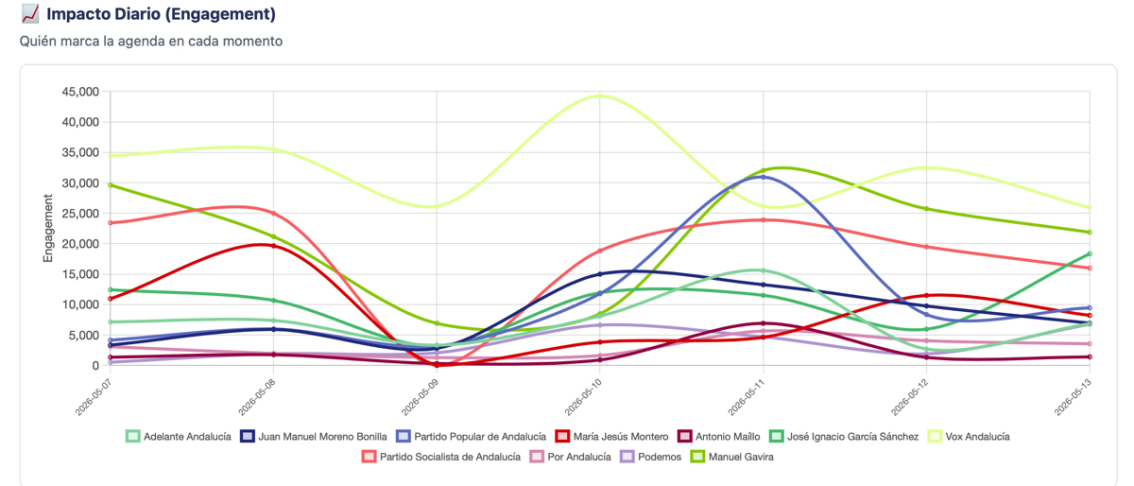
In daily impact, Gavira maintains high figures for a good part of the period and reaches one of his peaks on May 11, when he exceeds 30,000 engagement points. The graph shows that this is not an isolated eruption, but a sustained presence throughout the week.
Gavira does not compete in community with Moreno or Montero. Nor does he have the institutional centrality of the two main candidates. But his digital performance is very high because he concentrates the message, avoids thematic dispersion, and uses formulas with strong emotional charge.
In a campaign with polls that place Vox as a potential relevant player for governability, that viralization capacity can have added political value: it not only mobilizes the convinced, but also forces other parties to respond to it.
Antonio Maíllo improves and overtakes Adelante Andalucía
Antonio Maíllo appears fifth in the Digital Power ranking with 59.9 points. This is a significant increase compared to the first measurement, where he was at 55.0. His advance allows him to surpass Adelante Andalucía, which remains sixth with 59.1.
Maíllo arrives at the campaign's closing with a more settled conversation. His activity revolves around public healthcare, education, public funding, corruption, labor rights, and public services. He also mentions Moreno Bonilla, the PP, and Vox in a critical tone. His style combines ideological discourse, left-wing language, and appeals to unity.
His main limitation remains traction. His posts with the highest engagement fall far short of the figures for Vox, Gavira, Moreno, Montero, or José Ignacio García. Data indicates a highlighted post as a defense of public healthcare, education, and a united left, with 494 likes and 37 comments. These are correct figures for his community, but they do not break the general conversation.
Maíllo has political coherence, discursive structure, and a clear identity, but in the X ecosystem, coherence does not always equate to virality. His improvement in the ranking indicates greater presence in the final stretch, although his challenge remains to break through beyond his natural space.
Adelante Andalucía drops slightly, but maintains presence
Adelante Andalucía appears sixth, with 59.1 points. In the first measurement, it was at 61.4, so it registers a small setback. Even so, it remains in the upper-middle zone of the ranking and retains conversational capacity, especially on issues of housing, public services, labor rights, and criticism of the right.
In followers, Adelante Andalucía appears below the major parties and candidates, but maintains a sufficient community to sustain its presence. In posts, it is not at the top, although its activity is relevant. In mentions, it also falls into a middle position.
The difference with José Ignacio García is interesting: the Adelante brand maintains structure, but the candidate can generate more striking peaks when he hits the mark with specific messages. This tension between brand and personal figure is one of the keys for the alternative left in this campaign.
Adelante has a narrative, but needs to turn it into impact. The digital campaign shows that messages about housing, mental health, labor rights, or criticism of the PP can work well, but performance depends heavily on the specific formulation, timing, and ability to provoke conversation.
José Ignacio García is the big digital surprise, although he loses global position
José Ignacio García Sánchez ranks seventh, with 51.7 points. This is a decrease from the first measurement, when he obtained 59.5, but he remains one of the most interesting cases in the analysis due to his relationship between community size and impact.
His account does not have the community of Moreno, Montero, or the major party brands. However, it appears in high positions in publication volume, with around 130 publications, and maintains an intense conversation about the campaign, labor rights, public health, education, Andalusian culture, and criticism of the right.
The report highlights messages such as "The PP censors Carnival" or "Mental health must be a right." References to meetings with unions and direct criticism of Juan Manuel Moreno and the Popular Party also appear. His style is direct, often colloquial, with the ability to alternate between a militant tone and emotional messaging.
In interaction data, one of his highlighted publications reaches 1,745 likes and 49 comments, while another reaches 2,020 likes and 87 comments. These are figures much higher than those of other actors of similar size and confirm that José Ignacio García retains the capacity for specific impact.
His fall in the global ranking does not eliminate the underlying conclusion: he remains a profile with performance above his size. He does not dominate the campaign, but he can alter specific conversations when he connects housing, culture, social rights, or criticism of the PP with a direct formula.
Publishing More Does Not Guarantee Winning the Digital Campaign
The publication graph offers a central lesson. The Andalusian PSOE and Vox Andalucía are the two actors that publish the most. Por Andalucía and José Ignacio García also have a very high volume. Manuel Gavira appears in an intermediate-high zone. In contrast, Moreno and Montero publish considerably less.
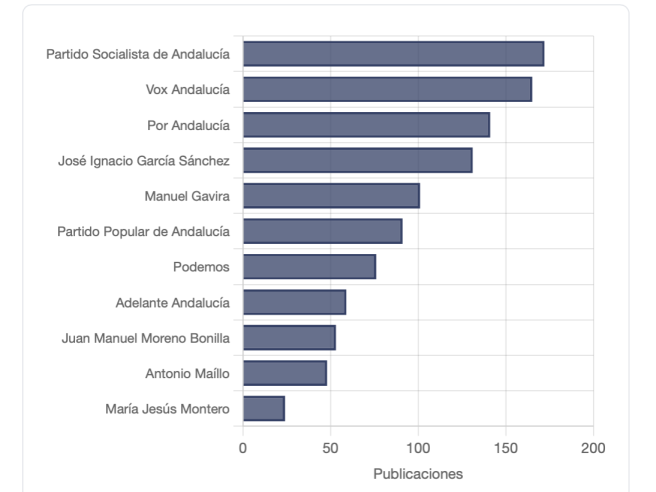
However, Montero and Moreno lead the global ranking. This confirms that the digital campaign is not won solely by frequency. Publishing a lot serves to occupy space, but digital power depends on a more complex combination: community, mentions, engagement, authority, virality, daily impact, and centrality in the conversation.
The Volume-Impact Graph Shows Four Distinct Campaigns
The intersection of publication volume and total impact allows for the distinction of four digital campaign models.
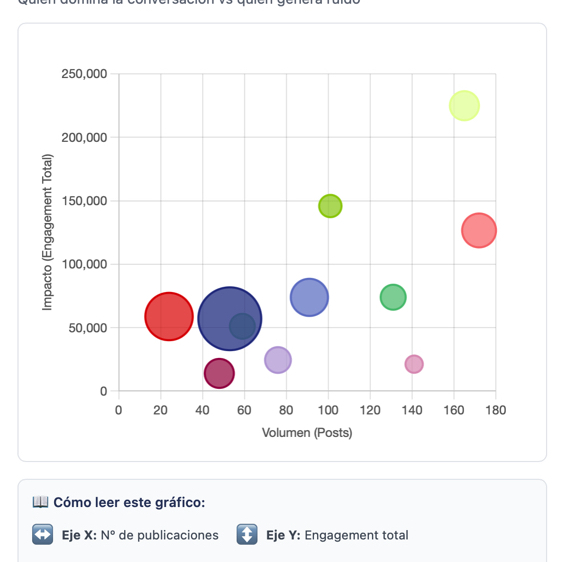
- The first model is high volume and high impact. There appear Vox Andalucía and Manuel Gavira. Vox is positioned around 165 publications and more than 220,000 total interactions, a very prominent position on the graph. Gavira, with lower volume, also achieves very high impact, around 145,000 interactions.
- The second model is institutional authority and community. Moreno is positioned with a lower publication volume, around 50, but with relevant impact and a large bubble due to his community. His strength is not in saturating the conversation, but in starting from a dominant position.
- The third model is political centrality with medium-high community. Montero appears with low volume, around 25 publications, but with relevant impact, around 60,000 interactions, and global leadership of the index. His power is not in publishing more, but in being mentioned, discussed, and placed at the center of political combat.
- The fourth model is insurgent activity or expanded niche. Here enter José Ignacio García, Antonio Maíllo, Adelante Andalucía, Por Andalucía, and Podemos. Some have high volume, others less, but all seek to turn specific issues into conversation: housing, healthcare, education, labor rights, anti-fascism, or criticism of the PP and Vox.
Daily impact shows three major peaks: Vox, Gavira, and PP
The daily impact graph between May 7 and 13 allows us to see who sets the agenda at each moment. Vox Andalucía maintains a very high level almost all week and reaches its highest peak on May 10, when it exceeds 44,000 engagement points. It is the highest daily peak of the entire period.
Manuel Gavira also sustains high figures, with a clear peak on May 11, above 30,000. His curve confirms that Vox does not depend solely on the party's organic account: the candidate also acts as a driver of virality.
The Popular Party of Andalusia registers another important peak on May 11, also above 30,000 points, showing activation capacity at specific moments. The Andalusian PSOE maintains a high and relatively stable line, although without reaching Vox's maximum. Montero has an initial peak between May 7 and 8 and then regains intensity on May 12 and 13.
José Ignacio García especially highlights May 13, when he registers a strong increase and approaches 18,000 engagement points. It is a relevant sign because it comes right at the final stretch, when digital attention becomes more competitive.
Montero turns the campaign into a plebiscite on public services
The qualitative analysis of María Jesús Montero's account shows a very consistent strategic line. Her digital campaign seeks to present the 17-M elections as a decision about the public services model in Andalusia.
The socialist candidate insists on healthcare, education, universities, criticizes the PP's management, and the recovery of rights. She also directly attacks Juanma Moreno, accusing him of boasting about his management while, according to her discourse, public services deteriorate.
Her tone is direct, clear, and frequently critical. It is not institutional communication, but electoral combat. Montero uses the account to create contrast: experience versus emptiness, public services versus deterioration, PSOE versus the right.
The strength of this strategy is that it keeps the candidate at the center of the conversation. Its weakness is that it depends heavily on the ability to transform criticism into effective mobilization. In digital, Montero leads; at the polls, it will be measured on Sunday whether this centrality translates into votes.
Moreno reaches the close with a more presidential than combative campaign
Moreno Bonilla reaches the last day of the campaign in second place in Digital Power, with the largest community and leadership in personal mentions. His strategy is not that of a candidate who needs to break the mold, but that of a president who wants to retain a majority.
That is why his communication is broader and less monothematic than that of his rivals. He talks about culture, traditions, management, taxes, government proposals, healthcare, security, criticism of the opposition, and institutional agenda. The result is an account that is less explosive than Vox and less confrontational than Montero, but very solid.
The risk of this strategy is that it may seem less intense in a digital environment that rewards polarization. The advantage is that it projects stability, an important variable for a candidate who arrives as the favorite and seeks to retain moderate votes.
Moreno does not need to win every battle on X to win the digital campaign. It is enough for him to maintain community, authority, visibility, and mentions. In this measurement, he achieves it.
The alternative left competes for space, but not for global leadership
Por Andalucía, Adelante Andalucía, Antonio Maíllo, and José Ignacio García appear with a relevant presence, but none manage to get close to Montero or Moreno in the global index.
Maíllo improves and ranks fifth. Adelante maintains a high position, although somewhat below its start. José Ignacio García loses points but retains impact capacity. Por Andalucía stands out especially in volume of publications, although in followers it appears with a very reduced community compared to other actors.
The problem with this space is not the absence of topics. It has topics with potential: healthcare, education, housing, mental health, labor rights, Andalusian culture, criticism of the PP, and confrontation with Vox. The problem is the fragmentation of the conversation and the difficulty in converting activity into aggregated leadership.
In the alternative left, there is intensity, but not a single dominant voice. This allows it to occupy several niches, but makes it difficult to build a large digital center alternative to the Montero-Moreno axis.
This is how they arrive at the campaign's closing
On the eve of the closing events this Friday, May 15, the digital ranking provides a very precise snapshot of the Andalusian campaign.
María Jesús Montero arrives as the leader of Digital Power, with 93.7 points. She maintains centrality, conversation, and confrontation capacity. Her account is the main personal engine of the socialist opposition on X.
Juanma Moreno Bonilla arrives second, with 83.4 points, but with the largest community and leadership in mentions. He reinforces his position compared to the start of the campaign and maintains a presidential communication, less noisy but very structural.
The Andalusian PSOE arrives third, with 65.7 points, and as the actor that publishes the most. Its digital machinery is activated, although with lower aggregated performance than at the start.
The Andalusian PP arrives fourth, with 61.9 points. It maintains a solid presence, although subordinate to Moreno's personal weight.
Antonio Maíllo arrives fifth, with 59.9 points, improving his position in the final stretch. His challenge remains to transform ideological coherence into greater virality.
Adelante Andalucía arrives sixth, with 59.1 points, with a relevant presence but somewhat less momentum than at the start.
José Ignacio García Sánchez arrives seventh, with 51.7 points, below his initial breakthrough, although still as a profile capable of obtaining very high returns for his community size.
And Vox Andalucía, although it does not lead the visible global ranking, arrives at the close as one of the big winners of virality: it publishes a lot, impacts a lot and places several of the messages with the most interaction of the whole week.