
The Twenty-Seven have closed this Monday a political understanding to apply sanctions to Israeli settlers for the violence exercised from their settlements in the West Bank, as well as to adopt new restrictive measures directed against high-ranking officials of the Islamic Resistance Movement (Hamas).
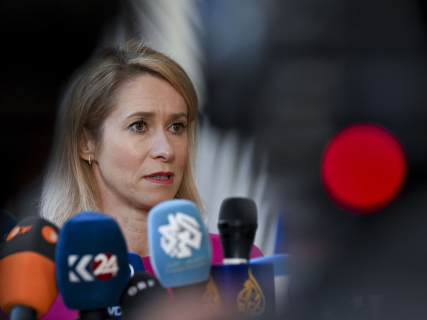
"The EU foreign ministers have just given the green light to sanction Israeli settlers for the violence exercised against Palestinians. They also agreed on new sanctions against senior Hamas officials," announced the High Representative of the European Union for Foreign Policy, Kaja Kallas, in a message on social media.
The head of European diplomacy has celebrated that "it was time to move from blockade to action" because "extremisms and violence have consequences", in reference to the evictions, demolitions, confiscations, and forced transfers of Palestinians in the West Bank attributed to Israeli settlers.
Unanimity
The pact, which must now be translated into concrete legal provisions, has been reached after achieving the unanimity of the member states in the Council of Foreign Affairs (CAE), meeting this Monday in Brussels. Hours earlier, Kallas herself had called for this consensus, after attempts to agree on sanctions against Israel for its offensive in Palestine and Lebanon failed at the previous ministerial meeting.
"I hope we reach a political agreement on sanctions against violent settlers. Hopefully, we will achieve it," said the Estonian politician, recalling that, although there are "different issues that have been on the table for a long time" promoted by several member states, such as the total or partial suspension of the EU-Israel Association Agreement, in these cases the required unanimity still does not exist.
In the absence of that consensus, diplomatic sources point out that the sanctions against the settlers coincide with the progress of work on possible commercial measures that affect products from settlements considered illegal.
Defense of International Law
According to these same sources, these restrictive measures constitute "an important signal and step" to underline that the European Union remains "firm" in the defense of International Law and that, from the community perspective, "there can be no double standards".
Other European sources consulted by Europa Press describe this move as a "first step", but insist on the advisability of "going further", particularly regarding the commercial treatment of goods originating from settlements in the West Bank.