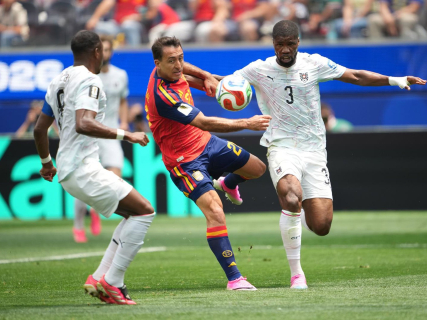

Doctor Jesús Adolfo Alarcón, a professor at the European University of Valencia, has detailed that the frequency of injuries in World Cups has decreased in the last two decades, although it continues to be up to three times higher than that recorded in league competitions.
"In a World Cup, the risk of getting injured during a match can be two or three times higher than in a league matchday," Alarcón stated.
The specialist relies on FIFA reports, which have systematically collected all injuries occurring in its championships since the France 1998 World Cup, allowing for a more precise understanding of their origin and circumstances.
Between 2002 and 2014, the injury rate ranged between 2.67 and 1.68 per match, while in professional club football it is around 0.69 per match. Even in Russia 2018, when the downward trend was broken, 1.88 injuries per match were recorded.
The key to this difference lies in the competitive context of the tournament. World Cups are usually played at the end of a ten-month campaign, a time when players are carrying a high level of physical and mental fatigue.
"The muscular and connective tissue (tendons and ligaments) arrives with its adaptive reserve compromised (they can no longer tolerate much more accumulated load), and the nervous system is very fatigued, which can influence hormonal, immune, metabolic, and of course, psychological regulation," explains the doctor in Physical Activity and Sport Sciences.
Added to this scenario is the accumulation of matches every three or four days, the maximum competitive demand, and an increase in game intensity compared to the regular league season.
The Qatar 2022 example supports this explanation. Being held in November, with less prior load of minutes and effort, the incidence of injuries dropped to levels very close to those in club football. "This data shows that the fatigue factor is decisive in the risk of injury," adds Alarcón.
Despite this relatively higher risk, the global trend is favorable. From the South Korea and Japan 2002 World Cup to Brazil 2014, the incidence of injuries decreased by 37 percent, which is attributed to the evolution of the rules, the introduction of technologies such as VAR, and the increase in the number of substitutions allowed.
"The decline is not accidental: it responds to the strictest application of the regulations and the progress of injury prevention programs in professional football," highlights the researcher. As a result, the percentage of injuries caused by fouls has gone from exceeding 50 percent in the earliest records to being below 35 percent in the most recent editions.
Muscle injuries: the big pending challenge
Even with these improvements, a constant problem persists: the high proportion of muscle injuries. In Qatar 2022, they accounted for almost half of all physical setbacks, with the hamstrings as the most affected muscle group.
"If players go faster and generate more power, the tissues have to keep up. And sometimes, they don't," warns Alarcón, who points out that the increase in maximum intensity actions could be counteracting some of the advances in prevention.
Looking ahead to the 2026 World Cup, Alarcón emphasizes that the key will be in the prior work. "The difference is in physical preparation: what is done during the season, before the World Cup, is what truly protects the footballer," he states.
According to the expert, specific tasks such as eccentric hamstring training require several weeks of adaptation to be effective, as do structured programs like FIFA 11+. During the tournament, he considers it essential to regulate the load through monitoring systems and tactical decisions about the minutes and intensity of play for each footballer. "The challenge will not only be to compete better, but to manage the footballers better," he concludes.