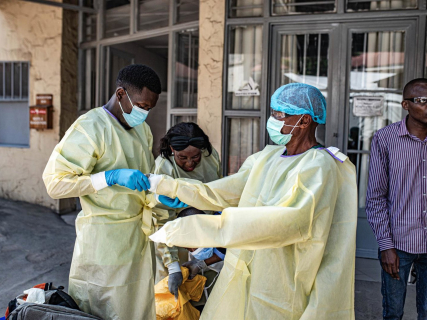

The Director-General of the World Health Organization (WHO), Tedros Adhanom Ghebreyesus, announced this Thursday the start in the Democratic Republic of Congo (DRC) of the clinical trial 'PARTNERS', designed to study the monoclonal antibody 'MBP134' and the antiviral remdesivir, both separately and combined, as possible therapies against Ebola.
"The study is being coordinated by the National Institute of Biomedical Research of the Democratic Republic of Congo (DRC), with the support of a coalition of partners, including the WHO, and is being carried out in close collaboration with the affected communities," Tedros said at a press conference.
Along these lines, the head of the WHO detailed that participants in the trial will receive full clinical care and continuous medical monitoring. "We are also working to ensure they have access to both drugs if they prove to be safe and effective in the trial," he added.
Likewise, Tedros announced that this very Thursday the WHO has given the green light to the emergency use of the first molecular diagnostic test specific for the Bundibugyo Ebola virus.
Despite these advances, the Director-General of the WHO warned that the Ebola outbreak continues to spread in the DRC, with an average of 38 new confirmed infections per day in the last two weeks. "To date, 1,406 cases have been confirmed and 438 people have died," he added.
On the other hand, he stressed that diagnostic capacity has been strengthened to reach 10 laboratories, located closer to the affected areas. He also indicated that contact tracing has progressed, "although many more per case still need to be identified," he pointed out.
In addition, treatment infrastructure has been increased, with about 650 beds operational in 22 health centers: "While about 96 percent of the beds are currently occupied, we are working to add another 300," he indicated.
Tedros stressed that, despite the improvement in resources, "significant challenges" persist, including mistrust and episodes of violence. "Just this week, an Ebola treatment center in the province of Ituri was attacked, causing the death of two people. The center was set on fire and patients fled," he stated.
"These acts not only endanger patients and healthcare personnel, but also hinder efforts to stop transmission and save lives. The complexity of the outbreak requires close coordination across the United Nations system," he stated.
Marburg Virus in Uganda
Following this, Tedros announced that no new cases of Ebola have been registered in Uganda since June 21st. However, he specified that on Tuesday, the country's authorities notified the WHO of a confirmed case of Marburg virus disease in the Kyegegwa district, in western Uganda.
"The case was identified through intensified epidemiological surveillance for Ebola. Health authorities have informed the WHO that they are monitoring all identified contacts, but so far, none have shown symptoms," he detailed.
In this context, he pointed out that the WHO is collaborating on investigations to determine the origin of exposure, assess the public health risk, and strengthen community involvement.
Pandemic Accord Negotiations
Finally, Tedros emphasized that the episodes of hantavirus, Ebola, and Marburg highlight the importance of international cooperation in the face of health threats. "No country can fight alone," he added.
In this regard, he announced that next week, WHO member states will meet again to continue negotiations on the Access to Pathogens and Benefit-Sharing system contemplated in the WHO Pandemic Accord.
"Differences persist, but one thing is clear: countries remain committed to finding common ground and reaching a consensus," he concluded.