
The polls in Peru have opened this Sunday at 7:00 AM —2:00 PM in peninsular Spain— to celebrate the second round of the presidential elections, in which far-right candidate Keiko Fujimori and left-wing contender Roberto Sánchez are vying for control of the Executive.
Fujimori went early in the morning to a venue for representatives or agents of her party, Fuerza Popular, in the district of Villa El Salvador, south of Lima. From there, she emphasized the mobilization of "95,000 volunteers" from her party who are participating in monitoring the process.
The candidate highlighted the oversight work they are carrying out throughout the day. "We have spoken with the heads of each polling station. There are 95,000 agents who are accompanying us," she stated, addressing her collaborators.
Later, she participated in her traditional electoral breakfast in the Lima district of Juan de Lurigancho. "I believe this will be my last electoral breakfast as a candidate for the presidency of the Republic," she affirmed, recalling that this is her fourth attempt to reach the Government Palace.
Meanwhile, Sánchez began the day in the town of Huaral, north of the capital, where he called for voting "with hope." "Today is a blessed day of hope," he stated before calling for a "democratic vote, a vote of conscience, and a vote of love for our homeland," with the goal of lifting up a country "with zero discrimination, zero poverty, and with much justice and democracy." At his electoral breakfast, the candidate opted for chicharrón with sweet potato.
More than 27 million Peruvian citizens are called to vote in a day that will last until 5:00 PM —12:00 AM in peninsular Spain—. In addition, numerous embassies and consulates have set up polling stations abroad, given that 1,210,813 Peruvians residing outside the country are on the census and can exercise their right to vote.
Installation of polling stations and security deployment
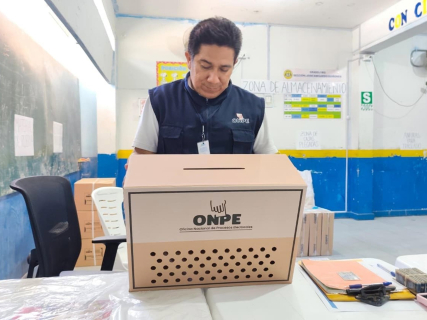
The electoral body has reported the planned installation of 92,766 polling stations, of which 2,260 are located in Metropolitan Lima and the Constitutional Province of Callao, areas where serious logistical setbacks occurred in the distribution of materials in the first round.
The National Office of Electoral Processes (ONPE) has assured that 100 percent of the electoral material has been distributed to all polling stations set up in Lima and Callao.
However, the National Elections Jury (JNE) has indicated that, almost four hours after the start of voting, 10,064 tables had not yet been constituted, which is equivalent to 11.15% of the total. In contrast, 80,159 tables were already operational, meaning 88.85%.
The ONPE has also specified that, at 8:57 AM, 90% of the polling stations already had the necessary material for their installation.
In terms of security, a large deployment has been made with 45,000 members of the Armed Forces and 61,000 agents of the National Police to guarantee the normal development of the electoral event.
According to the latest Ipsos poll, Fujimori, the Fuerza Popular candidate, would obtain 38% of the votes compared to 35% for her opponent from Juntos por el Perú. The conservative leader already won clearly in the first round on April 12th with 17% of the support, in elections marked by extreme fragmentation of votes, with 35 presidential candidates, and by citizen fatigue with successive political crises that have led the country to have ten different presidents in the last decade.