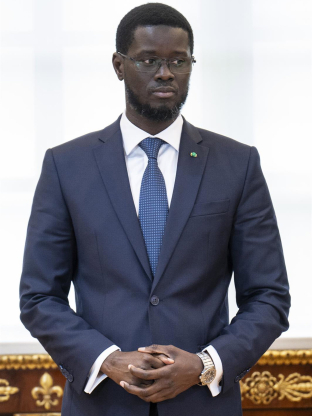

The President of Senegal, Bassirou Diomaye Faye, has removed Prime Minister Ousmane Sonko from his post this Friday and plans to appoint a new Executive shortly after several months of strong political disagreements between the two leaders.
"By decree n.° 2026-1128, signed on May 22, 2026, the President of the Republic, His Excellency Bassirou Diomaye Faye, has ended Ousmane Sonko's functions as Prime Minister," the Presidency has officially announced.
With Sonko's departure, the current cabinet is automatically dissolved, forcing Faye to form a new ministerial team in the coming days. The former head of government has reacted sarcastically on his social media to his dismissal. "Praise be to God. Tonight I will sleep with a light heart in the Keur Gorgui neighborhood," he wrote.
Faye's rise to the head of state had the explicit support of Sonko in 2024, after the latter was excluded from the presidential race due to disqualification by the judiciary. Now, the leader of African Patriots of Senegal for Work, Ethics, and Fraternity (PASTEF) is trying to pave the way to run for the presidency in the elections scheduled for 2029.
Parliament Approves Key Reform for Sonko's Potential Candidacy in 2029
Last Saturday, May 9, the National Assembly of Senegal gave the green light to a controversial reform of the Electoral Code, which the opposition interprets as a move aimed at facilitating a potential candidacy of then-Prime Minister Ousmane Sonko for the 2029 presidential elections.
The legal change, approved comfortably thanks to the parliamentary majority of the ruling party, African Patriots of Senegal for Work, Ethics, and Fraternity (PASTEF), proposed to narrow down the offenses that prevent running for presidential elections, limiting the causes of ineligibility primarily to economic crimes such as corruption or embezzlement.
Sonko, who was excluded from the 2024 presidential elections after being convicted of defamation following accusations against a minister of embezzling public funds, could thus run again as a candidate for the position in the next electoral event if the new wording of the Electoral Code is maintained.
The processing and approval of this regulation take place in a climate of growing political tension surrounding the reform package promoted by President Bassirou Diomaye Faye, who is also preparing projects to modify the Constitution and reorganize the country's institutional framework.
Among the initiatives under consideration is the conversion of the current Constitutional Council into a Constitutional Court and a broader review of the electoral system, as reported by the Senegalese newspaper "Le Quotidien".
Opposition parties maintain that the modification of articles L.29 and L.30 of the Electoral Code is part of a strategy to "personalize" the rules to favor certain political figures, while the presidential circle defends it as an essential update to strengthen the rule of law.
This standoff has sharpened fractures within the National Assembly and complicates Faye's schedule, who must decide whether to try to advance his reforms through the parliamentary procedure or opt to call a referendum and submit them directly to the citizens' decision.
According to local media, the parliamentary route would allow for faster approval of the changes if the ruling bloc retains a solid majority, but the current atmosphere of distrust could turn any vote into an internal test of strength for the Executive.
In contrast, the option of a referendum would grant broader popular legitimacy to the institutional reforms, although it carries risks for Faye in a context of social and economic tensions, as the consultation could be interpreted as a plebiscite on his administration.
Faye, who has not yet clarified which path he will take to advance his agenda for change, came to the presidency in April 2024 from the opposition, as a member of the general secretariat of the party led by Sonko practically since its emergence on the Senegalese political scene in 2014.
Sonko could not run in those elections after being convicted of "corruption of youth" in a controversial case of alleged rape, charges of which he was acquitted, but he ended up being appointed prime minister by Faye to consolidate PASTEF's control over national politics and definitively relegate the influence of former president Macky Sall.
The harmony between Faye, who still has to ratify the electoral reform, and Sonko had been deteriorating for months. In March, Sonko even stated that he was willing to "return the party to the ranks of the opposition" if Faye did not "align" with his project for the country.
"If the president is not aligned with his party, even if we govern together, we find ourselves in what I call a situation of 'soft power sharing'. We would manage our differences accordingly and also look for common ground to move forward together, but if a clearer break occurs, we will become an opposition party again," he warned.
In this scenario of internal friction, Faye has acknowledged that PASTEF is now "on a trajectory that risks leading it to ruin if measures are not taken," as he declared last night to public television RTS.
"PASTEF is not just Ousmane and me. We have always sought to separate the project from the leader," he added before issuing his warning to Sonko: "The prime minister is there because he has my trust. As soon as that trust is broken, there will be a new prime minister."