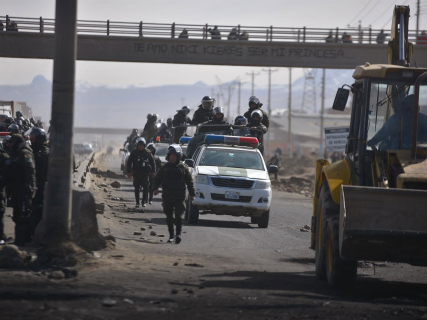


The Minister of Defense of Bolivia, Ernesto Justiniano, assured this Tuesday that the decision of former president Evo Morales to temporarily suspend the blockades is not a response to an act of "generosity," but rather is driven by the "pressure" and "suffering" accumulated by Bolivian families.
This is the first official response from the Executive to the announcement by Morales and his followers to momentarily interrupt the road closures, on the fourth day since the declaration of the state of exception and after more than 50 days of blockades throughout the national territory, within the framework of protests against President Rodrigo Paz.
Justiniano stressed that what has been stopped is not the protest itself, but "a method of pressure that was punishing millions of Bolivians." In this vein, he remarked that "this is a victory for the people, for those who resisted peacefully and for those who wanted to work."
The head of Defense emphasized that, during these weeks, citizens have expressed their rejection of pressure measures that have severely impacted transportation, worker mobility, the supply of basic goods, and the country's economic activity.
After supervising the clearing operations on the road connecting La Paz with Copacabana, Justiniano warned that the former president will have to answer to Justice for the statements in which he encouraged the blockades in recent days.
"Mr. Morales made statements that have been recorded by the press. The law must act and seek the responsibility of the people who were in charge of these types of situations that generated violence and suffering for the population," the minister stated, according to a note released by the Ministry of Defense.
He added that the investigations should not only focus on Morales, but also on those "leaders of a political slogan," "who financed this situation that left Bolivian families suffering for so many days."
In statements to 'El Deber,' Justiniano maintains that this outcome "leaves all Bolivians happy" and that Morales and his circle have ended up admitting, "although they were the last," "that politics cannot be made at the expense of pressure from blockades, at the expense of people's suffering."
Origin and evolution of the protests
Coinciding with International Workers' Day, the Bolivian Workers' Central (COB), one of the country's main unions, called for an indefinite general strike to demand labor and salary improvements, as well as concrete measures to address the shortage of foreign currency and fuel.
Days later, peasant organizations from La Paz joined the mobilization, setting up the first roadblocks on the highways, a pressure tactic that was soon replicated by other groups, including sectors close to Morales, spreading throughout various regions of the country. The demand for Paz's resignation was added to the initial demands.
At the most tense moments of the crisis, more than a hundred roadblocks were counted in seven of Bolivia's nine departments. After several failed attempts to establish dialogue, when the conflict reached 50 days, the COB and the Government finally managed to reach an agreement.
Hours after that understanding, Paz declared a state of emergency to resort to the Armed Forces with the aim of dismantling the roadblocks that were still being driven by peasant groups and Morales' allies. Three days after the state of emergency was declared, the former president announced "a recess" in the roadblocks.