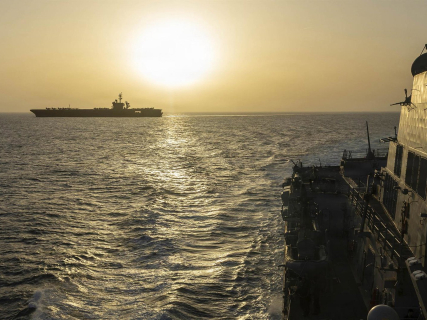
Tonight the two-week ceasefire between the United States and Iran, which came into effect on April 8, was ending. This was planned until the US president, Donald Trump, announced at 10:00 PM an extension of the truce until Iran presents "a unified proposal" to reach a peace agreement.
"Based on the fact that the Government of Iran is seriously fractured, something that is not unexpected, and at the request of Field Marshal Asim Munir and Prime Minister Shehbaz Sharif, of Pakistan, we have been asked to suspend our attack against the country of Iran," Trump assured through a message on Truth.
The course of the war in the Middle East constantly wavers between an apparent de-escalation and spikes in tension due to the exchange of accusations between the actors involved, making it impossible to imagine the date that will end the conflict.
The second round of contacts in Islamabad is still pending, and although everything indicated that Washington and Tehran would hold new talks in Pakistan, the mediating country in the conflict, this Wednesday, delegations from both countries have confirmed that they have not yet traveled to the Pakistani capital.
Over those spikes in tension looms the threat that the US president, Donald Trump, launched on Tuesday afternoon at Iran: "I hope to bomb because I think it's a better attitude to go with. But we are ready to go. I mean, the military is ready for it," he said in an interview granted to CNBC.
In the same conversation with the American network, Trump had refused to extend the truce that expired this Wednesday, according to him, because he does not have "so much time", although hours later he changed his mind. Thus, the president's contradictions, far from clearing up the unknowns about a next agreement, awaken even more doubts about the state of the talks between Washington and Tehran.
Even more so when, on Monday night, the president of the Iranian Parliament, Mohamad Baqer Qalibaf, at the head of the Tehran delegation in negotiations with the US, warned Trump that his country would not accept negotiations "under the shadow of a threat".
Iran has not decided whether to attend Pakistan
Added to this is the complaint that, on Tuesday afternoon, the Iranian Foreign Ministry spokesman, Esmaeil Baghaei, launched, who described Washington's recent actions against two Iranian ships as “maritime piracy and state terrorism”, questioning the United States' real willingness to move forward in negotiations.
It refers to the interception and boarding by United States Forces on Monday night of a sanctioned and Iran-related tanker in the Indo-Pacific region, according to the United States Department of Defense itself.
It was Baghaei himself who pointed out on Iranian state television that a decision has not yet been made regarding Iranian assistance for the round of talks scheduled for this Wednesday.
Blockading Iranian ports is an act of war and thus a violation of the ceasefire.
— Seyed Abbas Araghchi (@araghchi) April 21, 2026
Striking a commercial vessel and taking its crew hostage is an even greater violation.
Iran knows how to neutralize restrictions, how to defend its interests, and how to resist bullying.
For his part, the Persian country's Foreign Minister, Seyed Abbas Araghchi, has expressed this Tuesday on his official X account that "the blockade of Iranian ports is an act of war and a violation of the ceasefire," in clear allusion to those actions to which his spokesperson referred hours earlier.
JD Vance delays his trip to Pakistan
And it is that, at 6:00 PM on Tuesday, the EFE agency confirmed that the Vice President of the United States, JD Vance, had postponed his departure to Pakistan, citing sources from the US Government in conversations with media such as The New York Times and CNN and contradicting Trump again, who on Monday celebrated that Vance had already left for Islamabad.
Thus, the vice president remained this Tuesday in Washington to participate in meetings at the White House, while uncertainty grows about the holding of the second round of talks with Iran. Vance led the talks on April 11 and 12 without reaching an agreement and was scheduled to travel accompanied by special envoy Steve Witkoff and Jared Kushner, advisor and son-in-law of President Donald Trump.
At that time, the Government of Pakistan was still awaiting formal confirmation from the Iranian delegation. In this context, the United States has imposed new sanctions related to Iran, according to the Treasury Department's website, which affect individuals and companies linked to trade and air transport.
Macron and the Lebanese Prime Minister call for a more lasting truce
For their part, the president of France, Emmanuel Macron, and the Lebanese prime minister, Nawaf Salam, have announced this Tuesday in a joint appearance the holding of an international conference aimed at supporting the Lebanese Army and financing the reconstruction of the country.
Salam has indicated that Lebanon needs at least 500 million euros in the coming months to face the current situation and advance in the stabilization of the country.
Both leaders have agreed on the need to move towards a “more lasting” truce between Israel and Lebanon, which remains in effect despite ongoing attacks in the region. Macron has warned that the ceasefire is still fragile, although he has highlighted that results of international efforts, with the support of the United States and other partners, to strengthen Lebanese sovereignty are already being seen.
Israel's attacks on Lebanese territory in its offensive against Hezbollah have already left 2,454 dead, according to a new official tally. The Israeli Army reported this Tuesday that the militia has launched "several rockets" against its troops in southern Lebanon, which constitutes a "flagrant violation" of the ceasefire agreement, which began last Thursday.
In response, the Israeli Air Force has bombed the vicinity of the line where its troops remain deployed in the region. According to the military report, the soldiers identified alleged Hezbollah militants who had allegedly crossed the so-called “yellow line” in the Al Qusayr area. Faced with this situation, the Israeli aviation acted to neutralize what it described as “an immediate threat”.