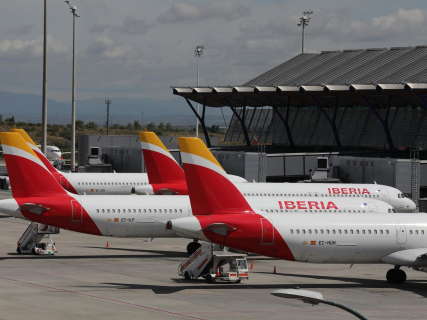

The problem for European aviation is no longer just how much fuel costs, but something much more basic: if there will be enough. If the conflict in the Middle East lengthens and ends up affecting refining in the Gulf, the passage of oil tankers through the Strait of Hormuz or routes in the Mediterranean, the scenario goes from being financial to logistical. And there appears the most delicate risk: cuts in the supply of kerosene that could translate into diversions, flight cancellations or even operational restrictions on certain routes.
In parallel, the European Union will debate this week in Cyprus a package of measures to reduce pressure on the energy system that includes, among other recommendations, implementing at least one day of teleworking a week and limiting air travel for work reasons when possible, as part of a strategy to contain demand in a context of supply tension.
Against this framework, Michel Bove, director of corporate ratings at Scope Ratings, warns that the conflict has once again put the focus on the structural dependence on fuel in the European airline sector. Tensions are already reflected in prices: kerosene has almost doubled its value compared to pre-crisis levels. But the most relevant risk is not only the cost, but the possibility of physical disruptions in the supply chain, which directly affect the daily operations of airlines.
In parallel, the European Commission is working on a draft of measures to reduce pressure on the energy system derived from the war in Iran, as reported by RTVE. Among the proposals are, in addition to mandatory teleworking at least one day a week, the closure of public buildings when possible, the reduction of public transport prices and the recommendation to avoid air travel for work reasons when alternatives exist, especially in the public sector.
Airlines in operational tension
Meanwhile, the European airline sector tries to cushion the impact of the geopolitical context. It is true -explains Bove-, that European airlines have benefited from disruptions at the airports of Dubai, Doha, and Abu Dhabi following the start of attacks by the United States and Israel on Iran on February 28, as travelers opt for direct long-haul flights from European hubs. This constitutes a real relief for short-term revenues against rising fuel costs, while crude oil prices hover around 100 dollars per barrel. However, this hides a deeper structural vulnerability.
The routes that most benefit from the diverted traffic from the Gulf —as airlines like Emirates, Etihad, and Qatar Airlines cancel flights— are precisely the most exposed to the risk of physical access to fuel during the journey. Long-haul flights to Southeast Asia, South Asia, and Oceania require overflying compromised airspaces, which adds between one and two additional hours of fuel consumption through diversions via Egypt or Central Asia, or forces technical stops at airports whose fuel supply chains depend, ultimately, on the same Gulf infrastructure currently under pressure. An escalation that closes intermediate refueling points or interrupts the supply lines that feed them would not only raise the costs of these routes, but would force their total suspension.
Price risk and physical supply risk are analytically distinct. European airlines have faced this crisis with solid hedging through derivatives, which provides contractual buffers against the current price shock.
However, a hedging contract does not imply the delivery of a liter of fuel if the supplier cannot send it. Physical access depends on a chain of infrastructures completely separate from financial instruments: production in refineries, the transit of oil tankers through open sea routes, the integrity of pipelines from coastal terminals to supply points at airports, and the volume physically stored at any given time.
Therefore -adds Scope Ratings-, an escalation of the conflict that interrupts any of these links would generate an operational crisis that no hedging program, however disciplined, can resolve. The renewal of hedges at structurally higher prices will compress margins in 2027, regardless of the strategy adopted. Before that price review cycle is completed, a disruption in physical supply represents a credit event of greater severity.
The dependence of the Mediterranean countries
Europe's dependence on Gulf supply exposes airlines more than their hedging ratios suggest. The Persian Gulf accounted for 43% of Europe's aviation fuel imports in 2025, with greater dependence in Mediterranean countries such as Spain, Italy, and Greece, which rely on tanker routes through the Suez Canal and the Eastern Mediterranean. Northern European hubs, supplied mainly by Atlantic refineries and pipeline networks, are relatively more protected.
Geography points to a probable hierarchy of physical supply risk. Northern European airlines benefit from pipeline connectivity that avoids dependence on Mediterranean maritime routes. Companies with diversified networks present a mixed exposure, depending on access to refineries and terminal infrastructure at each base. Those concentrated in the Eastern Mediterranean, which depend almost exclusively on tanker-supplied terminals, present the highest import risk. Operators with multiple bases reduce the vulnerability of depending on a single hub, although Southern European bases still depend on maritime transport, in any case.
The level of infrastructure development reinforces these differences. The supply connected by pipelines allows for continuous delivery and larger in situ reserves, while the operations of the Mediterranean region dependent on tankers have less storage capacity and greater exposure to currently strained routes.
The result -points out Scope Ratings- is a scenario in which the problem is no longer only about costs, but about operational continuity. And in that context, the price of fuel influences profitability, but access to supply is what determines whether flights can be carried out or not, with possible adjustments, diversions or cancellations.