Earthquake in Venezuela: 1,430 dead, six Spaniards deceased and 133 missing

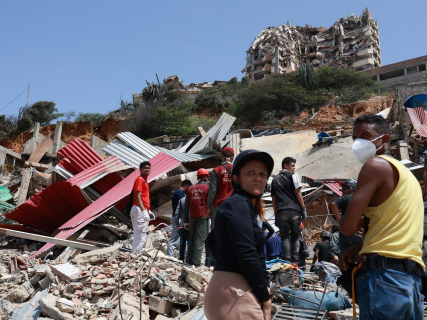
Venezuela raises the official death toll from the earthquakes that hit the north of the country to 1,430, while Spain confirms six citizens deceased, 133 missing, and 14 located but trapped under the rubble. Rescue teams continue to work against the clock in Caracas and La Guaira, the two areas most affected by the double earthquake.

3 minutes

fotonoticia 20260627172541 1920

fotonoticia 20260627172541 1920

Add DEMÓCRATA to Google

Ask FREN

Published

Last updated

3 minutes

Most read

The toll of the earthquakes in Venezuela continues to rise. Venezuelan authorities have now raised the official death toll to 1,430 and the number of injured to 3,238 following the double earthquake that struck the north of the country.

The tragedy also has a direct impact on Spain. The Ministry of Foreign Affairs has raised the number of Spanish fatalities to six and maintains that 133 citizens are missing or unaccounted for. Additionally, another 14 Spaniards have been located alive but remain trapped under the rubble of collapsed buildings.

The emergency continues more than 48 hours after the earthquakes, with rescue teams working in Caracas and La Guaira, the areas most affected by the catastrophe.

1,430 dead and 3,238 injured in Venezuela

The president of the Venezuelan National Assembly, Jorge Rodríguez, has raised the death toll from the earthquakes registered this week to 1,430.

The official toll also places the number of injured at 3,238. Authorities maintain a state of alert due to the possibility that the figures may continue to change as rescue efforts progress and information from the most damaged areas is consolidated.

The two earthquakes, with magnitudes of 7.2 and 7.5, shook northern Venezuela and caused severe damage to buildings, hospitals, homes, roads, and basic services.

Six Spaniards dead and 133 missing

The latest report from the Ministry of Foreign Affairs raises the number of Spanish fatalities in Venezuela to six.

The Ministry maintains the figure of missing or unaccounted for Spanish citizens at 133, and the number of Spaniards found under the rubble but not yet rescued at 14.

The Ministry insists that all consular emergency lines remain open and urges Spaniards in Venezuela to use them to communicate their situation or provide information about relatives.

14 Spaniards trapped under rubble

The most urgent situation involves the 14 Spaniards located under collapsed buildings.

Rescue teams are working to extract them alive, but in several cases, the instability of the structures and the lack of heavy machinery are complicating the efforts.

The Military Emergencies Unit is now participating in the search and rescue operations deployed in Venezuela, alongside other Spanish teams and international aid.

Caracas and La Guaira, the hardest-hit areas

Caracas and La Guaira account for a large portion of the most severe damage.

In the Venezuelan capital, landslides, evacuations, and buildings with structural damage have been registered. In La Guaira, authorities have described a particularly critical situation due to the collapse of constructions and the high number of affected families.

Maiquetía International Airport, key for the connection with Caracas, has also been affected by the emergency.

Spain activates humanitarian aid

The Minister of Foreign Affairs, José Manuel Albares, has explained that Spain has already delivered the first financial package from AECID to address the most urgent needs.

Spanish aid is added to the deployment of rescue teams, specialized personnel, medical supplies, and logistical support.

The immediate objective is to support the search for survivors, assist the injured, and attend to the victims who have lost their homes or remain without normal access to basic services.

17 countries and the UN send aid

The international community has mobilized to respond to the catastrophe.

So far, 17 countries and the UN have sent humanitarian assistance to Venezuela. The aid includes rescue teams, specialized dogs, medical supplies, drinking water, food, generators, and technical support to locate trapped people.

The next few hours are decisive for rescuing alive those who remain buried under the collapsed buildings.

The key

The earthquake in Venezuela already leaves a devastating toll: 1,430 dead, 3,238 injured, six Spanish citizens deceased, 133 missing, and 14 Spanish citizens trapped under the rubble.

La Guaira and Caracas continue to be the main centers of the emergency. Spain maintains open consular lines and has activated humanitarian aid while rescue teams work against time to locate survivors.

More key points, information and questions with FREN

AI-GENERATED CONTENT

What procedures must Spain follow to send humanitarian aid to a foreign country according to current legislation?

Spain can send humanitarian aid abroad within the framework of its foreign action and international cooperation policy, but it must follow a series of administrative and political procedures. The Government, through the MAEC and AECID, is the management hub, while the General Courts exercise political and budgetary control, and in some cases of military deployment they intervene more intensively. In practice, three main routes are distinguished: financial aid, sending civil material, and deployment of civil or military personnel. Below is the general procedural scheme according to current legislation, without going into article-by-article detail.

1. Sending financial aid

Economic aid is framed within the Constitution, the Law on State Foreign Action and Service, and the regulations on international cooperation and humanitarian aid. It is mainly channeled through AECID, contributions to international organizations (UN, Red Cross, specialized agencies), or EU instruments.

First, the need is identified (calls from the UN/EU or reports from embassies, AECID, and NGOs). Then, MAEC and AECID prepare a technical proposal (amount, instrument, executing partner) verifying that it fits within the cooperation planning and that there is credit in the General State Budgets. If there is insufficient credit, budget modifications are processed which, in relevant cases, require a bill and parliamentary approval.

The political decision is usually made by the Council of Ministers through an agreement that sets the amount, destination, and channel (bilateral, multilateral, NGO, EU). Minor operations can be approved by resolution of the competent bodies within the legal framework. Then the commitment is formalized (contribution agreements with international organizations, grants to NGOs, exchange of notes with the recipient State) and AECID/MAEC supervise execution. The expenditure is subject to internal control, the Court of Auditors, and parliamentary control through questions, appearances, and reports.

2. Sending civil material and equipment

This includes everything from food, medicines, or emergency shelters to search and rescue equipment or field hospitals. The Government, MAEC and AECID, Interior/Civil Protection, sectoral ministries (Health, Agriculture, etc.), possibly Defense (if providing military transport or logistics), and Treasury (credit and customs/tax regime) are involved.

After the aid request (from the affected country, the EU, or the UN), MAEC, AECID, and Civil Protection evaluate the type and volume of material, mode of transport, and the recipient on the ground. In significant operations, the Council of Ministers adopts an agreement authorizing the shipment and designating the executing body; minor actions are decided at the management level.

If material must be acquired, public procurement legislation applies, allowing emergency procedures. If existing stocks are mobilized, internal protocols are activated. Transport can be civil or military and is coordinated with the recipient country's authorities and with EU or UN mechanisms. Export, health, and possible dual-use regulations apply, as well as customs and tax facilities typical of humanitarian aid. All this is subject to administrative monitoring, auditing, and parliamentary control.

3. Deployment of civil and military personnel

3.1. Cooperants and civil personnel

The sending of cooperants is part of already approved cooperation or humanitarian action programs and projects, managed by MAEC, AECID, other ministries, and NGOs. Calls, contracts, or service commissions are approved according to labor and public function regulations, with the necessary internal authorizations for travel abroad.

MAEC, through embassies and consulates, assesses risks, sets security protocols, and processes consular registration. In especially sensitive missions, the decision to deploy civil personnel is elevated to the Government. Financing (salaries, per diems, insurance) is covered with cooperation or emergency credits and is subject to parliamentary and accounting control.

3.2. Participation of the Armed Forces

When humanitarian aid requires military deployment (for example, engineer units, field hospitals, or large air assets), the constitutional defense framework and laws on missions abroad apply. Defense and MAEC study military feasibility, international legal framework, and coordination with the EU, UN, or other organizations.

The Council of Ministers adopts an agreement defining mission, area, personnel, means, duration, and multinational framework. According to applicable legislation, prior authorization or ratification by Congress may be required, in addition to continuous information to the General Courts. Deployment, extensions, and withdrawal are decided by the Government with periodic accountability to Parliament.

4. International coordination and parliamentary control

Spain integrates its aid into EU mechanisms (humanitarian aid, civil protection, PCSD) and the UN system (OCHA and specialized agencies), as well as collaborating with the Red Cross, regional organizations, and NGOs. In all cases, agreements are formalized according to foreign action, grants, and cooperation regulations.

Although the General Courts do not execute the aid, their role is central: they approve budgets and their modifications, may authorize certain military operations, and politically control foreign action through debates, questions, interpellations, motions, and appearances. The result is a system in which the Government directs the external humanitarian response, but under a regulatory framework and demanding parliamentary and financial control.

What are the competencies of the Minister of Foreign Affairs in international emergency situations?

The Minister of Foreign Affairs, European Union and Cooperation is the political head of Spain's foreign action in an international emergency, but always acts under the direction of the Prime Minister and in close coordination with other ministries (Defense, Interior, Health, Presidency, etc.) and with the EU, NATO, and the UN. His role combines diplomatic leadership and representation, international coordination, consular protection and evacuation, humanitarian aid management, and accountability before the Courts. He does not single-handedly direct the entire crisis, but he does lead the external aspect: Spain's position, relations with other States and organizations, and protection of Spaniards abroad.

Political direction and external representation

In a war, natural disaster abroad, diplomatic or international health crisis, Foreign Affairs formulates and executes, together with the Prime Minister and the Council of Ministers, Spain's official position. This includes proposing condemnations, mediation initiatives, sanctions, participation in international operations, support for ceasefires or humanitarian corridors. It also leads the drafting and negotiation of diplomatic notes, joint statements, and declarations on behalf of the Government.

The Minister represents Spain before other States and organizations such as the UN, EU, NATO, or OSCE in emergency meetings and donor conferences. He politically directs the actions of embassies and consulates, which are the front line in crisis management on the ground. When the emergency has a military dimension, he shares prominence with Defense: the latter manages the operation on the ground and Foreign Affairs the political and diplomatic interlocution.

Interministerial coordination and with the EU, NATO, and the UN

The general direction of a major crisis corresponds to the Prime Minister and the Council of Ministers, supported by national security bodies. Within this framework, the Minister of Foreign Affairs coordinates the international dimension of the response: prepares the positions Spain will defend before partners and organizations and aligns other ministries when the crisis has an external projection.

With Defense, he negotiates political and legal conditions for military deployments, evacuations, or use of air and sea corridors. With Interior, he coordinates the external aspects of population movements (evacuees, refugees, border closures), while Interior organizes devices on Spanish territory. With Health, he promotes health diplomacy before the WHO and the EU, and with Migration or Social Rights negotiates international frameworks for reception and resettlement.

In the EU, he participates in the Foreign Affairs Council and other sectoral Councils where the common response is defined (sanctions, missions, humanitarian aid, civil protection, joint evacuations). He contributes to setting Spain's position regarding the common foreign and security policy, the EU Civil Protection Mechanism, or coordination with the European External Action Service. In NATO, Defense leads the military aspect, but Foreign Affairs handles the political dimension in the North Atlantic Council. At the UN, he represents Spain in emergency debates, negotiates resolutions and humanitarian or peace cooperation frameworks.

Consular protection and evacuation of Spaniards

The Minister directs consular policy, executed by embassies and consulates. In an emergency in a foreign country, consular emergency plans are activated: registration of Spaniards, security alerts, issuance of documentation, and assistance in cases of detention, injury, or death. He also coordinates European consular protection so that Spaniards can be assisted by other Member States where Spain is not present.

The political decision to evacuate corresponds to the Government, but Foreign Affairs identifies affected nationals, negotiates with the host country and transit countries the necessary authorizations, and coordinates joint evacuations with partners and EU mechanisms. Defense provides military means (planes, ships, on-ground support) and Interior handles reception and border control. All this is usually organized in joint crisis cells.

Humanitarian aid, emergency cooperation, and parliamentary control

Through Spanish cooperation (AECID), the Minister is the political head of international humanitarian action. He assesses with international partners the impact of the disaster and proposes aid packages: financing to UN bodies and NGOs, sending medical material or rescue teams, and donations of vaccines or medicines in health crises. He coordinates these resources with Interior and Civil Protection (emergency teams) and with Defense (strategic transport), avoiding duplications with the EU and other donors.

Finally, the Minister of Foreign Affairs is accountable before the Congress and Senate. He appears in Plenary or the Foreign Affairs Committee, answers questions, and participates in thematic debates to explain the Government's position, consular protection management, evacuations, and humanitarian aid. Additionally, he informs the public through press conferences and messages coordinated with the Presidency and the network of embassies and consulates, ensuring a unified and coherent foreign action in the emergency.

What were the results of the latest presidential elections in Venezuela and what is the current composition of the National Assembly?

The latest presidential elections in Venezuela were held on July 28, 2024, and are marked by a strong dispute over the results. Officially, the National Electoral Council (CNE) proclaimed Nicolás Maduro the winner with 51.2% of the votes against 44.2% for Edmundo González Urrutia, with a turnout close to 59%. However, the opposition and various international actors maintain, based on polling station records, that the real winner was González with around 67% of the votes. Meanwhile, the National Assembly remains dominated by the PSUV and the Great Patriotic Pole following the 2020 legislative elections, without its composition having been renewed since then.

Results of the 2024 presidential elections

Official results from the CNE

According to official data released by the CNE and reported by international media, in the July 28, 2024 presidential elections:

According to the CNE:

  • Nicolás Maduro obtained 51.20% of the votes, with 5,150,092 ballots.
  • Edmundo González Urrutia achieved 44.20%, with 4,445,978 votes.
  • Turnout was around 59% of the census.
These data have been disseminated, among others, by RTVE and summarized in later analyses such as that of Directorio Legislativo.

Foreign political organizations, such as the Euzkadi Buru Batzar of the PNV, have emphasized that with the figures released and the lack of full delivery of records to the opposition, there are serious doubts about the transparency of the process, demanding the publication of results table by table, as stated in their public statement available on the PNV website.

Results according to the opposition and alternative sources

The Venezuelan opposition has presented a parallel count based on polling station records collected by their witnesses and disseminated through the platform resultadosconvzla.com. From 24,532 records (approximately 87% of the tables), their figures are very different:

  • Edmundo González: 7,443,584 votes, 67.20%.
  • Nicolás Maduro: 3,385,155 votes, 30.44%.
  • González would have won in 23 states and the Capital District.

These figures are cited, among others, by BBC Mundo and align with the position of international actors who question Maduro's official proclamation. The United States Embassy in Chile, for example, has published a critical evaluation of the process.

The tension between both versions is also reflected in analyses such as the Wikipedia entry on the 2024 presidential elections and other audiovisual materials, such as the content in this video and this other, where fraud allegations, candidate restrictions, and limited international observation are discussed.

Irregularities and political context

Various sources highlight that the process was marked by personal disqualifications, actions against opposition parties, campaign restrictions, and great difficulties for the Venezuelan diaspora to vote, with external participation below 2% due to problems in the Electoral Registry and very short deadlines. The Government also withdrew the invitation to the European Union to observe the elections, increasing international skepticism.

A broader summary of the country's electoral cycles can be found in the annex on elections in Venezuela, which contextualizes the 2024 elections in a sequence of increasingly questioned processes.

Current composition of the National Assembly

The current composition of the Venezuelan National Assembly derives from the 2020 legislative elections, organized under chavista control and boycotted or severely limited for much of the opposition. According to the analysis by Directorio Legislativo, the United Socialist Party of Venezuela (PSUV) and its allies in the Great Patriotic Pole obtained an absolute majority, with at least 167 of the 277 total seats.

This majority gives the government bloc comfortable control of the Legislative Power, without significant opposition presence in the official Assembly. Meanwhile, opposition sectors maintain an opposition “National Assembly” constituted abroad based on the 2015 elected mandate, but this body is not recognized by the CNE nor has effective seats within the country.

In summary, while the 2024 presidential results are deeply disputed—with an official winner (Maduro) and a winner claimed by the opposition (González)—the National Assembly continues under majority control of the PSUV and the Great Patriotic Pole, without recent legislative renewal reflecting the balance of forces shown by opposition records in the presidential election.

A more global overview of the Venezuelan political system and its electoral processes, including those of 2020 and 2024, can also be consulted on the general page of elections in Venezuela.

Play

Test your knowledge with FREN!

How much do you know about this topic? Answer the following 3 questions.

What is the official death toll after the earthquakes in Venezuela?

Question 1 of 3

How many Spaniards have been found alive but remain trapped under the rubble?

Question 2 of 3

Which areas of Venezuela have suffered the most severe damage from the earthquakes?

Question 3 of 3

Hola, soy Fren. ¿Cómo te ayudo?