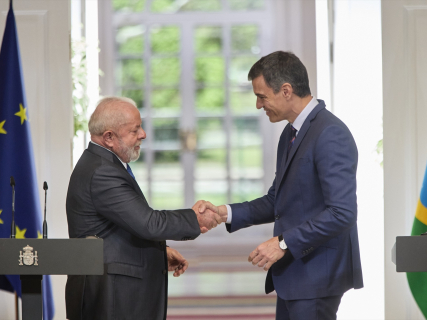

The President of the Government, Pedro Sánchez, leads this weekend in Barcelona a diplomatic agenda aimed at consolidating alliances with progressive leaders from around the world, with a common message in defense of multilateralism and against the war in Iran, in a context of growing international tension marked by the positions of the American president Donald Trump.
This Friday, April 17, Sánchez and the president of Brazil, Lula da Silva, co-chair the bilateral summit between both countries, the first of this level between Spain and a Latin American country. A dozen ministers from each Executive will participate in it and the signing of agreements in areas such as the economy, the social agenda, innovation and digital transformation is expected, according to Moncloa sources.
The meeting, at the highest institutional level, raises the status of diplomatic relations between Spain and Brazil, driven by the political alignment that both leaders have been showing in recent years.
Sánchez has traveled on several occasions to Brazil and Lula has visited La Moncloa on two occasions, first in 2021 as former president and subsequently in March 2024 after his return to power.
Both leaders have expressed their rejection of the conflict in Iran initiated by the United States and Israel and have defended the need to preserve an international order based on rules, with a central role for the United Nations Organization (UN).
Meeting in defense of democracy
On Saturday will take place the IV Meeting in Defense of Democracy, an initiative promoted by Spain and Brazil that will bring together in Barcelona progressive leaders from different continents, among them the president of Colombia, Gustavo Petro; the president of Mexico, Claudia Sheinbaum —in a visit that symbolizes the thawing of bilateral relations—; and the president of the European Council, António Costa.
Also will participate representatives from countries such as Uruguay, South Africa, Ireland, Lithuania or Albania, totaling about 30 leaders including heads of State, vice presidents, ministers and ambassadors.
The debates will be articulated around three major axes: the defense of multilateralism and democratic institutions; the impact of disinformation and digital technologies; and the rise of extremism and inequality.
The meeting gives continuity to the three previous meetings held within the framework of the UN General Assembly in 2024 and 2025, and in Santiago de Chile in July 2025, consolidating a common agenda in defense of the international system based on rules.
Spain and Brazil launched this initiative in 2024 with the objective of responding to the increase of polarization, disinformation and extremism, phenomena that they consider a direct threat for social cohesion and democratic stability.
A global progressive response
The weekend is completed with a political act, the ‘Global Progressive Mobilisation’, organized by the PSOE, which will bring together several international leaders, among them Lula and Sheinbaum, to launch a joint message against war.
Although the party stresses that it is not an event directed against Donald Trump, it does seek to project a progressive alternative to current global challenges.
The meeting takes place in an especially tense international context, with the White House raising the tone towards various international leaders, including some traditional allies, for their refusal to support the military intervention in Iran.
Sánchez attends this meeting after a four-day official visit to Beijing, where he has strengthened relations with China, a country that the Spanish Government points to as a key actor to facilitate a diplomatic solution to the conflict.