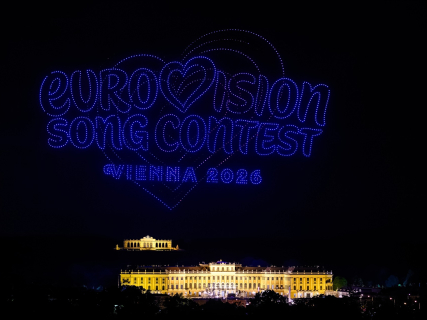
The Eurovision Song Contest 2026 has this year definitively broken the fiction of political neutrality on which it has historically tried to sustain itself. Israel's participation in the midst of the war in Gaza has transformed the competition into a diplomatic, media, and cultural battle that has ended up affecting audiences, sponsors, public broadcasters, and the credibility of the European Broadcasting Union itself.
The edition being held this weekend in Vienna also coincides with the 70th anniversary of the festival, but far from projecting an image of pan-European celebration, it has been marked by protests, boycotts, and mutual accusations of televote manipulation and political use of the contest.
Israel as the epicenter of European division
Israel's continued participation in the contest has acted as a catalyst for a deep division within Europe: how to respond culturally and institutionally to the war in Gaza and to what extent large international events can remain "apolitical" in the midst of high-intensity international conflicts.
RTVE was one of the public corporations that most pushed for an internal debate on Israel's continued participation in Eurovision. Finally, Spain decided to withdraw from the 2026 festival along with countries such as Ireland, the Netherlands, Iceland, and Slovenia.
The president of RTVE, José Pablo López, even stated that the festival is "dominated by geopolitical interests" and that the EBU's management "has lost its way."
In the background, the clash reflects two opposing visions within Europe: countries and sectors that consider excluding Israel to be politicizing the contest, and those who maintain that its continued participation is, in itself, a political decision.
Televote, propaganda, and "soft war"
One of the major controversies of the festival revolves around the televote. Various international media outlets and officials from European public broadcasters have questioned the vote mobilization campaigns promoted around the Israeli candidacy.
They point out that Israel has turned Eurovision into a "soft power" tool, using international campaigns and digital strategies to reinforce political and reputational support in Europe. The controversy escalated to the point where the EBU modified part of the voting and advertising rules following criticism received in 2025.
The problem for the organization is that Eurovision has always functioned precisely as a mix of music, national identity, and cultural diplomacy. The difference is that currently geopolitical tension has overflowed the format.
Gaza Enters the Eurovision Stage
Pro-Palestinian protests have become a constant around the festival. During the semi-final held this week in Vienna, the Israeli representative, Noam Bettan, was met with boos and shouts of “Free Palestine” and “Stop the genocide” by protesters near the stage.
The image has enormous symbolic weight: a festival born after World War II to culturally unite Europe now appears to be crossed by one of the most polarizing international conflicts of the moment.
Furthermore, the debate has moved beyond the musical sphere. Human rights organizations, artists, and former winners of the contest have publicly criticized the EBU's position, while other sectors denounce a double standard regarding other international exclusions that have occurred in recent years.
The EBU Tries to Save the Idea of "Neutrality"
The EBU's official strategy has been to insist that Eurovision "must not be used as a political stage." However, that position has become increasingly difficult to maintain. The festival itself has been loaded with geopolitical readings for decades: votes between regional blocs, historical rivalries, diplomatic conflicts, identity debates, and the use of performances as a tool for national projection.
The difference in 2026 is that the controversy is no longer peripheral: it affects the core of the contest and its future viability.
The withdrawal of several important countries—especially Spain as a member of the so-called "Big Five"—has caused a significant reputational and economic impact for the festival. Some analyses already speak of falling audiences, loss of interest, and brand deterioration.
A Political Mirror of Current Europe
Beyond music, Eurovision has become this year a fairly accurate reflection of Europe in 2026: polarized societies, pressure from digital public opinion, culture intertwined with international politics, questioned European institutions, and growing difficulty in maintaining "neutral" common spaces.
The festival that was born 7 decades ago as a symbol of continental reconciliation today highlights, precisely, the political and moral fractures that run through Europe.