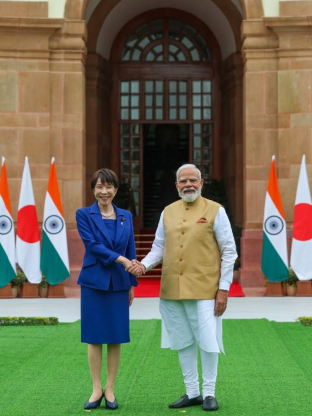

The Indian Prime Minister, Narendra Modi, and the Japanese Head of Government, Sanae Takaichi, have closed this Thursday in New Delhi a roadmap of collaboration for the next ten years in areas such as Artificial Intelligence, defense, economic security, and the energy sector, in a meeting conditioned by growing geopolitical tension and the expansion of Chinese influence in the region.
"By leveraging each other's strengths, Japan and India can become stronger and more prosperous together. In a turbulent international context, building such a partnership, based on mutual complementarity, has become increasingly important," the Japanese leader stressed in a joint appearance reported by the newspaper 'The Japan Times'.
On the regional level, both leaders have backed an Indo-Pacific "where freedom and prosperity are enjoyed." "We agree to deepen the strategic cooperation relationship to achieve this common goal," Takaichi said in a message disseminated on social media.
In the security field, the two countries have committed to strengthening their coordination, while in the economic security sphere, they plan to sign a joint declaration to move towards "concrete actions" involving both the public and private sectors.
Regarding energy, India and Japan will maintain bilateral dialogue channels in order to enhance the crude oil reserve system in Indian territory and accelerate the energy transition of the Asian country.
Modi, for his part, has described Japan as an "important partner" for India and has focused on the agenda setting precise economic goals for investment in the next decade. He mentioned as an objective "In the next ten years, 10 trillion yen of Japanese investment in India and doubling the number of Japanese companies in India," referring to the concrete aspirations of the agreed plan.