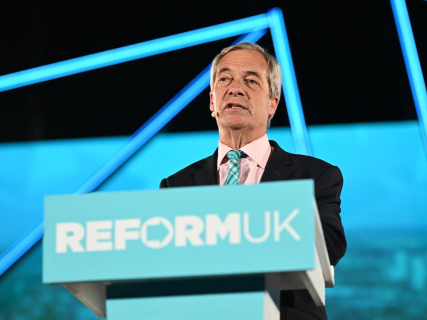

Reform UK is emerging as the big winner of the election day in the United Kingdom. With the final results still to be known, preliminary data indicate that the party led by Nigel Farage has swept the polls in an election in which 5,000 councilors are being elected in more than a hundred local authorities.
Formed in 2019, it entered with 29 MEPs into the European Parliament that year, coming from both the Conservative Party and, to a lesser extent, the Labour Party, which today it has hit hard, putting Prime Minister Keir Starmer between a rock and a hard place.
First steps
On January 20, 2019 Catherine Blaiklock, former Economy spokesperson for the UK Independence Party, founded the Brexit Party and remained as leader until March, when she resigned after being accused of sending Islamophobic messages.
In February, he was registered with the electoral commission to stand in any election to be held in Scotland, Wales, England and in the European Parliament elections. Nigel Farage stood to head the party's ticket in any European election.
On May 15 of that year, the Brexit Party achieved its first parliamentary representation through the defection of four deputies from the National Assembly for Wales.
In the 2019 European Parliament elections, held on May 23, the party was the winner in the elections, achieving its best results in those areas where the Brexit option triumphed in the 2016 referendum. It achieved victory in the United Kingdom by securing 29 out of the 73 seats allocated to the British; 30.5% of the total votes cast.
After Brexit, the party changed its name to Reform UK. In 2024, Nigel Farage took over the leadership of the party.
Farage's return to politics in 2024
Elected British Member of Parliament for the first time in 2024, he returned to politics that year after a break that began in 2021 to run in the British general election, managing to boost Reform UK in the polls after being elected leader.
Farage eclipsed all other British parties with the populist formation in the use of social networks for his campaign and political communication, highlighting his rise especially on TikTok.
His program is based on tax cuts and the reduction of mass migration, in addition to taking the United Kingdom out of the European Court of Human Rights. The party obtained 4,114,287 votes in the 2024 general election, being the third most voted political force, achieving 5 seats in the British Parliament.
Reform UK in parliament
Reform UK announced a few months ago that it had reached 250,000 members, more than double the 123,000 Conservatives and about 60,000 less than the Labour Party.
In 2026, after the defection to the Reform UK party of former Conservative ministers Robert Jenrick and Suella Braverman, Farage announced Laila Cunningham's candidacy in the 2028 London mayoral elections.
Reform UK achieved a breakthrough in the 2025 British local elections to replace the Conservatives as the main opposition party. Farage's ambition is to become Prime Minister in the 2029 British general election.
A party that pressures the British bipartisanship
The advance of Reform UK has had an immediate political effect: pushing traditional parties to modify their positions.
Both Labour and Conservatives have hardened their rhetoric on immigration and border control, in an attempt to curb the flight of voters towards Farage's party.
This phenomenon is contributing to a structural transformation of the British political system, where historical bipartisanship shows signs of weakening in the face of a more fragmented and competitive scenario.
Reform UK has ceased to be a fringe project and this week's elections in the United Kingdom confirm what has been announced for some time: with Nigel Farage as the dominant figure, the party has managed to consolidate a sufficient electoral base to condition the national political debate as well as compromise the position of Prime Minister Keir Starmer.