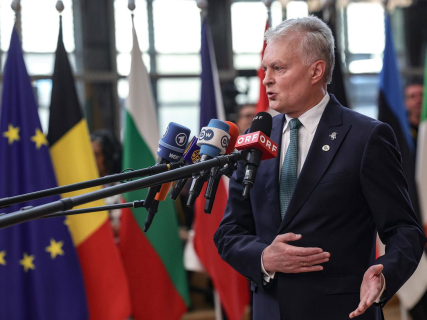

The president of Lithuania, Gitanas Nauseda, has proposed this Thursday to modify the country's Constitution with the aim of suppressing the current prohibition on nuclear weapons. The leader has stressed that Lithuania is in a "grey zone" within NATO, especially after Finland has approved regulations that eliminate legal obstacles to the entry, transit, and storage of nuclear armament on its territory.
"It is an absolute prohibition, without reservations. Lithuania is practically the only NATO country that has imposed this prohibition on itself. Without a doubt, we must take this into account," Nauseda declared in statements broadcast by the LRT channel, warning that the Baltic country is situated "in a kind of grey zone within NATO itself."
Along these lines, he has warned that Lithuania could become the "weak link" of the Atlantic Alliance and has defended promoting the necessary constitutional amendments to allow the eventual deployment of nuclear weapons on Lithuanian soil.
Nauseda seeks political agreement for reform
Nauseda has emphasized that almost all officials from the different parliamentary factions share the diagnosis that the current regulation has become outdated. "We have reached the conclusion that now is the time for both the Seimas and the Speaker of the Seimas to demonstrate the necessary leadership," he stated, thus calling on Parliament to initiate the constitutional review procedure.
His words come after a meeting with the Seimas groups in which options for modifying the Magna Carta clause that bans the deployment of nuclear armament in Lithuania were discussed.
Currently, the Lithuanian Constitution establishes that weapons of mass destruction or military bases belonging to foreign states cannot be located on national territory, a restriction that the president considers must be re-evaluated in light of the new security context in the region.