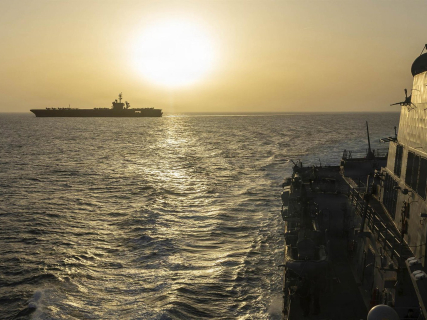

The US president even suggested that an aircraft carrier like the USS Abraham Lincoln could be positioned off the Cuban coast to force Havana's surrender, in a statement that increases political and military pressure on the island.
Trump affirms that the United States “will take control” of Cuba
Donald Trump has raised the tone against Cuba with a statement of enormous political impact. The President of the United States assured that his country "will take control" of the island "almost immediately", although he linked that move to the evolution of the war against Iran.
The phrase occurred during a private dinner of the Forum Club in West Palm Beach, Florida, where Trump intervened as the main speaker. In his speech, the Republican said that he first wants to finish the “job” in Iran before turning his attention to Cuba.
The message did not remain a generic threat. Trump even raised a scenario of naval pressure in the Caribbean, with the deployment of a US aircraft carrier off the Cuban coast.
The aircraft carrier threat off Cuba
Trump affirmed that, upon returning from Iran, he could send one of the great American aircraft carriers - he cited the USS Abraham Lincoln as a possibility - towards the Caribbean and position it very close to the Cuban coast.
According to his own account, the presence of the ship would be enough for the Cuban authorities to say: “thank you very much, we surrender”. The phrase was formulated in a defiant tone and in Trump’s usual style, but it comes in a context of a real hardening of Washington’s pressure on Havana.
It is worth clarifying that Trump presented the scenario as a political and military hypothesis within his speech, not as an operation officially announced by the Pentagon. The importance of the statement lies in the message: the US president places Cuba as the next strategic objective after Iran.
Cuba, in the spotlight after Iran
The reference to Iran is not minor. Trump directly linked Cuba's future to the closure of the US operation in the Middle East. "I like to finish jobs," he came to point out during his speech, before pointing to the Caribbean island.
The statement comes amid international escalation and after Washington has hardened its position against several countries considered adversaries. In the Cuban case, the White House combines rhetorical pressure, economic sanctions, and threats of a military nature.
That linkage is key: Trump does not speak of Cuba in isolation, but within a logic of force that he is already applying in Iran and that he now projects onto the Caribbean.
New sanctions against Havana
Trump's words also coincided with new economic pressure measures against Cuba. According to published information, the US Administration has expanded sanctions against key sectors of the Cuban economy, including energy, mining, defense, and financial services.
These sanctions seek to hit individuals, companies or structures linked to the Cuban Government and restrict their access to assets, operations or travel to the United States.
The combination of sanctions and military threat marks a new phase in Trump's strategy towards Cuba. It is not just about diplomatic isolation: the US president is using a language of direct pressure that reopens one of the great historical fronts of US foreign policy.
A statement with a strong political charge
Trump's phrase has an evident symbolic weight. Cuba has occupied a central place in US foreign policy for decades, especially in Florida, where the Cuban-American vote has decisive political weight.
That is why the chosen scenario is not accidental either. West Palm Beach is located in a key state for Trumpism and for the electorate most hostile to the Cuban regime. The promise to increase pressure on Havana connects with an important part of the Republican base in Florida.
The risk, however, lies in the leap in scale. Talking about sanctions is part of Washington's usual repertoire. Talking about "taking control" of Cuba and placing an aircraft carrier off its coast introduces a much more explosive dimension.
Havana rejects Washington's pressure
Cuba has rejected the new sanctions from the United States and has described them as coercive measures against the island. The Cuban response comes at a time of serious internal economic deterioration and strong external pressure.
The Cuban government interprets these measures as an offensive aimed at economically strangling the country and forcing a political change. Washington, for its part, maintains that the pressure seeks to weaken the regime and limit its sources of financing.
Trump's declaration now adds an element of greater uncertainty: how far is the United States willing to go in its offensive against Cuba if it maintains the same hard line it has applied on other international fronts.
Trump reopens the Caribbean chessboard
The threat from Trump returns Cuba to the center of the American geopolitical board. For years, the relationship between Washington and Havana has oscillated between attempts at opening, sanctions, economic blockade, and diplomatic pressure. Now, the US president introduces a much more aggressive formulation.
There is no announced military operation against Cuba for now, but there is a presidential declaration that functions as a political warning. Trump has said that the United States "will take control" of the island and has placed that possibility after Iran.
The phrase can be read as a threat, as a demonstration of strength before its electoral base or as a direct warning to Havana. In any case, the message has already placed Cuba at the center of Washington's next great international tension.