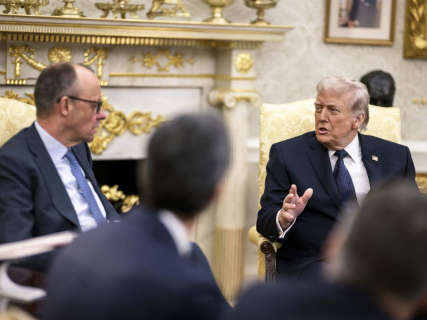

The withdrawal comes amid a political clash between Trump and the German Foreign Minister, Friedrich Merz, over the war against Iran. The tension between both leaders had escalated in recent days after Merz criticized the US strategy and accused Washington of having been "humiliated" by Tehran in the negotiations.
The movement does not represent a total break from the US military presence in Germany, but it is a political signal of the highest order. Germany currently hosts one of the largest US military structures outside its territory, with key bases for European defense, projection towards the Middle East, and coordination within NATO.
The Pentagon speaks of a strategic review
The Pentagon spokesman, Sean Parnell, explained that the decision responds to a review of the US military deployment in Europe and the needs of the current theater of operations. According to information released by international agencies, the withdrawal will be completed in the next six to 12 months.
The measure affects approximately 14% of the 36,000 US military personnel deployed in Germany, according to Associated Press. Among the most relevant facilities are Ramstein Air Base, Wiesbaden Army Airfield, Grafenwöhr and Hohenfels training areas, Spangdahlem Air Base, and the Stuttgart military complex.
Although the Pentagon frames the decision in military and strategic terms, the political context weighs as much as the operational one. Trump had threatened this very week to withdraw troops from allied countries if Europe did not more clearly back Washington's position in the war against Iran.
Clash with Merz raises tension between US and Germany
The decision comes after several public clashes between Trump and Merz. The German chancellor initially supported the US and Israeli attacks against Iran, but later hardened his tone and questioned Washington's strategy in the conflict.
Trump responded with a direct offensive against the German leader, whom he reproached for not supporting the United States and urged him to take care of "fixing" his own country. The US president also linked his criticisms to the German economic and political situation, in a new demonstration of the deterioration of the link between Washington and Berlin.
The troop withdrawal turns that political confrontation into a concrete military decision. It is no longer just about crossed declarations: the White House moves pieces on the European defense map and sends a message to the rest of the allies.
Germany, a key piece for NATO in Europe
Germany has been for decades one of the main centers of operations for the United States in Europe. Its geographical position, its military infrastructures, and its role within NATO make it an essential platform for the American deployment on the continent, in the Mediterranean, and in the Middle East.
Therefore, the withdrawal of 5,000 soldiers has a meaning that goes beyond the figure. It does not dismantle the US military architecture in Germany, but it does reduce its volume and opens a strategic question: to what extent is Trump willing to condition European defense on the political alignment of his partners.
The decision also comes at a particularly delicate moment for European security, with the war in Ukraine still open and with growing demands from Washington for European countries to assume a larger share of the cost of their own defense.
A signal for all of Europe
The withdrawal of troops from Germany also serves as a warning to the rest of the European capitals. Trump has repeatedly criticized his allies for not sufficiently accompanying the US strategy in Iran and for not assuming, in his opinion, a more forceful role in international security.
According to Reuters, US officials have argued that Europe must assume more responsibility for its own defense, as Washington reorients priorities towards other regions, especially the Indo-Pacific and the Western Hemisphere.
The message is clear: US military protection is no longer presented as a political automaticity. In Trump's logic, the security umbrella must be accompanied by support, spending, and alignment