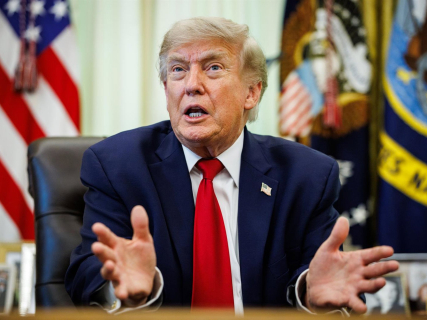
US rejects renewing USMCA and opens a period of annual reviews of the agreement with Mexico and Canada

The Trump Administration's decision activates the annual review mechanism of the North American treaty and forces the renegotiation of its future until 2036

2 minutes

fotonoticia 20260701163512 1920

fotonoticia 20260701163512 1920

Add DEMÓCRATA to Google

Ask FREN

Published

Last updated

2 minutes

Most read

The United States has officially communicated that it will not renew the Treaty between Mexico, United States, and Canada (T-MEC), North America's main trade agreement, a decision that does not imply its immediate disappearance, but opens a period of annual reviews and permanent negotiation among the three countries.

The announcement was made by the U.S. Trade Representative, Jamieson Greer, in compliance with the review mechanism provided for in the treaty itself. According to that clause, if any of the three partners does not express its will to extend the agreement upon completion of the first six years of its validity, it will cease to be automatically renewed for another 16 years and will be subject to an annual evaluation until its expiration, scheduled for 2036.

The decision represents a change in strategy by the Administration of Donald Trump, which had already anticipated in recent weeks its intention to thoroughly review the terms of the agreement. Washington considers that the treaty must be modified to respond to the economic and commercial priorities of the United States, especially in sectors such as the automotive industry, manufacturing production, and supply chains.

Extended Validity

Despite the announcement, the T-MEC will remain fully in force. The rejection of its renewal does not imply the United States' withdrawal from the agreement or the suspension of its commercial provisions, but rather activates a process of periodic reviews in which the three countries will have to negotiate possible changes to ensure its continuity.

Mexico and Canada had advocated for the automatic renewal of the treaty, considering that it has provided legal and economic stability to one of the largest free trade areas in the world since its entry into force in July 2020, when it replaced the old North American Free Trade Agreement (NAFTA).

The new scenario, however, introduces a greater degree of uncertainty for companies and investors. The possibility of annual renegotiations could affect long-term investment decisions in sectors particularly integrated among the three countries, such as automotive, agri-food industry, energy, or the manufacturing of technological components.

With this move, the Trump Administration keeps the door open to reforming one of the continent's main trade agreements, while Mexico and Canada prepare for a negotiation that could last throughout the next decade.

More key points, information and questions with FREN

AI-GENERATED CONTENT

What are the formal steps and deadlines foreseen in the USMCA annual review mechanism following the United States' refusal to renew?

After a refusal by the United States to renew the USMCA at the 6-year review, the treaty does not end immediately. Legally, annual reviews for up to 10 years are activated, with the agreement remaining fully in force meanwhile. Only if, after those 10 years, there is still no consensus, the USMCA automatically expires upon reaching the total term of 16 years. In parallel, the United States always retains the option to formally denounce the treaty, which would open a 6-month period for its effective withdrawal.

1. Starting point: refusal to renew at the six-year review

The USMCA provides in its Article 34.7 for a review at the sixth year from entry into force (around 2026) in the Free Trade Commission (FTC), composed of the three countries. In that review:

  • the functioning of the treaty is analyzed, and
  • each Party indicates whether it is willing to renew and extend the validity for another 16 years.

If all three countries agree, the expiration date is updated 16 years forward and a new six-year review is scheduled. But if at least one (for example, the United States) does not agree, there is no extension of those 16 years and the annual review mechanism is activated.

2. Annual review mechanism: formal steps

2.1. Activation and nature of the reviews

The refusal to renew at the sixth-year review:

  • does not equate to a withdrawal or denunciation of the treaty,
  • does not alter the current validity (the initially planned 16 years), and
  • requires the FTC to hold annual meetings for up to 10 years.

At each of these annual meetings, the FTC must:

  • review again the functioning of the USMCA, and
  • ask the Parties if they are now willing to consent to renewal for another 16 years.
2.2. Deadlines and schedule

The treaty itself does not set deadlines like “30 or 60 days” for calls or document submissions; it only establishes key moments:

  • 6th year: initial review in the FTC (where the possible refusal by the United States occurs).
  • From there, if no consensus: one review each year, up to a maximum of 10 years.
  • 16th year from entry into force: automatic expiration date if renewal has not been agreed.

Between reviews, the treaty continues to apply normally: preferential tariffs, rules of origin, investment and services disciplines, dispute resolution mechanisms, etc.

3. Scenarios following the United States' refusal

3.1. “Pure” annual review scenario without denunciation

If the United States merely states that it does not wish to renew, but does not formally denounce the USMCA:

  • The treaty remains in force at least until the 16-year date.
  • At each annual review, the United States may:
    • maintain its refusal, bringing closer the scenario of automatic expiration, or
    • change its position (for example, after a change of government) and consent to renewal.
  • If at any of those annual reviews all three countries consent:
    • the USMCA's validity is extended again for another 16 years from the current expiration date, and
    • the ordinary six-year review cycle resumes.
3.2. Formal denunciation and 6-month period

Independently of the annual review, the United States may opt for the route of Article 34.6, notifying in writing its denunciation of the USMCA. In that case:

  • a 6-month period opens from the notification,
  • after those 6 months, the treaty ceases to apply to the United States (unless another period is agreed),
  • for Mexico and Canada, the USMCA may remain in force between them.

Until that 6-month period expires, the denunciation can be reversed by political and diplomatic agreement (for example, withdrawing the notification).

4. Automatic expiration and possibilities of reversal

If the annual reviews are exhausted over 10 years without agreement and the treaty has not been denounced, the USMCA automatically expires upon reaching 16 years. Before that date:

  • any annual review (or extraordinary FTC meeting) can serve to reach consensus and extend 16 years,
  • and even an amendment to Article 34.7 itself can be agreed, provided all three countries ratify the amendment according to their internal procedures.

Once expiration occurs or, if applicable, a country's effective withdrawal after denunciation, no automatic reversal is possible. Any re-entry by the United States would require negotiating and ratifying a new agreement or re-accession, with all the internal constitutional procedures that implies.

What powers does U.S. Trade Representative Jamieson Greer have and what has been his political career?

Jamieson Greer is currently the United States Trade Representative (USTR), appointed by Donald Trump in November 2024 and confirmed by the Senate in February 2025. His position grants him the responsibility to lead U.S. foreign trade policy, negotiate trade agreements, and litigate disputes in forums such as the WTO, although the ultimate definition of tariff strategy remains in the hands of the president and the Secretaries of Commerce and Treasury. Greer arrives at the post after having been chief of staff to the previous USTR, Robert Lighthizer, during Trump's first term, participating in the tariff war with China and in the renegotiation of NAFTA that resulted in the USMCA. His profile is that of a technical lawyer, very aligned with the Republican protectionist agenda, rather than a career politician with his own electoral trajectory.

Powers as U.S. Trade Representative

According to various economic and general press profiles such as El Financiero, López-Dóriga or El País, Greer's main powers as USTR are:

First, to lead negotiations and reviews of trade agreements. He is described as the key White House figure for the review of the United States-Mexico-Canada Agreement (USMCA), of which he “knows every paragraph” having participated in its drafting as chief of staff to Lighthizer. This role includes relations with his counterparts in Mexico and Canada and designing the U.S. negotiating position in the treaty's periodic review mechanisms.

Second, he has the mandate to combat unfair trade practices and reduce the U.S. trade deficit, with a special focus on China. According to analyses collected in The New York Times in Spanish and the Wikipedia entry, Greer advocates aggressive use of tariffs, export controls, and sanctions to force reciprocity and open markets to U.S. industry.

Third, he leads the defense of the national industry (manufacturing, agriculture, and services) in multilateral and bilateral forums. This involves preparing claims and defenses at the World Trade Organization, as well as including clauses protecting employment and local content in agreements. In this context are contacts with strategic partners like Mexico; for example, then Foreign Minister Marcelo Ebrard highlighted on social media a “cordial and productive dialogue” with Greer on USMCA issues and supply chains, according to a Facebook post (link).

Finally, Greer promotes the negotiation of new agreements with countries such as the United Kingdom, India, Kenya, or the Philippines, with the idea of countering China's economic influence and “reshoring” part of the U.S. manufacturing base, as detailed in the analysis by La Voz de Galicia.

Professional and political career

Greer does not come from electoral politics but from legal technocracy and the Republican administration. According to the cited profiles and Wikipedia, he was born in 1980 and trained as a lawyer: he holds a Bachelor's degree in International Studies from Brigham Young University and a Juris Doctor (JD) from the University of Virginia, as well as a joint Master's in Global Business Law from Sciences Po and the University of Paris I. He is a member of The Church of Jesus Christ of Latter-day Saints (Mormon), which has been highlighted by the U.S. press as a distinctive trait in a cabinet-level position.

Before his time in Washington, he served as a lawyer in the U.S. Air Force, where he was involved in criminal investigations and was deployed in Iraq. Later, he worked at major law firms specializing in international trade, such as Skadden, Arps, and later at King & Spalding, where he became a partner in the international trade area, representing, among others, U.S. Steel in litigation against China for unfair practices (NYT and López-Dóriga).

His rise to the forefront of trade policy occurred in 2017, when he became chief of staff to Robert Lighthizer, then USTR in Trump's first term. From that position, he coordinated the office's internal work, participated in the architecture of tariffs on China and the negotiation of the “Phase One” agreement of the trade war, as well as in the renegotiation of NAFTA that culminated in the USMCA (El Financiero).

Strictly speaking, his “political career” is mainly administrative and public policy design, not parliamentary representation or elected government. He is identified as a Republican and one of Trump's trusted figures in trade matters, but his power is exercised through the technical and legal negotiation of treaties and sanctions, in coordination with the White House's economic core. As a specialized policy assistant in Spain, this profile is relevant due to the direct impact that the U.S. trade agenda has on the EU and, by extension, on the Spanish economy.

How might Jamieson Greer's trade strategy affect trade relations between the United States and the European Union, especially Spain? What differences exist between Robert Lighthizer's and Jamieson Greer's tenures as head of the U.S. Trade Representative's Office? What implications does the USMCA review led by Greer have for Spanish companies with presence in Mexico and the United States?

What legal requirements and procedures must be met to modify or formally exit the USMCA according to each country's legislation?

Exiting or modifying the USMCA combines two levels: that of the treaty itself (which sets how withdrawal is notified or amended) and that of the internal legal systems of Mexico, the United States, and Canada (which determine who can decide, with what parliamentary controls, and how to adapt internal legislation). The USMCA allows withdrawal with six months' notice and can be amended by agreement of the parties, but each State has different constitutional rules on who approves, denounces, or amends treaties. Below is a breakdown, by country, of the relevant legal requirements and procedures for a formal exit or modification of the USMCA.

Framework of the USMCA itself

The USMCA regulates withdrawal and modification in its final chapter:

Unilateral withdrawal: a Party may denounce the treaty by notifying the others in writing. Withdrawal takes effect six months after notification, unless the Parties agree otherwise. The treaty remains in force among the other Parties that do not withdraw.

Amendments or modifications: must be negotiated and agreed upon among the three Parties. An internal act is not enough; any change requires an international amendment instrument that each country must then approve and ratify according to its own internal law.

Mexico

Procedure to modify the USMCA

In Mexico, the Constitution assigns a central role to the Senate:

Constitutional powers:

– Article 76, section I, grants the Senate the exclusive power to approve international treaties and their termination.
– Article 89, section X, establishes that the President directs foreign policy and enters into treaties, submitting them to Senate approval.

Practical consequence: to amend the USMCA requires:

1) Negotiation of modifications by the federal Executive Power.
2) Signing of the protocol or amendment instrument.
3) Approval by the Senate by a simple majority of senators present (unless it is claimed that the amendment affects matters requiring reinforced majorities by constitutional modification, in which case additional reforms would be needed).
4) Publication and adaptation of internal implementing laws (tariffs, rules of origin, sectoral standards, etc.).

Procedure to exit the USMCA

From the internal point of view, denunciation of a trade treaty like the USMCA, involving the “termination” of a treaty approved by the Senate, must also have the approval of this Chamber, according to Article 76.I. The President could not, without Senate intervention, unilaterally terminate a treaty that required legislative approval for its entry into force. Once authorized internally, the Executive would send the withdrawal notification provided in the USMCA, which would take effect after six months.

United States

Modification of the USMCA

In the United States, the USMCA was approved as a congressional-executive agreement, through a specific implementing law. The typical process is:

1) The Executive Power (USTR, under the President's authority) negotiates any amendment.
2) The amendment is submitted to Congress via a bill to implement or modify the existing law.
3) The House of Representatives and Senate approve the law by simple majority, unless there are specific fast track (Trade Promotion Authority) provisions structuring debate and vote.
4) The President signs the law and ratifies the amendment internationally.

Exit from the USMCA

The U.S. Constitution does not detail the procedure to denounce agreements, and there is debate about whether the President can withdraw the country from a trade agreement without Congressional authorization. However, in recent practice, the Executive has assumed that power, while Congress may try to limit it through laws (for example, conditioning withdrawal on certain reports or consultations) or budget decisions. Legally, withdrawal would imply the formal notification provided in the USMCA and, internally, repeal or adaptation of the implementing law to avoid contradictions in the federal system.

Canada

Amendments to the USMCA

In Canada, the power to sign and denounce treaties resides in the federal Executive (the Crown, exercised by the Prime Minister and Cabinet), but any modification affecting internal rights and obligations requires parliamentary legislation:

1) The Government negotiates and signs the amendment instrument.
2) According to the Tabling of Treaties in Parliament policy, the treaty or amendment is presented to the House of Commons during a period of information and possible debate.
3) If the amendment requires regulatory changes, Parliament must approve a law implementing or modifying the existing one.
4) Only afterward does the Government ratify the amendment internationally.

Exit from the USMCA

Formally, the Executive could notify denunciation of the treaty, since the power to sign and terminate treaties is a prerogative of the Crown. However, effective exit requires Parliament to modify or repeal the laws that incorporated the USMCA into domestic law, to avoid a legal vacuum or incoherent regulatory system. Politically, parliamentary debates and possible control motions are expected beforehand, although they are not legally binding on the Executive's formal capacity to denounce.

What specific economic implications would a unilateral exit from the USMCA have for Mexico, the United States, or Canada? What precedents exist of each country denouncing or renegotiating trade agreements comparable to the USMCA? How do the USMCA rules on 6- and 16-year reviews interact with the possibility of early withdrawal?

Play

Test your knowledge with FREN!

How much do you know about this topic? Answer the following 3 questions.

What happens after the United States decides not to renew the USMCA?

Question 1 of 3

Which economic sector does the United States mention as a priority to review the conditions of the USMCA?

Question 2 of 3

Since when has the USMCA been in effect?

Question 3 of 3

Hola, soy Fren. ¿Cómo te ayudo?