
In 1998, most political parties signed the so-called Anti-Defection Pact, an agreement whose objective is to prevent elected officials from changing government majorities by betraying the party under which they were elected to their office. However, this commitment does not have penal status nor does it legally prevent a councilor or deputy from changing blocs. This has led to, in practice, numerous municipal and regional governments changing their political color thanks to defectors or dissidents.
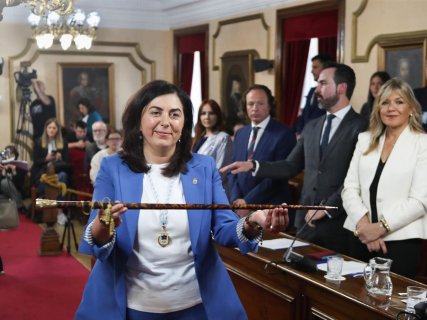
The latest of these episodes has happened in Lugo, a capital that the PP recovers after 27 years thanks to the support that the former socialist María Reigosa has given to Elena Candia, the new mayor of the city after ousting the socialist Miguel Fernández, who led the municipal government together with the BNG. Facilitating this operation, Reigosa has once again brought political defection into focus.
The PSOE's reaction to this fact has not been delayed. For the Organization Secretariat of the socialists, Rebeca Torró, "what we all already knew has been consummated: the Popular Party has a master's degree in turncoatism. It buys wills again without shame, this time to take over the government of Lugo, forgetting that a motion of no confidence is part of the democratic game, but turncoatism is not, no matter how much they practice it".
According to the PSOE, "the Galician PP, with Feijóo's approval, even bypasses its own statutes. In its article 14:2 it states: 'Those belonging to an Institutional Group of the Party who use or take advantage of defectors from other parties to constitute or change government majorities in public institutions commit a very serious infraction'. We already knew that Feijóo's word was worthless. Now we know that what he signs is also worthless"
In its condemnation of what happened this Thursday in Lugo, the PSOE has also wanted to recall past episodes of turncoatism that still hurt in Ferraz: "Feijóo's PP uses the same modus operandi that Génova has been practicing for years. We saw it in Madrid in 2003 or in Murcia in 2021. With the right, clean politics loses, citizens lose, and turncoats and tamayazos win. The ballot boxes will put everyone in their place".
That socialist looking back leads us to recall some of the best-known cases of political turncoatism in Spain that caused —or decisively facilitated— changes in regional or municipal governments and that had a great media and political impact.
The “Tamayazo” in Madrid (2003)
Focusing on cases of political defection that occurred in the present century, the most famous in Spanish democracy was the one staged in Madrid by socialist deputies Eduardo Tamayo and María Teresa Sáez. Both were absent from the investiture vote in the Assembly of Madrid in June 2003, preventing the socialist Rafael Simancas from reaching the regional presidency despite having a majority with IU.
The crisis forced the elections to be repeated and ended up allowing the arrival to power of Esperanza Aguirre and the PP, initiating more than two decades of popular hegemony in the Community of Madrid. The episode gave rise to the political and media term “Tamayazo”.
The motion of no confidence in Murcia that ended up strengthening the PP (2021)
On a much more recent date and, although the motion did not ultimately succeed, what happened in Murcia in 2021 was another example of defection. Fernando López Miras saved his Government after several deputies from Ciudadanos broke the discipline of the agreement signed between PSOE and Ciudadanos to oust the PP. The orange parliamentarians went on to support the popular Executive and thwarted the operation.
The crisis also ended up triggering the early election in Madrid by Isabel Díaz Ayuso, who distrusted the alliance she maintained at that time with Ciudadanos.
León: the fall of the PP mayor due to a turncoat councilwoman (2019)
Although the laments for the Lugo defection are now socialist, in 2019, in the León City Council, José Antonio Diez (PSOE) achieved the mayoralty thanks to the support of a Ciudadanos councilwoman who broke her party's voting discipline. The case generated strong national controversy within Ciudadanos.
Ponferrada and the pact with a convicted sex offender (2013)
Without being a classic case of party switching, special mention deserves what happened in Ponferrada in 2013. There, the PSOE initially agreed with the former mayor Ismael Álvarez, convicted of sexual harassment, to snatch the mayoralty from the PP. The socialists were using a split councilor to gain power, which caused an enormous political and reputational crisis for the socialists, with direct intervention from Alfredo Pérez Rubalcaba.
Before the 1998 Anti-Defection Pact: Benidorm and Marbella
Doing some more archaeology of the political turncoat, we find some other famous examples in the final stretch of the 20th century.
One of the most cited precedents of municipal transfuguismo was that of Benidorm: in 1991, which resulted in the arrival of Eduardo Zaplana to the city's mayoralty thanks to a motion of censure.which prospered due to the support of the socialist councilwoman Maruja Sánchez, who allowed the PP to regain government.
That episode was decisive for Zaplana's political career, who years later would reach the presidency of the Generalitat Valenciana and a ministry with the Government of José María Aznar.
For its part, the Marbella of the 90s of the last century, marked by the “gilismo”, was a recurring scene of changes of majorities through disloyal councilors, cross-party pacts and turncoatism. The internal fractures of the GIL and the changes of loyalties allowed constant alterations of local governments until the intervention of the City Council for corruption in 2006.