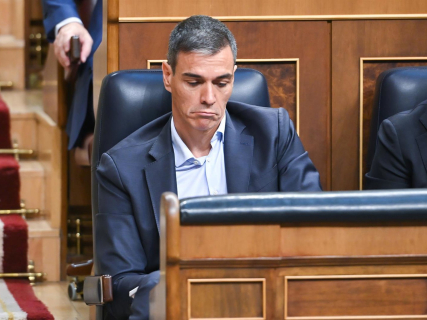
The Congress approves the PP's motion urging Sánchez to resign thanks to Junts' vote

He is also urged to submit to a vote of confidence over the corruption cases that splash the PSOE and former members of the Executive.

1 minute

fotonoticia 20260625144751 1920

fotonoticia 20260625144751 1920

Add DEMÓCRATA to Google

Ask FREN

By A. L.

Published

Last updated

1 minute

Most read

The Plenary of the Congress of Deputies approved this Thursday, thanks to the vote of Junts, a motion promoted by the Popular Party to demand the resignation of the President of the Government, Pedro Sánchez, while urging him to submit to a vote of confidence due to the corruption cases affecting the PSOE and former members of the Executive.

Among the three points of said initiative that have been approved, number three, which was approved by 178 votes in favor, states that "in the event that he decides not to call elections, it urges the President of the Government to consider the opportunity to raise a vote of confidence, in accordance with the prerogative conferred by the Constitution, taking into account the political nature, without legal ties, of the present initiative."

Likewise, in its fourth point, which was approved by 177 votes in favor, the PP's motion "considers that the accumulation of investigations into corruption cases, which feature political leaders directly appointed and supported by President Pedro Sánchez.

Finally, in the last point approved with the support of 171 deputies, the PP defends "its freedom to exercise its constitutional legislative functions of government control and political orientation without further censorship than the rigorous and non-arbitrary application of the constitutional order, and therefore condemns the will to veto, both by the Executive and by certain political groups, the debate of certain initiatives or amendments.

Nevertheless, the leader of the opposition, Alberto Núñez Feijóo, continues to reject the possibility of promoting a motion of no confidence.

More key points, information and questions with FREN

AI-GENERATED CONTENT

What is the current status of the processing of a possible motion of no confidence against the Prime Minister in the Congress of Deputies?

Currently, in the Congress of Deputies there is no motion of no confidence registered, being processed, or underway against the Prime Minister. As of today (June 25, 2026), no parliamentary group has formalized such an initiative in the current legislature. The last debated motion of no confidence was presented by VOX in March 2023, with Ramón Tamames as the alternative candidate, which was rejected by a large majority. The last approved motion of no confidence remains the one by PSOE against Mariano Rajoy in 2018, which led Pedro Sánchez to the Presidency of the Government.

Current situation: absence of motions of no confidence in process

According to available information, as of June 25, 2026, there is no motion of no confidence registered or in the processing phase in the Congress of Deputies against the Prime Minister. There is no record that the Board of the Congress has admitted any new motion for processing nor that a schedule has been set for a no confidence debate in the Plenary.

This absence of formal initiatives is largely explained by the current parliamentary arithmetic: the right-wing opposition parties (PP and VOX) do not reach by themselves the absolute majority of 176 seats necessary for a constructive motion of no confidence to succeed, as required by Article 113 of the Spanish Constitution. Without the support of other groups, any motion would be doomed to failure, which discourages its presentation unless a strictly political gesture is sought.

Last debated motion of no confidence: VOX–Tamames (March 2023)

The last motion of no confidence effectively debated and voted in Congress took place on March 21 and 22, 2023. It was presented by Santiago Abascal, on behalf of the parliamentary group VOX, with the initial support of 51 deputies from this party.

On that occasion, VOX proposed as alternative candidate for the Presidency of the Government the economist Ramón Tamames Gómez, an independent. The motion was directed against President Pedro Sánchez and was processed according to the mechanism of constructive motion of no confidence, which requires presenting a candidate for president in the initiative itself.

The voting result was clearly unfavorable to the no confidence:

• Votes in favor: 53
• Votes against: 201
• Abstentions: 91

Since it did not achieve the absolute majority (176 votes) required by the Constitution, the motion was rejected and Pedro Sánchez's government continued in office without any change. Furthermore, according to parliamentary rules, the signing deputies cannot present another motion in the same session period, which contributes to the absence of new immediate initiatives after failures of this type. General information about the figure of the motion of no confidence can be consulted in the Congress's archive: motions of no confidence in Congress and in doctrinal analyses such as Legal News or the UNED academic blog on the subject (UNED).

Last approved motion of no confidence: PSOE–Rajoy (2018)

Although the question focuses on the current status, it is relevant to recall that the last motion of no confidence that succeeded in Spain was presented by the Spanish Socialist Workers' Party (PSOE) against then Prime Minister Mariano Rajoy, following the Gürtel case ruling.

That motion was voted on June 1, 2018, with Pedro Sánchez as the alternative candidate. It obtained 180 votes in favor, 169 against, and 1 abstention, surpassing the necessary absolute majority and causing the fall of Rajoy's government and Sánchez's investiture as the new Prime Minister. To this day, this remains the only motion of no confidence that has succeeded since the 1978 Constitution came into force, as reflected in general analyses on the figure, for example in this general summary or in studies such as those by Administrativando and other doctrinal works (Hay Derecho, academic studies).

Constitutional framework and short-term prospects

The motion of no confidence in Spain is regulated as an exceptional and constructive tool in Article 113 of the Constitution and in Title V on relations between Government and Parliament, available on the La Moncloa website (Title V of the Constitution). It must be signed by at least one-tenth of the deputies and must always include a candidate for the Presidency.

In the current scenario, without substantial changes in parliamentary power balances, the viability of a motion of no confidence that could succeed is not foreseen in the short term, unless there is a political upheaval with very broad cross-party support among currently opposed parties. Therefore, the tool remains more as a instrument of pressure and political debate than as a realistic way to replace the Government in the present legislature.

More descriptive and contextual information about the figure can also be found in outreach materials such as audiovisual explanations and divulgative summaries on legal and academic portals.

What are the powers and functions of the Prime Minister of Spain according to the Constitution?

The Prime Minister, according to the 1978 Spanish Constitution, is the head of the Executive Power and the director of the Government's action. His powers revolve around the formation of the Government, political direction and coordination of the Council of Ministers, relations with the Cortes Generales, institutional interaction with the Crown, political and criminal responsibility, and the regime of cessation and continuity in office. Most of these functions are set out in Articles 97 to 102, 108 to 115, and 134 of the Constitution.

Formation of the Government

The Constitution regulates the investiture in Article 99. After each renewal of the Congress or in other cases provided, the King, after consulting with representatives of political groups and through the President of the Congress, proposes a candidate for Prime Minister (art. 99.1). The candidate presents his program before Congress and requests the confidence of the Chamber: in the first vote an absolute majority is needed; in the second, held 48 hours later, a simple majority suffices (arts. 99.2 and 99.3). Once confidence is obtained, the King appoints him Prime Minister.

Once invested, the Prime Minister decides the composition of the Executive. Article 100 establishes that the other members of the Government shall be appointed and removed by the King at the proposal of its President. Thus, it is politically the Prime Minister's responsibility to determine vice presidencies and ministries, and to propose appointments and dismissals.

Direction of the Government's action

Article 97 provides that the Government directs domestic and foreign policy, the civil and military administration, and the defense of the State, and exercises executive function and regulatory power. The Prime Minister is the head of this body. Article 98.2 specifies that the Prime Minister directs the Government's action and coordinates the functions of the other members, without prejudice to their direct competence and responsibility. This implies political leadership, coordination, and, in practice, arbitration in internal conflicts.

Article 98.1 indicates that the Government is composed of the Prime Minister, the Vice Presidents, if any, and the Ministers. Although organizational details are developed by law, the Constitution presupposes that the Prime Minister defines the basic structure of the Cabinet through his power of proposal (art. 100).

Relations with the Cortes Generales

The Government is politically accountable to the Congress of Deputies (art. 108), and this responsibility is concentrated in the figure of the Prime Minister. The confidence relationship is articulated, besides investiture (art. 99), through the question of confidence and the motion of no confidence. Article 112 allows the Prime Minister, after deliberation of the Council of Ministers, to submit to Congress a question of confidence on his program or a general policy declaration. If Congress denies it, the Government must resign (art. 114.1).

The motion of no confidence, regulated in Article 113, is directed against the Government and must include an alternative candidate for the Presidency ("constructive" motion). If approved, the Government resigns and the proposed candidate is understood to be invested, and the King must appoint him Prime Minister (art. 114.2).

In the legislative field, the Government, under the Prime Minister's direction, holds legislative initiative (art. 87.1) and presents bills approved in the Council of Ministers (art. 88). Article 134 assigns the Government the preparation of the General State Budgets and the power to oppose amendments that increase expenditure or reduce income.

In parliamentary control, the Chambers may request information from the Government (art. 109) and summon its members (art. 110); the Prime Minister leads this accountability.

Relations with the Crown

The Prime Minister endorses numerous acts of the King. Article 64 establishes that those who endorse the King's acts, usually the Prime Minister or the competent ministers, are responsible; the endorsement gives validity to the act and makes the Government politically responsible. Article 62 includes various functions of the King (sanctioning laws, issuing decrees agreed in the Council of Ministers, etc.) that require such endorsement and are exercised on proposal or under the direction of the Government.

Article 62 f) provides that the King may preside over the Council of Ministers when he deems appropriate, but only at the request of the Prime Minister. Additionally, Article 115.1 assigns the Prime Minister, after deliberation of the Council of Ministers and under his exclusive responsibility, the power to propose the dissolution of the Congress, the Senate, or the Cortes Generales; the King formalizes the dissolution and the electoral call.

Responsibility and dismissal

In the criminal sphere, Article 102 provides that the criminal responsibility of the Prime Minister and other Government members is required before the Criminal Chamber of the Supreme Court, and that for certain crimes (treason or against State security in the exercise of their functions) the initiative of one-fourth of the deputies and approval by absolute majority of Congress is required.

Article 101.1 establishes that the Government ceases after general elections, in cases of loss of parliamentary confidence (denial of confidence or approved motion of no confidence), and by resignation or death of its Prime Minister. Article 101.2 adds that the outgoing Government will continue in office until the new Government takes office, so the Prime Minister maintains his functions, although with the limitations set by ordinary legislation.

What requirements does Spanish legislation establish for the Congress to force the Prime Minister to resign or call elections?

The Congress of Deputies cannot directly vote "that the Prime Minister resigns" nor "that elections be called." What it can do, with full legal effects, is approve a constructive motion of no confidence, which forces the dismissal of the Prime Minister and automatically places another in his place, or deny or withdraw confidence from a Government, forcing its resignation and a new investiture process. The calling of elections is the Prime Minister's competence, who proposes to the King the dissolution of the Cortes (art. 115 CE), although Congress can create situations that de facto lead to early elections (blocked investitures, loss of confidence, etc.). All this is articulated in arts. 99, 112‑115 CE and in arts. 173‑179 of the Congress Rules, which can be fully consulted at the Rules of the Congress of Deputies.

Motion of no confidence: the only direct mechanism of Congress

According to art. 113 of the Constitution and arts. 175‑179 of the Congress Rules, the Chamber can demand political responsibility of the Government through a motion of no confidence, with these basic conditions:

First, who presents it and numerical requirements. It must be proposed by at least one-tenth of the deputies (in a Congress of 350, minimum 35), by motivated written addressed to the Board (art. 175.2 RCD). The Board verifies requirements and, if met, admits it for processing.

Second, its constructive nature. The motion must necessarily include a candidate for the Presidency of the Government who has accepted the candidacy (art. 113.2 CE and 175.2 RCD). A "negative" motion that only aims to remove the Prime Minister without offering an alternative is not admissible.

Third, the required majority. For the motion to succeed, the favorable vote of the absolute majority of the members of Congress is required (art. 113.1 CE and 177.5 RCD); a simple majority of those present is not enough.

If approved, the motion has very intense automatic effects (art. 114.2 CE and 178 RCD): the censured Government must present its resignation and the included candidate is understood to have obtained Congress's confidence for the purposes of art. 99 CE, that is, he is invested as new Prime Minister without an additional investiture vote. The change of Prime Minister occurs without the need to call elections.

If the motion is rejected, the Prime Minister remains in office and no automatic dissolution is triggered. Deputies who signed it cannot subscribe another during the same session period (art. 179 RCD). While a motion is in process, the Prime Minister cannot propose the dissolution of the Cortes (art. 115.2 CE), which prevents him from "escaping" to elections to avoid it.

Question of confidence: initiative only of the Prime Minister

The question of confidence is the inverse instrument: it proceeds from the Government to Congress. According to arts. 112 and 114.1 CE and 173‑174 RCD, only the Prime Minister can raise it, after deliberation in the Council of Ministers, on his program or a general policy declaration.

The vote takes place at least 24 hours after its presentation and is resolved by simple majority: confidence is understood to be granted when there are more votes in favor than against (art. 174.5 RCD). If Congress denies confidence, the Government must present its resignation to the King (art. 114.1 CE) and a new investiture process opens according to art. 99 CE. Therefore, Congress does not decide resignation via autonomous resolution, but it can cause it when the Prime Minister himself submits to confidence and loses it.

Calling elections and Congress's capacity for pressure

The dissolution of Congress and calling of elections corresponds to the King at the proposal of the Prime Minister, after deliberation of the Council of Ministers (art. 115.1 CE). Congress cannot approve an agreement with legal effect that says "general elections are called." Nor can it directly vote the "resignation" of the Prime Minister; it can only force it indirectly through confidence mechanisms (motion of no confidence or loss of a question of confidence).

However, Congress can practically force a change of Prime Minister without elections, by approving a constructive motion of no confidence, or lead to early elections by generating a political deadlock: denying successive investitures (which leads to automatic dissolution if two months pass from the first vote without investiture, art. 99.5 CE) or making Government action unviable until the Prime Minister himself opts to propose dissolution, always respecting the limits of art. 115 CE.

What political and practical differences have been seen in Spain between the different motions of no confidence presented since 1978? In what recent situations has the early dissolution of the Cortes been used and what political motivations were alleged? How is the investiture procedure regulated in Article 99 of the Constitution developed in detail and what blockage scenarios does it foresee?

Play

Test your knowledge with FREN!

How much do you know about this topic? Answer the following 3 questions.

Which party promoted the motion in Congress calling for Pedro Sánchez's resignation?

Question 1 of 3

Which parliamentary group was key to the approval of the motion promoted by the PP?

Question 2 of 3

What is the nature of the motion approved by Congress regarding the resignation of the Prime Minister?

Question 3 of 3

Hola, soy Fren. ¿Cómo te ayudo?