Who is Silvia López Quivira? Óscar López's surprise rival in the PSOE primaries of Madrid

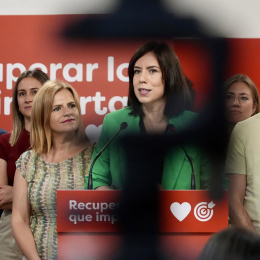
Grassroots militant, labor lawyer, and without public office, Silvia López Quivira bursts in by surprise into the PSOE-M primaries and will force minister Óscar López to measure himself against the militancy

2 minutes

WhatsApp Image 2026 07 03 at 17.43.22

WhatsApp Image 2026 07 03 at 17.43.22

Add DEMÓCRATA to Google

Ask FREN

Published

Last updated

2 minutes

Most read

The race to lead the PSOE candidacy for the Presidency of the Community of Madrid in the 2027 elections will no longer have a single protagonist. Against all odds, the general secretary of the PSOE-M and minister for Digital Transformation and Public Function, Óscar López, will have to dispute the primaries with a candidate practically unknown to the general public until now: Silvia López Quivira.

Her emergence has surprised both inside and outside the party, as the socialist leadership took for granted that Óscar López would be proclaimed candidate without the need for a vote. The presentation of a second candidacy now forces the opening of the endorsement collection process and, if both aspirants gather the necessary support, the militancy will have the last word in primaries scheduled for July.

Labor lawyer and grassroots militant

Silvia López Quivira has worked as a labor lawyer for about fifteen years, heading her own professional office in Madrid. She is linked to the public defender system and is part of the Free Association of Lawyers of Madrid, where she coordinates the Labor Commission. In addition, she is a member of the socialist group of Chamartín and, until now, had not held institutional responsibilities or relevant organic positions within the PSOE.

Her candidacy aims to represent a sector of the militancy that demands a party more connected with the grassroots and with the daily problems of citizens, moving away from the profiles promoted by the federal leadership, such as López's.

The challenge of endorsements

The next step for both aspirants will be the collection of endorsements, which will take place between July 4 and 11. To officially become candidates, they must gather the support of at least 12% of the census of PSOE-M militants, made up of about 14,000 members. If both exceed that threshold, the internal campaign will be held between July 12 and 18 and the vote will take place on the 19th.

López's bid in Madrid is part of the strategy designed by Pedro Sánchez to place several ministers at the head of the main socialist federations and turn them into aspirants for regional presidencies. Without going any further, this Friday the National Ethics Commission of the PSPV proclaims Diana Morant candidate for the Presidency of the Generalitat Valenciana for the 2027 regional elections.

According to the PSPV detailed in a statement, the proclamation comes after verifying that Morant's was the only pre-candidacy submitted within the calendar and with the established requirements. 
 

More key points, information and questions with FREN

AI-GENERATED CONTENT

What does the PSOE primary process consist of and what are its usual parliamentary or internal procedures?

The specific PSOE primary procedure (how candidacies are presented, who votes, what majorities are required, which bodies convene and validate them, etc.) is not detailed in the consulted sources, so there is insufficient information to describe that internal process step by step. However, it is possible to generally explain how these internal election mechanisms connect with subsequent parliamentary functioning: formation of groups, election of spokespersons, and participation in investitures. This connection is articulated through parliamentary groups, their internal regulations, and the appointment of their officers, who operate in the Cortes once the general elections have been held. What follows describes that institutional part and how it relates, in general terms, to the leaderships resulting from party primaries.

From primaries to the parliamentary group

After general elections, each party's electoral result translates into seats in the Congress of Deputies. With those deputies, the party can form its own parliamentary group if it meets the conditions set by the Congress Regulations. Sources indicate that, generally, two types of numerical requirements are demanded: a minimum of 15 deputies; or, exceptionally, at least 5 deputies who have obtained 15 % of the votes in the constituencies where they ran or 5 % of the votes nationwide. Additionally, no deputy can be part of more than one group and the request must be submitted within five days following the constitutive session of the Congress.

Within this framework, the leadership emerging from primaries (for the general secretary or for the candidacy for the presidency of the Government) decisively influences how that parliamentary group is organized: what political strategy it follows, what profile of spokespersons is chosen, and what position it adopts in various votes, especially in the investiture. However, the group formation procedures do not include the primary process, only the electoral result and compliance with these regulatory criteria.

Internal group regulations and voting discipline

Once formed, each parliamentary group can establish internal statutes or its own regulations to organize its functioning, always within the limits of the Congress or Senate Regulations. According to sources, these internal regulations usually govern aspects such as the election of the group's leadership, allocation of time and resources, decision-making procedures, voting discipline, and appointment of representatives in committees.

This is where it indirectly connects with primaries: the party leadership and the leadership emanating from those processes influence the content of those regulations and how they are applied. For example, they may define a more or less rigid voting discipline criterion or give more weight to certain sectors in the appointment of spokespersons and committee positions. But, normatively, this part is no longer a parliamentary procedure but an internal organizational matter of the group.

Election of the spokesperson and relation to investiture

The spokesperson of the parliamentary group is the key figure who conveys the party's position in debates, in the Board of Spokespersons, and especially in investiture sessions. According to available information, the spokesperson is internally elected by group members, following procedures established in its internal regulations: it can be by secret ballot, by consensus, or proposed by the political leadership. Once elected, the group communicates their name to the Chamber's Board, which recognizes them as the official representative.

In an investiture session, the leadership chosen in primaries (if they have finally been the lead candidate and deputy) is usually the candidate for the presidency of the Government, while the group's spokesperson plays a central role in negotiating support and articulating the parliamentary discourse. Decisions on the group's voting direction in the investiture are made according to the group's internal regulations and the voting discipline it establishes, usually consistent with the line set by the party leadership.

Scope and limits of parliamentary procedures

The parliamentary procedures that are clearly regulated – group formation, election and communication of spokespersons, participation in committees and votes – do not include references to how primaries are conducted within the party, but assume the result of those processes in the form of political leadership and electoral lists. From there, the Congress only controls compliance with objective requirements: number of deputies, deadlines, absence of duplications in groups, and formal adequacy of communications.

In summary, primaries are an internal party democracy mechanism whose institutional translation is later seen in the configuration of the parliamentary group, its internal regulations, the election of its spokespersons, and its position in investiture and other votes. But the detail of their development – in the specific case of the PSOE – does not appear in the sources used, so no further specific information on their internal rules is available.

What are the functions and competencies of the general secretary of PSOE-M and the Minister for Digital Transformation and Public Function?

The general secretary of PSOE-M and the Minister for Digital Transformation and Public Function play very different roles: the former is the highest political and organizational leader of the Madrid federation of the PSOE (an internal party position), while the latter is a senior official of the Government of Spain with legal competencies over public policies on digitalization and public function. The general secretary of PSOE-M acts as the organic leader, electoral reference, and main political interlocutor of Madrid socialism. The minister, on the other hand, heads a ministerial department, proposes regulations, executes government policies, and coordinates with other administrations. In the first case, functions derive mainly from the party's internal statutes; in the second, from the Constitution, laws, and the ministry's own regulations.

1. General Secretary of PSOE-M (Madrid federation)

1.1. Nature of the position and scope of competencies

The general secretary of PSOE-M is the highest leader of the socialist federation in the Community of Madrid. Their position is mainly defined by the PSOE federal statutes and the PSOE-M's own statutes, which set the territorial structure, governing bodies, and distribution of responsibilities.

This is not a state institutional position but an organic party position. Therefore, their functions are not regulated by general laws (such as those regulating ministers) but by internal rules approved in party congresses and committees.

1.2. Internal and organizational functions

Among their typical functions within the Madrid federation are:

– Directing the political and organizational strategy of PSOE-M in the Community of Madrid.
– Coordinating and supervising the Regional Executive and local groups.
– Promoting membership, cadre training, and territorial implantation of the party.
– Convening and presiding over (as provided by the statutes) relevant internal bodies, such as the Regional Executive Committee and, occasionally, the Regional Committee.

These competencies are internal in nature and based on organic regulations and agreements. They aim to ensure cohesion, political discipline, and the daily functioning of the federation.

1.3. Electoral role and political relations

In the electoral and political relations sphere, the general secretary of PSOE-M usually:

– Serves as the main public reference of Madrid socialism and often as the "lead candidate" or central figure of the regional and municipal electoral strategy.
– Participates in negotiating electoral lists, coalitions, and pacts within the Community of Madrid.
– Acts as interlocutor with other Madrid political forces, unions, and social organizations in the territory.
– Maintains political coordination with the PSOE federal leadership, defending the interests of the Madrid federation in the party's state bodies.

All this is governed by the organizational autonomy of political parties, constitutionally recognized but concretized in internal rules, not in specific laws for the position.

2. Minister for Digital Transformation and Public Function

2.1. Nature of the position and legal basis

The Minister for Digital Transformation and Public Function is a member of the Government of Spain, appointed by the King at the proposal of the Prime Minister. Their status is based on the Constitution (which defines the Government and the figure of ministers) and laws regulating the General State Administration and ministerial organization.

Additionally, a royal decree on the Government and ministry structure specifies which secretariats of state, general directorates, and agencies depend on the department, thus delimiting its material competencies.

2.2. Political and regulatory competencies

Their functions have a clear legal and executive content, among which the following stand out generally:

– Propose to the Council of Ministers bills and royal decrees in matters of digitalization, telecommunications, electronic administration, and state public function.
– Develop and execute policies for the digital transformation of the economy, public services, and the General State Administration.
– Promote regulation of digital infrastructures and services, as well as cybersecurity strategies within their competencies, when attributed.
– Design and apply the state's public function policy: public employee statute, selection, career development, working conditions, and relations with public sector unions.

These functions derive directly from laws and royal decrees assigning competencies to each ministry, without prejudice to the internal operating regulations of the department itself.

2.3. Administrative leadership and institutional coordination

As head of a ministry, the officeholder:

– Directs the activity of secretariats of state, undersecretariats, general directorates, and agencies linked or dependent on their ministry.
– Represents the ministry before the Cortes Generales, defending bills, responding to parliamentary interpellations and questions, and accounting for their management.
– Exercises high inspection and coordination with autonomous communities and local entities in areas with shared or concurrent competencies (e.g., digital services or public employment), through sectoral conferences or cooperation bodies.
– Manages the department's budgets, strategic planning, and execution of programs funded with national and, when appropriate, European funds.

3. Key difference in the origin of their functions

In summary, the central difference is the normative origin of their powers: the general secretary of PSOE-M acts by virtue of the statutes and regulations of a political organization, approved internally, while the Minister for Digital Transformation and Public Function exercises competencies emanating from the Constitution, laws, and state regulatory provisions, with general legal effects on citizens and the Administration.

How is the general secretary of PSOE-M internally elected and which party bodies intervene in that process? What is the relationship of the Minister for Digital Transformation and Public Function with autonomous communities regarding digitalization and public employment? How does the role of the general secretary of PSOE-M differ from that of the PSOE spokesperson in the Assembly of Madrid?

What results did the PSOE obtain in the last Madrid regional elections and how many deputies does it currently have in the Assembly?

In the last regional elections of the Community of Madrid, held on May 28, 2023, the PSOE obtained 27 seats in the Assembly. That result represented around 18 % of valid votes, with just over 615,000 ballots, placing the party as the third force after PP and Más Madrid. Since the legislature's constitution, the Socialist Parliamentary Group maintains those 27 deputies, without relevant changes in its numerical composition. Therefore, as of today, the PSOE has 27 regional parliamentarians in the Assembly of Madrid.

PSOE results on 28M 2023 in the Community of Madrid

Official data from the 2023 Madrid Assembly elections, as recorded by the Electoral Board and the Community of Madrid's statistical portal, confirm that the Spanish Socialist Workers' Party obtained 27 deputies. In terms of popular vote, various official sources place the PSOE around 614,000–619,000 votes, with an approximate percentage of 18.17–18.19 % of the total cast. These results can be consulted broken down by municipality and constituency at: RTVE – 2023 regional results, the official portal resultados2023.comunidad.madrid and the Assembly of Madrid's summary on the electoral process Composition and electoral process – Assembly of Madrid.

A synthesis of these same data can also be seen in the encyclopedic summary of the Madrid regional elections: Madrid Assembly elections 2023, which reproduces the official figures of seats, votes, and percentage for each party.

Comparison with other political forces

The 28M 2023 shaped a Madrid Assembly strongly marked by the PP's absolute majority and the fragmentation of the progressive space. According to aggregated data from the above sources:

• The PP obtained around 70 seats, with just over 1.5 million votes and a percentage close to 47 %.
Más Madrid slightly surpassed PSOE in votes (around 620,000), with a percentage close to 18.3 %, and also 27 seats.
• The PSOE, with its 27 deputies, was behind Más Madrid in votes but very close in parliamentary representation.
Vox moved around 11–12 seats, with just over 9 % of the votes.

In this context, the PSOE consolidated a relevant space as one of the two main opposition groups but without arithmetic capacity, together with Más Madrid and Vox, to prevent the PP's absolute majority in the Chamber.

Current number of PSOE deputies in the Assembly of Madrid

From the definitive proclamation of results and the Assembly's constitution, the Socialist Parliamentary Group came to be composed of 27 deputies. The institutional composition information provided by the Assembly of Madrid itself confirms that:

• The legislature started with those 27 socialist seats assigned according to the official count.
• No resignations, substitutions, or changes of affiliation have occurred that alter the total sum of PSOE mandates.
• The distribution of forces thus continues to reflect the map resulting from 28M.

The Assembly of Madrid's portal dedicated to the electoral process and Chamber composition, accessible at this institutional page, maintains the figure of 27 regional parliamentarians for the PSOE. This is the same number recorded in the main result summaries, such as the special by RTVE or the official Community of Madrid portal resultados2023.comunidad.madrid.

Political significance of these 27 seats

From a parliamentary point of view, having 27 deputies allows the PSOE to:

• Be one of the main opposition groups, with the capacity to register legislative initiatives, non-legislative proposals, and significant amendments.
• Have a prominent presence in the Board of the Chamber and main committees, although the PP's absolute majority conditions the distribution of positions.
• Act as a key player in any hypothetical reconfiguration of majorities that might occur in the future, if internal correlations change or splits occur in other groups.

In summary, currently the PSOE fully retains the 27 seats it obtained in the 2023 regional elections in the Community of Madrid, and that is the number of deputies that make up its Parliamentary Group in the Assembly today.

Play

Test your knowledge with FREN!

How much do you know about this topic? Answer the following 3 questions.

What is Silvia López Quivira's main profession?

Question 1 of 3

What percentage of endorsements does each candidate need to be an official candidate in the PSOE-M primaries?

Question 2 of 3

When will the internal vote take place if both candidates gather the necessary endorsements?

Question 3 of 3

Hola, soy Fren. ¿Cómo te ayudo?