
The Ministry of Agriculture, Fisheries and Food, together with the Spanish Institute of Oceanography (IEO), has launched the MRT 2026 fisheries research campaign in waters of the Exclusive Economic Zone of Mauritania, with the aim of estimating the abundance and biomass of demersal resources, which include fish, crustaceans and cephalopods.
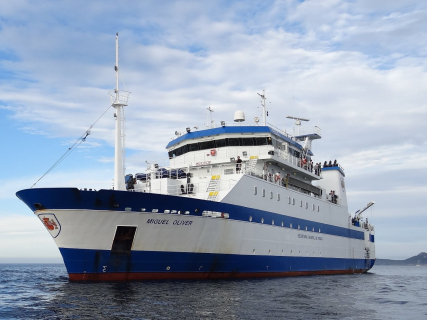
The scientific direction of this campaign rests specifically with the IEO, in coordination with the Mauritanian Institute of Oceanographic and Fisheries Research (IMROP, by its acronym in French), and is carried out aboard the oceanographic vessel Miguel Oliver, belonging to the Ministry’s fleet, until 12 December.
Agriculture has indicated that, to analyze the species that are the subject of the study, the swept-area method is applied, mainly through trawl nets, with the purpose of providing independent scientific information that serves as a basis for sustainable fisheries management.
The work area includes waters located between the southern border of Mauritania with Senegal and Cape Blanco, reaching depths of up to 1,000 meters. The sampling design is divided into three major geographic sectors — north, center and south — in order to achieve adequate representation of the different marine communities.
Among the species of greatest interest are the white shrimp, hake, the common squid, cuttlefish and ray. The scientific team will also analyze their geographic and bathymetric distribution, the demographic structure of the populations and their main biological parameters, in addition to compiling data on different environmental variables.
Agriculture has emphasized that this research campaign is of special importance due to the strong extractive pressure that demersal resources face in the central-eastern Atlantic.
These activities fall within cooperation between the IEO and Imrop, linked to the Joint Scientific Committee (CCC) of the sustainable fisheries partnership agreement between the European Union and Mauritania, concluded on 14 November and renewed through the agreement reached last Monday, 23. The campaign has co-financing from the European Maritime, Fisheries and Aquaculture Fund (Fempa).
The oceanographic vessel Miguel Oliver, 70 meters long, has state-of-the-art technology and is classified as an eco-friendly and quiet ship. In addition, it complies with ICES 209 regulations regarding the emission of noise and vibrations on research vessels.