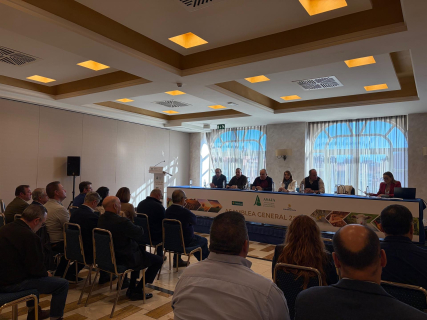

Asaja Castilla-La Mancha held this Friday in Toledo its Ordinary General Assembly, in which it reviewed the situation of the different agricultural and livestock sectors of the Community, assessed the work carried out by the organization, and set out the main lines of action for the coming year.
Asaja has stated in a press release that the agricultural organization approaches 2027 with the priority of safeguarding the sector’s production capacity, restoring profitability to farms, and ensuring that public policies respond to the real needs of professionals in the countryside.
The regional president of Asaja Castilla-La Mancha, José María Fresneda, has warned that next year will be key for the future of the agriculture and livestock farming in the region, both due to the decisions adopted at the Community level and due to the measures that the central and regional governments will drive forward.
"We are witnessing a regression of our production capacity. We are increasingly facing more difficulties in producing, higher costs, more restrictions, and fewer assurances of profitability. In 2027 we have to achieve that the administrations change the course of their policies and place the farmer and the livestock farmer at the center of their decisions," Fresneda said.
Among the main challenges for the coming year, Asaja Castilla-La Mancha highlighted the negotiation of the future Common Agricultural Policy (CAP) and the European financial framework after 2027.
The organization, which this Thursday was demonstrating in Brussels with the COPA-Cogeca and will do so again on December 17, has stated that it will continue to defend a CAP with sufficient budget, that maintains its common character, preserves its two pillars, and guarantees support for the professionals who produce food.
Likewise, it has said it will continue to demand reciprocity in commercial agreements with third countries, real administrative simplification, and an application of environmental requirements that is compatible with the production reality of farms.
"We cannot allow Europe to reduce support for its farmers and livestock farmers while it demands more and more from them and opens its markets to production that is not subject to the same conditions. Defending our agriculture is defending our food sovereignty," the regional president emphasized.
MEET THE PENDING DEMANDS
During the General Assembly, Asaja Castilla-La Mancha has highlighted the results of the technical work, the negotiation and the mobilization carried out throughout 2026.
Among these achievements, it highlights the acceptance by the Board of several of the organization’s proposals to make harvesting work compatible with the prevention of wildfires, such as that published yesterday in the Diario Oficial de Castilla-La Mancha: to consider ten-meter perimeter safety strips so that harvesting can be carried out without time limitations in the situations provided for.
However, the organization warns that there is still a long way to go.
With a view to 2027, it will continue to demand that harvesters be kept outside wildfire prevention regulations and that an actually effective strategy be put in motion against the overpopulation of rabbits and the rest of wildlife, with more resources, population control measures and adequate coverage of damage.
"We have demonstrated that a demand, when it is accompanied by proposals and technical work, yields results. But our goal is not to get announcements, but solutions that translate into real improvements for farmers and livestock farmers. We are not going to consider the problems resolved while they continue to exist on farms," Fresneda said.
The defense of water will continue to be one of Asaja C-LM’s priority areas in 2027.
The organization will insist that the planning and management of water resources be based on the knowledge of the scientific community and on sound technical criteria, away from political and ideological interests.
"We need to depoliticize water and address its management from scientific rigor, taking into account the real needs of the territory and guaranteeing compatibility between environmental sustainability and maintaining the region’s productive capacity," its president said.
To that end, it will continue working in favor of hydrological planning that provides legal certainty for water users, ensures the availability of resources and helps generate wealth, jobs and opportunities in rural areas.
Likewise, Asaja Castilla-La Mancha will continue to insist on the Costs Observatory and will strengthen its sector-specific work to ensure prices that cover production costs, improve transparency in markets and achieve effective implementation of the Law on the Food Chain.
Regional livestock farming will be the subject of specific attention, for which Asaja Castilla-La Mancha calls for a strategy with sufficient economic resources, that addresses health problems and the difficulties in ensuring the continuity of farms.
"Generational renewal is not achieved only by calling for aid to incorporate young people. It is achieved by ensuring that there is a profitable economic activity to join. We have to leave the next generations a field with the capacity to produce, to compete, and to generate wealth," Fresneda has said.
Lastly, the president of Asaja Castilla-La Mancha thanked Foro Interalimentario and Globalcaja for their collaboration at the General Assembly and closed his address with a clear message: "We do not want a countryside that is limited to surviving. We want a countryside that produces, that is profitable, that generates employment, and that has a future. And for that we are going to keep working from Asaja Castilla-La Mancha".