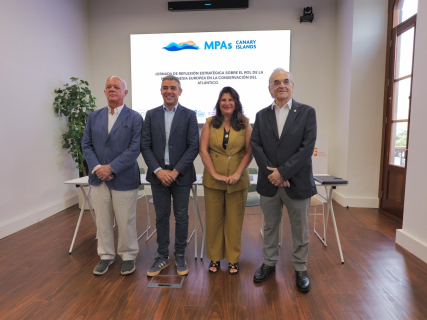

The international project "MPA Canary Islands" held a strategic reflection day this Friday in Las Palmas de Gran Canaria aimed at strengthening collaboration between public administrations and the scientific community, with the objective of consolidating the marine protected areas of European Macaronesia.
The session, held at the headquarters of the University Foundation of Las Palmas (FULP), brought together representatives from the Government of Spain, institutional leaders from the Azores, Madeira, and the Canary Islands, as well as marine specialists, with the purpose of identifying new conservation opportunities in the Atlantic, according to "MPA Canary Islands" in a press release.
The Minister of Agriculture, Livestock, Fisheries, and Food Sovereignty of the Government of the Canary Islands, Narvay Quintero, emphasized that the preservation of the marine environment "cannot be done with its back turned" to the territory, but rather by "listening" to science and the professionals who work in it daily.
Quintero recalled that the Canary Islands, Azores, and Madeira share the status of Outermost Regions (ORs) of the European Union (EU) and jointly possess almost two million square kilometers of Exclusive Economic Zone, which places this geographical space in a "key" position to lead the protection of the Atlantic.
The minister also insisted that the protection of the sea in the archipelago must be linked to sustainable development, the promotion of the blue economy, and the continuity of fishing activity.
In this regard, he reiterated the commitment of the Canary Islands to a model based on sustainable and responsible fishing, support for the artisanal fishing sector, and the promotion of permanent dialogue between fishermen, scientists, administrations, and involved organizations.
On the other hand, the Vice-Minister of Ecological Transition, Fight against Climate Change, and Energy of the Government of the Canary Islands, Julieta Schallenberg, remarked that the defense of the oceans requires management that integrates biodiversity conservation with responsible use of the marine environment.
Schallenberg expressed the commitment of the Canary Islands Executive to planning supported by scientific evidence, which will allow anticipating the impacts of climate change and strengthening the resilience of shared ecosystems in Macaronesia.
Likewise, the general coordinator of the "MPA Canary Islands" project, Octavio Llinás, recalled that European Macaronesia is "key" to achieving the global objective of protecting 30% of the oceans by 2030.
Llinás detailed that the Canary Islands Marine Demarcation accounts for nearly 50% of the national Exclusive Economic Zone and hosts ecosystems of high environmental value with thousands of species, many of them endemic, which represents a unique opportunity to advance with a global and integrating perspective.
Finally, the president of FULP, Alberto Cabré, stressed the importance of safeguarding the seas to ensure their sustainability and conserve the natural resources they provide. In this regard, he considered cooperation between scientists and administrations "key" for the management of these areas to be truly effective, valuing the day as a step towards the necessary consensus for the future of marine biodiversity.
The "MPAs Canary Islands" project, financially supported by the international alliance Ocean 5, has as its main objective to reinforce existing Marine Protected Areas (MPAs) and promote the declaration of new protected areas in the Canary archipelago.
This initiative focuses on global priorities such as curbing overfishing in Canary waters, promoting the creation of new marine conservation zones, and restricting the expansion of offshore oil and gas exploitation.