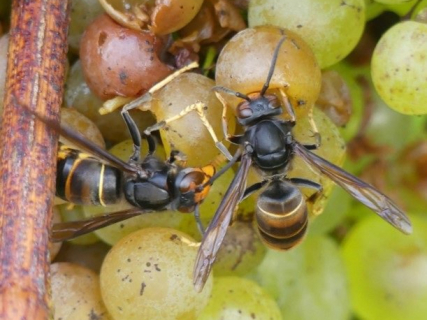

A research by Universidade da Coruña (UDC) raises the need to rethink the management of the Asian hornet in Galicia, considering the “inefficacy” of the trapping with liquids used to attract these insects.
The work examines the impact of the species in vineyards and in urban areas, and also evaluates various control strategies in one of the areas most affected by the spread of velutina.
According to the conclusions, “the effectiveness of anti-granizo nets is highlighted to prevent damage to grapes and demonstrates the ineffectiveness of generalized liquid trapping campaigns,” with reference to the devices designed to attract them, which it is emphasized “cause the accidental capture of numerous insects.”
For this reason, the research advocates a change in approach, one of the central ideas developed by Yaiza R. Lueje, which analyzes the effects of this invasive species on the agricultural and urban sectors, as well as the effectiveness of different measures to manage its presence.
In her doctoral thesis, the author studies a methodology based on visual assessment that facilitates estimating production losses. By contrast, she argues that campaigns with liquids to attract them “are not effective at reducing damage in vineyards and cause the accidental capture of numerous insects.”
In addition, the work investigates the distribution of velutina in urban areas through models that make it possible to examine its relationship with environmental factors such as vegetation cover, air and light pollution, or noise.
“The results show that velutina is capable of persisting in highly humanized landscapes and that certain environmental factors of cities may be associated with its distribution,” concludes the research.