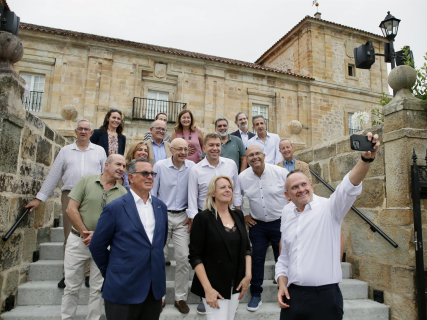

The Minister of Rural Development, Agriculture and Food of the Government of Cantabria, María Jesús Susinos, has emphasized this Thursday, during a meeting with the Directors General of Food from the different autonomous communities, the need to strengthen interregional coordination to face the challenges of the food sector.
According to the Cantabrian Executive, in a statement, the meeting, held at the Palacio de los Acevedos, was aimed at promoting institutional cooperation and jointly addressing the main challenges currently facing the Spanish agri-food sector.
In this context, the minister has highlighted the value of these shared working spaces to advance common policies that allow for a response with greater guarantees to the effects of climate change, sustainability requirements, the digitalization of rural areas, generational renewal, and the improvement of profitability for both producers and industries.
"This meeting is not just another technical meeting, it is an absolutely necessary strategic coordination space, because no community can solve these challenges in isolation. The strength of the sector lies in the ability to coordinate efforts, dialogue, and build common strategies," she insisted.
During her speech, Susinos highlighted the importance of the agri-food industry in Cantabria, an area that accounts for around 5.8% of the regional GDP and approximately 23.5% of the community's total industrial activity.
She also specified that this industry achieves an annual turnover of close to 1.7 billion euros, supports more than 7,000 direct jobs, and shows high female participation, with around 50% women in the workforce.
The head of the Ministry also reviewed the main lines of support launched to strengthen the competitiveness of the Cantabrian agri-food sector.
In this regard, she recalled the 2024 aid call, which started with an allocation of 14.37 million euros and which, given the strong investor interest from the sector, was increased to 16.45 million, representing a 65% increase in investments compared to the 2021 call.
"This aid will benefit 72 companies and will allow for the creation of between 330 and 360 new jobs, of which more than 75% will be for women," she specified.
Furthermore, it has announced that the next call will have a budget of 21.6 million euros for the 2027-2029 period, an amount that implies a growth of 31.5% compared to the previous call and 127.4% if compared to that of 2021.
Finally, it has pointed out that forecasts place investments linked to this new line of aid in a range of between 90 and 110 million euros, with an estimated generation of between 480 and 520 jobs.