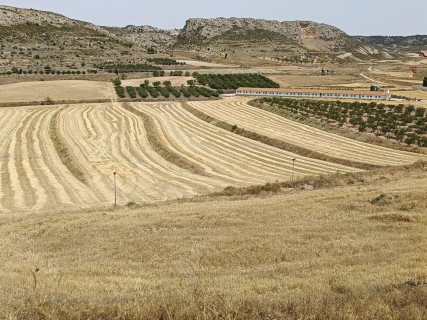

The 2026/2027 cereal marketing campaign -excluding rice- is expected to exceed 18.5 million tons, a volume that will be below the average recorded in the last five campaigns, which stood at 19.47 million tons, according to calculations released by the Ministry of Agriculture, Fisheries and Food.
In detail, the sown area of cereals -excluding rice- for this new campaign is around 5.43 million hectares, a level very similar to that of the last five years.
The general director of Agricultural Productions and Markets, Elena Busutil, held a meeting this Wednesday with the organizations and representative entities of the cereal (excluding rice), oilseed and grain legume sectors, with the aim of reviewing the 2025/26 marketing campaign already concluded and examining the forecasts for the campaign that began on July 1.
Regarding winter cereals, which concentrate most of the production, the harvest is estimated to reach 14.5 million tons, below the average of the last five campaigns, which stands at 15.7 million tons. The area dedicated to these crops exceeds 5.1 million hectares, in line with previous records.
For corn, according to surface advances, about 324,000 hectares are calculated to be sown and a satisfactory yield is expected, as it is mainly an irrigated crop that faces the summer with good water reserves, thanks to the abundant rainfall in the first months of the year.
As for oilseeds, forecasts indicate that the area in the 2026/27 campaign will exceed 800,000 hectares, about 4% more than in the previous campaign, although still a similar percentage below the average of the last five campaigns.
In the chapter on grain legumes, it is anticipated that the area in 2026/27 will reach 517,000 hectares, which represents an increase of 2% compared to the previous campaign and 17% above the average of recent years.
During the meeting, the development of the recently concluded 2025/26 campaign was also reviewed, marked by very high yields, with a production that exceeded 24 million tons of cereals, the best harvest since 2020, 20% higher than the previous one and 22% above the average of the last five campaigns.
The production of oilseeds stood at 1.1 million tons, cultivated in 762,000 hectares, while that of grain legumes exceeded 600,000 tons, obtained in approximately 500,000 hectares.
Structural deficit in the domestic market
The grain balance in Spain shows a notable trade deficit, conditioned by the weight of the animal feed industry, which is forced to resort to imports to cover its needs.
Agriculture has emphasized that this situation clearly determines the situation of the national market for agricultural raw materials.
In 2025/26, domestic cereal consumption stood at 37.7 million tons - compared to a national production of 24.1 million - of which three quarters were destined for animal feed, which implies a strong dependence on exports, representing 43% of consumption, while in the case of oilseeds, dependence approached 80%.
In international markets, price evolution is conditioned by the commodity exchanges of major producing countries, depending on global grain availability, currently very high, expectations about future harvests, and the global geopolitical context.
In this scenario, in which price fluctuations can affect the profitability of extensive crops, Agriculture recalls that it has deployed an "important" package of support measures.