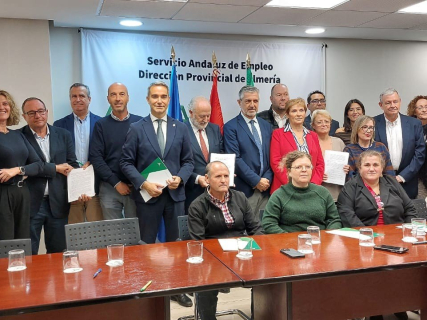

The adviser for Employment, Business and Self-Employment, Rocío Blanco, has expressed her satisfaction at the signing of the new collective agreement for the sector of processing and packing fruits, vegetables and flowers in Almería, a text signed this Friday that "opens a stage of stability" for this activity through 2030.
In a statement released after taking part via video link in the signing ceremony, the adviser stressed that this sector is one of the great pillars of the Almería economy, "with 150 companies and 20,000 workers, mostly women".
Blanco acknowledged "the breadth of vision, the sense of responsibility and the will to reach an understanding" shown throughout the negotiation both by the employers' associations represented in Coexphal, Ecohal and Asempal, and by the trade unions UGT and CCOO, whose efforts have made it possible to close the agreement after a negotiation "of more than two years".
The head of Employment also highlighted the work of mediation and the technical support provided by the Andalusian Council for Labour Relations (CARL), whose participation "has helped to bring positions closer and unblock the issues with the greatest difficulty, especially those related to the economic block, as a result of nearly a dozen meetings with the socio-economic agents involved".
In this context, Blanco defended the importance of social dialogue as "an instrument for economic progress and social cohesion". She emphasized that the new collective agreement "not only improves the working conditions of thousands of workers, but also provides companies with a framework of stability, certainty and legal security to face the coming years".
The text, which will be in force until 2030 and will apply its economic effects from next 1 December 2026, sets an annual wage increase equivalent to the rise in the Interprofessional Minimum Wage (SMI) plus half a percentage point, with a guaranteed minimum of 2.5 per cent, and includes a wage review clause linked to the Consumer Price Index (CPI), with an additional cap of 1.5 per cent per year.
In addition, it contemplates a gradual increase in the pay for hours of irregular distribution and overtime hours, together with a transport allowance of 1.75 euros for each actual working day. The agreement also includes various improvements in matters of hiring, safeguarding working conditions, licenses and permits, among other aspects.
The councilor has again highlighted the weight of Almería’s agri-food model as a "international benchmark" and has emphasized "the contribution of the thousands of professionals who, with their daily work in warehouses and handling centers, make possible the success of this production system".
Along the same lines, she pointed out that the impact of the agreement "goes beyond the strictly labor sphere", since it means "reinforcing the foundations of a strategic activity for the economy of Andalusia and favoring a scenario in which companies and workers can continue to grow together".