
Human beings evaluate the value of things reactively. Everything that works silently, that does not require conscious effort or produce disruptions, tends towards zero value in our perception, regardless of its real importance. Three mechanisms explain this paradox.
The first is the absence bias. We only actively value what its presence requires effort or whose absence causes harm. If the heating works, no emotional response is triggered, but if it doesn't, it is. This generates a profound asymmetry: the things that work best generate less attention and, therefore, less recognition. It is a self-reinforcing cycle until the system fails.
The second is the invisibility of prevention: the value of what did not happen cannot be represented. Maintenance generates no stories or headlines. We only see the incidents that occurred, not the thousands that were avoided. This produces a systematic distortion in how we allocate resources: almost always towards reactive response, almost never towards maintenance.
The third mechanism is complexity as a factor of opacity. The more sophisticated and robust a system is, the more invisible its operation becomes.
The first two reasons lead me to reflect on the gas distribution network and whether regulation truly allocates the necessary resources to it. Its extension would go around the world twice, it distributes more energy than the entire national electricity system, and it is the most critical element of the gas system due to its immense capillarity, which makes the "last mile" irreplaceable in the event of a massive incident because it concentrates the direct and immediate impact on the end-user and because its recovery after an incident is extremely complex and long. The value of capillarity is perhaps better perceived with roads. A few days after the DANA, the highways were already open, but months later many towns continue without access roads or with isolated parts without bridges connecting them. Capillarity takes a long time to develop and we only realize it when we have to rebuild it.
When we talk about energy supply security in Europe, public debate tends to focus on large cross-border gas pipelines, regasification terminals, or supply contracts with third countries. These are undoubtedly essential elements. But there is a link in the chain that receives less attention and yet, it is where supply security materializes or fails: the gas distribution network.
Supply security is built kilometer by kilometer, node by node, in the network that reaches every home and industry. For this reason, it is essential that the new remuneration framework recognizes that in distribution too, the remuneration of assets must be updated so that it can continue to be the link that closes the cycle reliably and remains the most critical element that is undervalued because it never fails.
On the other hand, a perfectly operating gas distribution network is a marvel of coordinated complexity that, precisely because of this, goes unnoticed. Well-designed complexity becomes transparent.
A perfectly operating gas distribution network is a marvel of coordinated complexity
Distribution networks are critical also from a cybersecurity perspective. As essential infrastructure for the country's security, they are exposed to a growing volume of threats in their operation. In 2025 alone, there were more than 15,000 attacks on the physical-digital layer that manages the gas distribution system.
It is impossible to foresee what we will have to do in the coming years – the "bad guys" are always ahead – to ensure that this extraordinary complexity remains invisible to society, but what is certain is that we will have to exponentially increase material and economic effort.
Distribution networks are critical also from a cybersecurity perspective
Identifying this invisible complexity requires a deliberate cognitive effort that goes against our natural psychology: cultivating the ability to value what works before it stops working.
In this regard, it is fair to recognize, and it should be valued, that the CNMC has done so by acknowledging that digitalization and cybersecurity are new realities that must be addressed and, therefore, require a specific remuneration mechanism. It should give us peace of mind that the regulator has this capacity to look beyond the visible and be anticipatory.
However, while it is a success on the part of the CNMC, the assigned value falls short compared to what various studies predict will be necessary and what we are seeing happen in other sectors, probably not as critical.
Trust makes invisible that in which trust is placed. The gas distribution network functions as a substrate of trust. It is a system so omnipresent that its maintenance cost has become invisible and, moreover, it is very cheap – we have the lowest tolls in Europe. Therefore, it is a perfect candidate to be ignored until it collapses.
Ultimately, this paradox has structural consequences in how societies allocate resources because there is a permanent bias towards the visible and the urgent over the important and the silent; there is a tendency to invest in inaugurations, not in maintenance or cybersecurity; there is a tendency for regulators to reduce remuneration, not to allocate the necessary resources for the systems to continue functioning perfectly.
The remuneration framework must respond to the invisible, it must be a lever of trust. Gas distribution companies operate in a regulated environment. This means that our ability to undertake investments and face expenses – whether in network renovation, digitalization, or cybersecurity – depends on the remuneration framework recognizing them as necessary and remunerating them adequately.
The current regulatory period in Spain, as in much of Europe, was designed in a technological and geopolitical context substantially different from the current one. The cyber threat did not have the dimension it has today. The integration of renewable gases did not require the level of digitalization it now demands. And the social criticality of distribution networks had not been as evident as it has been after the energy and geopolitical crises of recent years.
The alternative to adequately attending to asset maintenance, especially those with greater age, cybersecurity, and digitalization, is not saving, it is assuming a systemic risk whose cost, when it materializes, will be infinitely greater.
In reality, the answer is as simple as recognizing the paradox itself: the absence of a signal is not the absence of value, but often its purest form. If the gas distribution network does not concern us and never fails, it is because its value is immense. Let us be aware, let us take care of it, and let us allocate the necessary compensatory resources so that its value continues to be invisible to society's eyes.
ABOUT THE SIGNATURE:
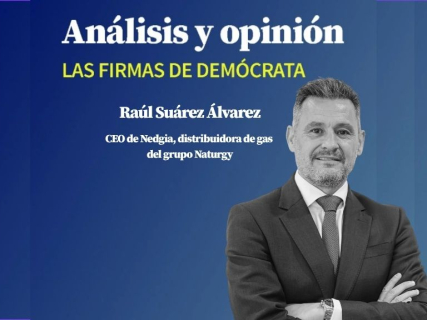
Raúl Suárez Álvarez, CEO of Nedgia, gas distributor of the Naturgy group.