Europe is living an epochal change that it still does not fully accept. For more than thirty years, the continent organized its security on three implicit pillars: the strategic umbrella of United States, economic interdependence as deterrence and the progressive reduction of traditional military capabilities. War was conceived as a distant anomaly, manageable through limited missions or international coalitions. That model has blown up.
The war in Ukraine has returned Europe to a more uncomfortable reality: the possibility of a high-intensity conflict in its own strategic environment. At the same time, the shift in US policy towards Asia and the growing unpredictability of transatlantic commitment force Europeans to assume greater responsibilities. In that framework, the British report on warfighting readiness —real preparation for war— is particularly revealing. Its thesis is not simply that more should be spent on defense. It is deeper: it argues that States must prepare as complete systems —political, industrial, and social— for prolonged conflict scenarios. We could infer that armies win or lose battles, but it is nations that can or cannot sustain wars, hence the title of the article, with due respect.
That diagnosis has implications that transcend the British case. In fact, the United Kingdom appears rather as a mirror in which other European countries should look at themselves. Because the problem that the report identifies is not exclusively British. It is, to a large extent, European.
The first error that he points out —and which can be easily applied to the whole continent— is the confusion between efficiency and security. In times of peace, Western democracies have optimized their structures: they have reduced reserves, outsourced production, adjusted workforces, and prioritized budgetary efficiency. However, war punishes precisely that logic. It demands redundancy, rapid production capacity, material storage, and industrial resilience. Ukraine has demonstrated that modern conflicts are not won only with advanced technology, but with volume, replenishment capacity, and prolonged resistance.

Spain is not alien to this dynamic. Although it has increased its defense spending in recent years, its model remains marked by peacetime inertias: external dependence on certain critical systems, limited industrial base in some segments and scarce culture of strategic reserves. The debate on European strategic autonomy —driven from Brussels— highlights these shortcomings, but its practical translation is still uneven.
The second major element of the British report is the need to think of defense as a matter of State, not just as a sectoral policy. Modern war, it argues, is not fought solely on the battlefield. It affects the economy, energy, critical infrastructure, cybersecurity, finance, and social cohesion. In other words, it is not the army that goes to war: it is the entire country.
Here the parallelism with Spain is again evident. The Spanish institutional system, like that of many European democracies, is designed for ordinary management, not for strategic exceptionality. Interministerial coordination in national security matters has improved in recent years, but it remains limited compared to the demands of a prolonged crisis scenario. The administrative culture, highly guaranteeing and procedural, can become an obstacle if it does not adapt to contexts that demand speed of decision and response capacity.
The third key aspect is the question of alliances. The British report does not question the importance of the OTAN, but warns of a risk: assuming that membership in an alliance replaces the need for own capabilities. This is, probably, one of the most sensitive debates in Europe. For decades, many countries have structured their armed forces under the premise that the United States would cover critical shortcomings. That premise is no longer so solid.
The credibility of a country in an alliance depends on what it contributes, not only on what it receives
For Spain, a NATO member but with limited resources, this reflection is particularly relevant. Participation in international missions and alignment with allies cannot hide the need to strengthen key national capabilities. The credibility of a country in an alliance depends, ultimately, on what it contributes, not just on what it receives.
Perhaps the most uncomfortable point of the British report is the one that refers to society. Is the citizenry prepared to assume the costs of a security crisis? For years, defense has been relatively disconnected from public debate in Europe. The professionalization of the armed forces has reduced the direct link between society and the army, and war has been perceived as something alien.
In Spain, this disconnection is especially pronounced. Strategic culture is limited, public debate on defense tends to be superficial and risk perception is low -something also has to do with the current composition of the council of ministers-. However, the war in Ukraine has begun to change that perception, albeit gradually. The question is whether that change will be enough to sustain more demanding defense policies over time.
The British report, ultimately, is not a call to militarism, but to strategic responsibility. Its central message is that peace is not a guaranteed state, but a construction that requires preparation, investment, and cohesion. Preparing for war does not mean wanting it, but avoiding it through credible deterrence.
Europe finds itself at a crossroads. It can continue clinging to a security model that no longer corresponds to reality, or it can assume the political and economic cost of adapting to a more dangerous environment. Spain, as part of that European framework, cannot remain outside of that debate.
The true question posed by the British report is not only how much more we should spend on defense. It is quite more uncomfortable: if we are truly prepared, as States and as societies, for a world in which security has returned to the center of politics. In the case of Europa, and also of España, the answer remains uncertain. But the margin to continue postponing that reflection narrows. And if that report was formulated at the dawn of the war of Ucrania, today the deterioration of the scenario in Oriente Medio only reinforces the urgency of that debate. Although that is already another reflection, which deserves its own chapter.
about the signature
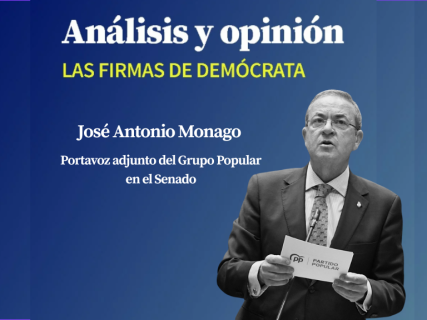
José A. Monago is the deputy spokesperson of the Popular Group in the Senate. Member of the National Security and Defense Commissions.