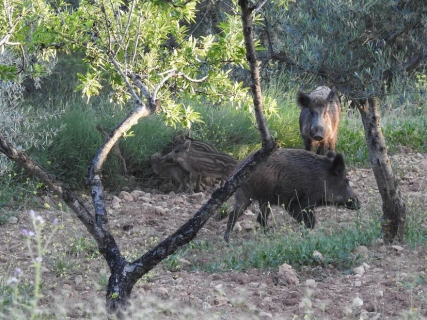

The Councillor for Sustainability and the Environment of the Junta de Andalucía, Fina Martínez, detailed this Wednesday, to the commission of the Andalusian Parliament, that from 2019 and up to the first half of 2026, 19,314 specimens of wild boar and feral pig have been removed from public forests and protected natural areas. These interventions are framed within the work of controlling the overabundance of these species, with the aim of limiting harm to agricultural and livestock holdings, minimizing the impact on ecosystems, and reducing the health risks that they entail.
In her intervention, and in response to an oral question, Martínez stated that the Department combines the direct capture of animals with exceptional measures of hunting-related control and continued monitoring of populations. To this is added surveillance of pathologies in wildlife, placing the focus on areas where livestock farming is more exposed to these dangers.
The capture actions remain active in public forests of Cádiz and Málaga, as well as in the national parks of Sierra Nevada and Sierra de las Nieves. In the natural space of Doñana, control work is also carried out using the Junta’s own resources. For all this apparatus, among other means, 292 trapping stations are available and management stalks are carried out.
At the same time, since 2014, exceptional measures have been applied through successive annual declarations of hunting emergency, in force until 2026. The most recent resolution, approved in May of this year, allows stalking from August to March 2027 and the waiting sets, also at night, throughout the season. This declaration also opens the door to intensifying control on non-hunting lands and placing trapping stations with a simple prior communication, so that actions can be extended beyond the areas specifically devoted to hunting to address problems associated with the presence of these animals.
In relation to hunting activity in the entirety of Andalusia, during the 2024-2025 season, the capture of 73,253 wild boars in private hunting grounds was reported. In parallel, within the framework of the hunting emergency, 1,175 trap devices have been installed, from which 7,601 declared captures have resulted. Added to this direct control of specimens is the health-prevention component, articulated through the Epidemiological Surveillance Program for Wild Fauna, which includes the monitoring of diseases such as African and classical swine fever, tuberculosis, or Aujeszky’s disease, in order to assess threats to livestock stock and guide preventive measures.
According to the latest available triennial study, corresponding to the 2022-2024 period, 2,983 individuals belonging to nine hunting species were examined and more than 29,000 analyses were carried out on 37 diseases. In addition, the Department is strengthening the monitoring system through camera traps supported by artificial intelligence, especially in areas of extensive pig farming, where the level of health risk requires more intensive supervision.