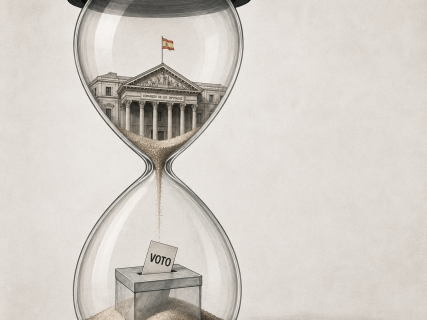

Has Spain entered early election mode?
Amid judicial pressure, political wear and tear, and parliamentary arithmetic, the debate over early elections is once again at the center of the stage
Has Spain entered early election mode? Will citizens go to the polls sooner than expected? Are the parties already preparing for an eventual early end to the legislature? The questions circulate insistently in the political debate, although the answer, for now, remains more prudent than conclusive.
In the opinion of political scientist Allende Salazar, the current scenario makes it "very difficult" to foresee an early general election, especially if one considers the latest statements by the President of the Government, Pedro Sánchez, the only one with the constitutional prerogative to dissolve Parliament.
Indeed, during his recent meeting with the Pope in the Vatican, Sánchez reiterated his intention to complete the legislature and reach 2027 without calling early elections.
Three reasons for an early election... and one main brake
However, apparent stability coexists with growing pressure. The succession of political scandals affecting the PSOE's circle could alter that roadmap. "There are too many judicial fronts, we practically have a summary or order per day," points out political consultant Allende Salazar in statements collected by Demócrata.
In this environment, she adds, Spanish politics is experiencing a kind of "state of waiting," conditioned by three factors: the pressure from investiture partners, internal tension within the PSOE, and the evolution of judicial proceedings affecting figures close to the president, including his family circle, former high-ranking officials like José Luis Ábalos or Santos Cerdán, and former president José Luis Rodríguez Zapatero, in relation to the Plus Ultra case.
Salazar, however, avoids a conclusive diagnosis: "The numbers do not give the government enough for an early election," she maintains, emphasizing that the political margin remains narrow.
The Zapatero factor and the political climate
The so-called "Zapatero case," linked to an alleged influence peddling scheme surrounding the rescue of the airline Plus Ultra, has intensified political and media noise. In parallel, it has reopened the internal debate within socialism about the advisability of completing the legislature or not.
In this context, former Prime Minister Felipe González has been one of the most critical voices. González believes that the legislature has entered a phase of wear and tear that is difficult to reverse, not only due to the opposition's pressure but also due to the progressive deterioration of the political climate within the PSOE itself.
In his opinion, governing without a Budget and with fragile majorities poses a growing risk to institutional stability. However, he does not propose a vote of no confidence, but rather an orderly exit: that the Government itself anticipate the elections and return the word to the citizens.
Internal division in socialism
González's position is not isolated. Territorial leaders and figures from historical socialism have also expressed their concern about the wear and tear of the legislature.
Among them, the president of Castilla-La Mancha, Emiliano García-Page, has warned of the political impact that corruption cases are having on the organization and its electoral base. Other PSOE figures such as Tomás Gómez, Jordi Sevilla, or Juan Lobato, as well as various mayors and territorial leaders, share this view, considering the political cycle to be exhausted.
The common diagnosis points to a progressive erosion of socialist electoral support, visible—according to this interpretation—in the last regional electoral cycles.
Pressure from the opposition and partners
Meanwhile, parliamentary opposition is intensifying pressure. The People's Party has managed to censure the Government in the Senate with the support or abstention of parties such as the Basque Nationalist Party (PNV) and Junts per Catalunya, key parties in the current parliamentary arithmetic.
From the PP, there is insistence that the legislature is going through a terminal phase, while the hypothesis of an eventual vote of no confidence is gaining ground, although without guaranteed numbers to succeed.
For their part, leaders such as the Deputy Secretary of Sectoral Coordination of the PP, Alma Ezcurra, have publicly called on the Government's partners to reconsider their support for the parliamentary majority.
Junts and PNV: pressure from the periphery of power
The role of the investiture partners has become a determining factor. From the PNV, messages have been sent in favor of an early election before the end of the political cycle, while Junts has hardened its discourse, linking its parliamentary support to the evolution of the political and judicial climate.
The spokesperson for Junts in Congress, Míriam Nogueras, has reiterated that her party did not go to Madrid "to support governments," increasing pressure on La Moncloa at a time of growing parliamentary fragility.
Socialist bewilderment
Within the PSOE, the atmosphere oscillates between official caution and internal unease. Although any statement about a potential early election is publicly avoided, some leaders privately acknowledge a scenario of prolonged uncertainty.
The dominant interpretation is that the decision depends exclusively on Sánchez, while a motion of no confidence would depend on an improbable convergence of the opposition.
Popularity, wear and tear, and political calculation
Political scientist Xavier Pastor introduces another element into the equation: the management of political time. In his opinion, the Government does not currently face a clear incentive to call early elections. "If Pedro Sánchez has one asset, it is the Government; abandoning it would mean losing everything," he maintains.
In his analysis, the key lies in the evolution of popularity: leaders, he recalls, usually call elections when their cycle of support is on the rise. In this case, the perception is the opposite: a stage of decreasing stability that would advise holding on rather than risking.
Conclusion: an open legislature, but under tension
Spain has not entered, at least formally, into "early election mode." But the legislature is indeed traversing a terrain of high political, judicial, and parliamentary pressure.
Between the declared will of the President of the Government to exhaust the mandate and the growing pressure from the opposition, from partners, and from a part of the socialist space itself, the scenario remains open.
For now, the key is not whether there will be early elections, but when—and under what conditions—they will cease to be a hypothesis and become a decision.