

This Sunday seals the end of a week as black as pitch for the PSOE. With the Zapatero case still lingering, the summary comes to light and opens new facets; the UCO plants itself at the socialist headquarters on Ferraz street to request documentation on the Leire Díez case; Judge Pedraz hints at the existence of an organized plot to destabilize judicial proceedings affecting the PSOE and the government of Pedro Sánchez; and to top it all off, the trial of the president's brother, David Sánchez, accused of having benefited from a position created ex profeso for him in the Badajoz Provincial Council, has begun. With this scenario as a backdrop, there has been little room for politics as such, with one exception: an event organized in the Senate by the socialist group on the impact of the Recovery Plan.
The spokesperson for the socialist group in the Upper House, Juan Espadas, promoted the event held this Thursday, where various successful projects were presented. Taking advantage of the break, he spoke to Demócrata, a conversation in which he highlighted the value of useful politics.
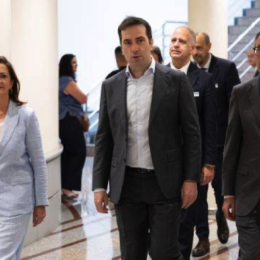
An oasis of 'Politics' in the midst of a whirlwind
When asked precisely about the timing of the event, Espadas stressed that "it is an opportunity to do something that we often say, but do little, which is to evaluate the results of public policies that have undoubtedly been decisive in our country in recent years."
"Four years ago, Spain's biggest problem was how to recover economic activity after the halt caused by the pandemic. The economic setback, in terms of GDP, was very serious. And we already had the experience of the last crisis, in which it took us ten years to recover," he added.
"It is an opportunity to evaluate the results of public policies"
In his opinion, it is the ideal time to advocate for "a national project like the one that the Government of Spain and President Sánchez were able to propose, generating great economic development and convincing other European partners that it had to be a great EU project."
The PSOE spokesperson in the Senate elaborated on an argument put forward by practically all the speakers who participated in the three debate panels: "It is probably the historical moment in our country in which the most transcendental economic decisions have been made for the transformation and strengthening of the productive fabric."
And he stressed: “We will talk for many years about the opportunity to reindustrialize Spain, and that is what we are talking about today, for example, about how energy will decide the future of the planet”.
The importance of territories
During the conference, successful projects funded by European funds in specific territories of the Spanish geography were mentioned, such as the ONUBA green hydrogen project in Andalusia or PowerCo Battery Spain in Sagunto, Valencia.
In response, Juan Espadas stated that “we have heard [during the conference] that we are moving from globalization to regionalization”; and “therefore, the autonomy of the territories, their capacity to be sovereign from the point of view of energy self-sufficiency and control of energy sources, is a vital element today on the international stage”.
In line with this, “the Government of Spain proposed that it be one of the axes on which to invest, to use our capacity to have renewable energy and turn it into a potential for developing industries, generating employment and, ultimately, changing the country practically like a sock,” he continued.
And the Industry Law?
In addition to the Recovery, Transformation and Resilience Plan, other important initiatives were mentioned at the event, such as the already approved Sustainable Mobility Law and the Draft Law on Industry and Strategic Autonomy.
The latter, fundamental for the country's industrial fabric and for strengthening strategic autonomy, has been blocked since February 2025 due to systematic extensions of the amendment period - and there are no signs on the horizon to suggest that its status might change. When asked about it, Espadas admitted that “indeed, laws are necessary”.
“An Industry Law means adapting, the last one was 30 years ago. It means adapting the reality of green industry or the potential of the energy development capacity our country has. Another example would be the digitalization process we are developing,” he argues; but “it also means understanding the role of workers in industry in a different way and how we are going to improve our competitiveness against markets like Asia and the United States”.
In this regard, he considers that “as a trade unionist who spoke commented, the labor reform itself is a measure that was part of the recovery program”.
Management as a refuge
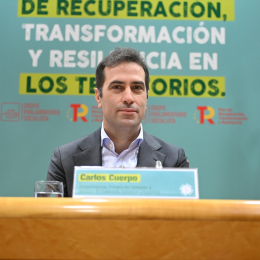
The First Vice President and Minister of Economy, Carlos Cuerpo, one of Sánchez's trusted men and who has repeatedly expressed pride in the Executive he is part of in recent days, was in charge of kicking off the event.
Espadas thanked him for his participation and adopted his words as his own: "Minister Cuerpo, with the solvency that characterizes him, has said that we are going to complete the plan and the program and that we are going to do so, moreover, by meeting the milestones we committed to with the European Union to develop." "They mean regulatory changes and, above all, the execution of projects that have been financed in the territory, achieving 100% of the objectives," he added.
Featured story
Government expects green light soon for sixth payment of European recovery funds
2 minutes
Juan Espadas concluded the talk with Demócrata by calling for trust in the Government's management: "I believe that trust, as we are seeing here with executives and those responsible for the major national projects currently underway throughout the country, demonstrates that there is a Spain before the Recovery, Transformation and Resilience program and a Spain after. This Spain is prepared for the future and, therefore, I also want to send a message of hope, which I believe is positive today."
The return of the event attendees to their seats to continue with the day brought a close to a brief interview that was nothing more than a haven of useful politics amidst the noise. The event continued to unfold normally while, outside the Senate, current events remained relentless. But for a few hours, the PSOE focused on industry, energy, and territories. And therein lies precisely part of Moncloa's strategy: to take refuge in management to sustain the narrative in the face of judicial and media wear and tear. The problem lies in the fact that useful politics requires time, stability, majorities, and focus, and right now, every headline threatens at least one of those conditions.