
The promise comes after the Government declared the Ministry of the Interior's documents related to the regularization "secret or reserved," in a parliamentary response to requests from the PP regarding technical reports, internal evaluations, legal analyses, and communications between ministries.
Feijóo promises to declassify documents on regularization
Alberto Núñez Feijóo has made the extraordinary regularization of migrants one of the axes of his political offensive against the Government.
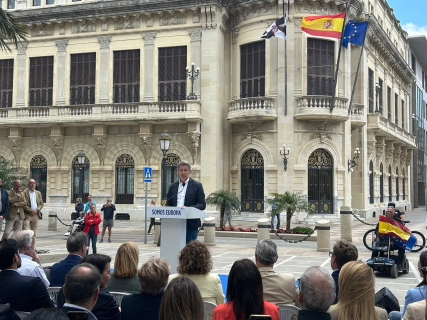
During an event held in Ceuta on the occasion of Europe Day, the president of the PP assured that, if he reaches the Presidency of the Government, he will declassify "all documents" related to this measure in his first week at the head of the Executive.
“We will open the drawers and the Spanish people will know why and for what all this has been done and is being done”. With that phrase, Feijóo tried to present the issue not only as an immigration debate, but as a problem of institutional transparency.
According to the PP, the regularization is being processed without sufficient public information about its scope, its administrative impact, its security consequences, its legal compatibility, and its alignment with European criteria.
The Government, on the other hand, has maintained that the measure responds to a citizen initiative and the need to respond to people who already live and work in Spain.
What documents does the PP want to know
The immediate origin of the controversy lies in a parliamentary response from the Government to several information requests submitted by the PP. The popular ones requested access to technical reports, internal evaluations, legal analyses on the compatibility of the decree with current legislation, communications between ministries, and possible warnings from European institutions about the impact on the Schengen area.
The Ministry of the Interior responded that, within the scope of its responsibilities, the requested documentation is affected by the regulations on official secrets, specifically by Law 9/1968 and by several agreements of the Council of Ministers that classify certain matters and subjects.
That is the point that Feijóo has used to raise the tone. For the PP, invoking the condition of "secret" or "reserved" in a measure of such political and social impact means hiding relevant information from Parliament and citizens.
“Spaniards will know why and for what”
During his speech, Feijóo stated that approving a massive regularization “against the will of the Spanish people, against what was voted in the Cortes, and against Europe’s criteria” constitutes, in his opinion, a “historical irresponsibility”. He also maintained that using state secrecy to hide its scope is a “mockery” that he does not intend to tolerate.
The PP leader linked his declassification promise to a broader message on immigration, borders, and security. He defended a "legal" migratory policy and accused the Government of offering "insecurity and lack of control".
In its approach, regularization affects not only irregular migrants but also regular migrants and all Spaniards. This framework seeks to place the debate in the realm of legal certainty, administrative management, and state control.
What the Government Says About Regularization
The Government has defended the extraordinary regularization as a response to a citizen initiative and an existing social reality: migrant people who live in Spain, work or try to join the labor market, but remain in an irregular administrative situation. In a document of questions and answers from the Ministry of Inclusion, the Executive maintains that the regularization “recognizes and dignifies” those who already live in the country.
The measure has been presented by its defenders as a way to reduce the underground economy, increase contributions, order administrative situations, and guarantee basic rights. Its critics, on the other hand, warn of possible pull effects, management problems, pressure on public services, and doubts about background checks or requirements.
The Government has not responded to Feijóo with a declassification, but it has protected the reservation of certain Interior documents under the official secrets regulations. That is the core of the institutional clash.
Why "secret" or "confidential" is being discussed
The classification of documentation as secret or confidential does not necessarily mean that all regularization is secret, but rather that certain reports or documents requested by the PP are protected by the official secrets regulations in the Interior field.
According to the parliamentary response disseminated by Europa Press, the Government refers to Law 9/1968, on Official Secrets, and to agreements of the Council of Ministers of 1986 and 1994 that classify certain matters and subjects.
The controversy is whether that protection is justified in this case or if, as the PP maintains, it is being used to prevent parliamentary control over a decision with a strong political impact.
Regularization divides public opinion
The debate also comes at a time of strong social division over immigration policy. A poll by 40dB. published by El País placed support for regularization at 37.6%, versus 33% against. The study also reflected citizen concern about the impact of the measure on housing, public services, and employment.
That data explains why Feijóo is trying to turn the issue into a political axis. The regularization is not a minor administrative issue: it crosses immigration, security, labor market, public services, national identity, and relations with Europe.
For the PP, it is an opportunity to confront Sánchez on a terrain where it believes social unease exists. For the Government, the key lies in presenting the measure as an orderly regularization, not as an indiscriminate opening.
Ceuta as a political stage
The place chosen by Feijóo is not accidental either. Ceuta is one of the most sensitive external borders of Spain and the European Union. Celebrating an event there on Europe Day allows the PP to link the migratory discourse with border protection, security, and Spain's role within the European project.
During his speech, Feijóo defended that Europe must guarantee "legal, orderly" immigration associated with respect for European values. He also addressed issues such as security, energy, NATO, Ukraine, or political corruption, but the message about regularization was the one that gained the most impact.