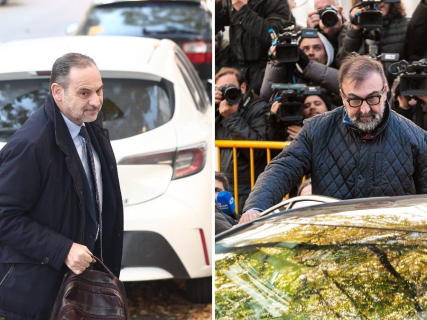

Former Transport Minister José Luis Ábalos and his former adviser Koldo García were sent to provisional prison exactly one year ago, in the final phase of the investigation of the 'mask case' before the Supreme Court, due to a risk considered "extreme" of flight. Today, with a final prison sentence already in place, both are awaiting a favorable decision from the Constitutional Court (TC) on their individual applications for amparo, and they continue under the spotlight of the 'Koldo case', which is being investigated by the National Court and in which they appear as investigated parties for alleged rigging in public works contracts.
The investigating magistrate in the Supreme Court, Leopoldo Puente, ordered on November 27, 2025 the entry into provisional prison of the former minister and his former adviser, who at that time were still charged, given the proximity of the trial that would end in a conviction of 24 years and three months in prison for Ábalos, 19 and a half years for Koldo for irregularities in public supply contracts for health-care material, and four years for the businessman and fixer Víctor de Aldama, who did not end up going to jail thanks to his cooperation with the justice system.
On that day, the judge detailed the "three milestones" that led him to order the preventive incarceration of both: that he had already proposed putting them in the dock before "the consistent evidence" of the commission of serious crimes; "the extension of the penalties requested", which "is so relevant that it comments on itself", and the imminence of the oral trial.
With that ruling, Ábalos became the first sitting deputy to be sent to prison, after having argued that precisely because he was a parliamentarian there was no flight risk. At the hearing to review the precautionary measures, the former minister argued: "I have no money and nowhere to go."
From the seat to the dock and the 'Koldo case'
Months later, already processed, the former minister resigned his seat —and with it his privilege as a member of parliament before the Supreme Court— with the intention, ultimately frustrated, of avoiding the trial in the High Court and of having the entire procedure — the mask contracts and the public works— continue in the National Court, where it had begun in 2024 after the arrest of Koldo García and which would end up deriving in the so-called 'Koldo case'.
In this separate piece, the magistrate of the National Court Ismael Moreno keeps open several lines of investigation, including the alleged rigging of public works contracts—among which the also former Secretary of Organization of the PSOE Santos Cerdán appears as an investigated person—and the PSOE’s cash payments between 2017 and 2024 to reimburse expenses advanced, a part of the case file that remains under seal.
The most recent actions in the 'Koldo case' were carried out a few weeks ago, when the Central Operational Unit (UCO) of the Civil Guard arrested six people, including Ábalos’s partner, Andrea de la Torre, and Cristian Corvillo, identified as the former driver of the former Prime Minister, Pedro Sánchez.
In this case there are numerous investigated parties who have already appeared before the Supreme Court in the trial for the 'masks case' against Ábalos and Koldo, although at that time they did so only as witnesses, including a former partner of the former minister, relatives of the former adviser, and several businesspeople.
Convictions for criminal organization and mask contracts
During the trial in the Supreme Court, both Koldo and Ábalos proclaimed their innocence. Despite this, the court found them guilty of criminal organization, bribery, influence peddling, and embezzlement, and acquitted them of the offenses of abuse of office, use of insider information, and document falsification.
The Chamber found irregularities proven in the awarding of 13 million masks by entities dependent on Transport, such as Puertos del Estado and Adif, to the company Soluciones de Gestión, linked to Aldama; a monthly payment of 10,000 euros for "fixed expenses" of Ábalos; and the hiring in public companies of two women related to the former minister, Claudia Montes and Jéssica Rodríguez, to whom the plot paid the rent for a home.
The court also concluded that the three "constituted an organization, in which each of them assumed a different and complementary role, with a precise division of functions".
In his understanding, "they agreed" that, taking advantage of the positions Ábalos held both in the Government of Pedro Sánchez and in the top leadership of the PSOE, "it could favor, in exchange for the corresponding financial benefit from which everyone would participate, contracting with the Public Administration on any occasions when there would be an opportunity," through companies driven by Aldama, as well as facilitating for the businessman "preferential access to the Administration for carrying out the procedures he needed for himself or for the aforementioned companies".
Appeals to the TC and fundamental rights
In addition to prison sentences, the ruling set a fine for Ábalos of 52,500 euros, 45,750 for Koldo and 72,000 for Aldama, as well as a joint compensation for Ábalos and his former adviser to the public companies Ineco and Tragsatec of 34,450 euros and 9,500.54 euros, respectively, and the forfeiture from the three convicted of 430,298 euros.
After the ruling, the former minister filed, at the beginning of November, an application for amparo before the Constitutional Court in which he seeks the nullity of the Supreme Court sentence. Ábalos's defense centers its criticisms on the weight given by the Chamber to Aldama's statements. Koldo has also appealed, pending the TC's decision on whether to admit or not to process his submission.
Regarding these statements, Ábalos's lawyer argues that the statement of a co-accused "requires minimal corroboration by data external to it regarding the accused's participation".
In his appeal, the former minister states that during the proceedings up to eight fundamental rights were violated: the right to a judge predetermined by law, to a process with all guarantees, to the presumption of innocence, to effective judicial protection, to criminal legality, and to liberty and security. The TC has not yet issued a ruling.
Sentence calculation and complaint against the Community of Madrid
On the eve of the one-year anniversary of his sentence, it has become known that the Supreme Court has set the date for the extinction of Ábalos's prison sentence for 11 May 2042 and that of his former adviser Koldo García for 2 November 2040.
That same Thursday, the former Minister of Transport also filed a complaint with the State Public Prosecutor's Office against the Government of the Community of Madrid, presided over by the 'popular' Isabel Díaz Ayuso, for alleged "irregularities" in contracts for the supply of face masks during the pandemic, for an amount which, according to Ábalos, exceeds 133 million euros.
Among other points, the former PSOE Secretary of Organization questions whether the awards processed "with a speed that limited competition were the most efficient and appropriate option".
He also emphasizes that "in many cases the awarded companies had no prior experience or activity related to the marketing of health protection equipment or emergency material". Along these lines, Ábalos points to the existence of a alleged "lack of justifying documebrtation" in those awards.