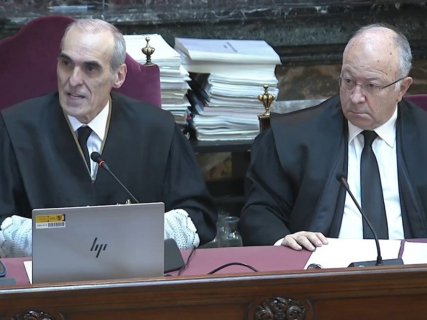

The chief prosecutor of Anticorruption, Alejandro Luzón, stated this Wednesday that the President of the Government, Pedro Sánchez, "was not number one" in the "real criminal organization" that, as he insisted, included former minister José Luis Ábalos, his former advisor Koldo García, and the businessman and alleged intermediary Víctor de Aldama.
This has been defended in his final report before the Supreme Court, in the trial against the three defendants for alleged irregularities in the contracts for the acquisition of masks during the health crisis.
"It is not about establishing a number one, a number two, a number three, and certainly the President of the Government was not number one, as Aldama attributes that role to him with notable ease," the representative of the Public Ministry has pointed out.
Luzón has stressed that Ábalos was "called boss by some and by others, certainly by the other two defendants, and also by Aldama's entire circle".
Furthermore, he has underlined the "nuance" introduced by the lieutenant colonel of the Central Operational Unit (UCO) of the Civil Guard, Antonio Balas, who declared that "whoever pays, commands, and whoever pays and demands is Aldama".
"But a clarification must also be made to this consideration, and that is that Aldama does not intervene in some of the crimes for which Ábalos and Koldo are accused," the prosecutor added.
Luzón has wanted to make "clear" that this point must be weighed when comparing his request for a sentence for the businessman —7 years in prison— with the sentences he is requesting for Ábalos (24 years) and for Koldo (19 years), who "have not needed Aldama for the commission of offenses".
The head of Anti-Corruption maintains that the alleged plot was hatched in the Ministry of Public Works —later renamed Ministry of Transport— after Ábalos's arrival in June 2018, based on "personal relationships" that arose and which "soon" led to "common profit," giving rise to a "true criminal organization."
"Everything ended in a corrupting pact that interested all parties," he emphasized, remarking that the "incriminating evidence" against the three defendants is "abundant" and "devastating."
Cash payments and origin of money
In relation to the monthly payments of 10,000 euros, he recalled that Aldama "acknowledges" them as his own. "The accused have not obtained a valid answer to that question that was asked in the old ditty: 'Where does he get the money for so much distinction?'", he stated.
Luzón has pointed out that that question should be asked "by all Spaniards regarding public officials" and also "by the directors of the bank branches where huge amounts of cash were deposited" by Ábalos and Koldo.
Mask contracts and benefits
Regarding the mask contracts, the prosecutor has denounced that there was a "prior and privileged agreement" with Aldama, since "the ministerial order" for the purchase of sanitary material "was issued much later" and that "the number of masks was decided by the awarded company," Soluciones de Gestión, linked to the alleged fixer.
He has also alluded to the payment of the apartment in Plaza de España where Jéssica Rodríguez, Ábalos' ex-partner, lived for almost three years, which he considers "the beginning of corruption, as early as March 2019".
Hiring in public companies
Regarding his incorporation into public companies such as Ineco and Tragsatec, he has pointed out that it is "fully accredited" that Koldo, "on behalf of Ábalos", exerted "efficient moral pressure" on the then president of Adif, Isabel Pardo de Vera, who acknowledged as a witness having sent Jéssica's resume to the president of Ineco.
"It's curious, Pardo de Vera says that she limited herself to sending the resume and said that sending a resume means nothing. And I profoundly disagree with that statement: sending a resume means nothing depends on who sends it," Luzón concluded.