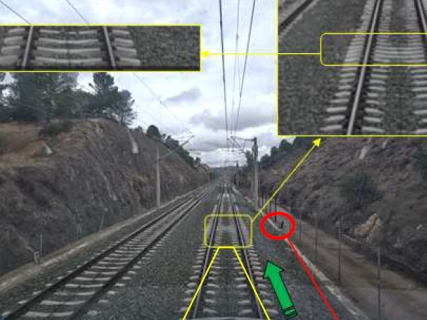

The Guardia Civil has informed the judge of the Civil and Instruction Section of the Court of Instance of Montoro (Córdoba), Plaza number 2, responsible for investigating the rail accident in Adamuz, in which on Sunday January 18, 46 people died and more than 150 were injured, that the ballast and the sleepers installed at the point of the incident date back to the year 1990.
So it is stated in the report of the Judicial Police Organizational Unit (UOPJ) of the Guardia Civil, dated November 23 and relating to the progress of the investigations, which Europa Press has had access to.
In that document, it is detailed that, between kilometers 316 and 320, on track 1, there were 37 meters of recycled ballast from 2023, 332 meters of new ballast from 2025, and 3,631 meters of original ballast from 1990, specifying that "at the specific point of the derailment and its nearest surroundings, the ballast dated from the year 1990".
The officers emphasize that "it remains to be determined in the report of the court-appointed experts whether the age of the ballast had any kind of impact on the breaking of the track".
With regard to the sleepers in that same section, the report indicates that, on track 1, there were 62 meters recycled from 2023, 554 meters new from 2025, and 3,384 meters of original sleepers from 1990, adding that "at the specific point of the derailment and its nearest surroundings, the sleepers dated from the year 1990".
As for the rails, it is recorded that on that segment of track 1, there were 37 meters from 2023 (Arcelor), 530 meters new from 2025 (Arcelor), and 3,433 meters from 1990 (Ensidesa), recalling that "at the specific point of the derailment, a section of 256 meters from 2025 was joined to another section of 1,319 meters from 1990, with its corresponding welding".
When asked about the possible impact of the age of the materials on safety, the court-appointed experts state that "the age of any material always contributes to the deterioration of its performance, for example geometry or resistance". For this reason, they add, "wear or aging indicators and maintenance plans are established".
In order to verify whether Adif has taken into account, in its maintenance standards, the age of the components of the high-speed track, the volume of rail traffic it supports, and the increase in circulations following the entry of new operators, the Guardia Civil has requested from Adif the specific maintenance plan for sleepers, ballast, and rails.
Irregularities in welds and ultrasound checks
Regarding the rail joints, the report of the Armed Institute indicates that, according to Adif regulations, "to the joint of used coupons with new ones, R260 force welding should be applied, so an incorrect force kit would have been placed."
However, this circumstance is qualified by Adif through "an error correction that it signs with the date 29 January 2026 -- eleven days after the incident -- in an errata slip that a welding inspector from Ayesa signs." In that document it is clarified that "a welder error occurred in which the kits corresponding to welds 5 and 6 were recorded in position 3 and 4 and vice versa."
The document also records that, although an inspector from the UTE intervened in the aluminothermic welds carried out in the renewal of points in the Adamuz area, performing tests using ultrasonics, "as stated in the inspection reports provided, he did not have the certification in accordance with the standard."
With regard to soundings, it has been found that of the ultrasound tests on the welds "no records of any type were kept, beyond the reports submitted at their conclusion, in which all the welds were declared suitable." For this reason, "it was not possible to carry out a second analysis of the data from the ultrasonic sounding carried out on the weld of kilometer 318,681 on track 1, outer strand, which fractured."
The Benemérita adds that, regarding the ultrasound sounding carried out by technicians of the UTE, "since there are no records of the measurements, only 'to rely' on the training, judgment, and experience of the technicians who carried out the test is possible," according to Redalsa, when asked about this matter.
In addition, a visual and geometric inspection was carried out by technicians from Ayesa, although "no documentary supervision was exercised over the kits installed by the welding technicians", and they point out that "it was not until after the accident that the data relating to the welding kits were requested, when Ayesa corrected the original report with the clarifying note".
The report insists that "it cannot be documented that ultrasonic testing was carried out, since there is no record in Adif indicating either the access to the track by the technicians or the work on the track section where the welds to be inspected were located".
However, it does appear in Redalsa’s work reports, in the statements of the two technicians who affirmed that they carried it out, and in the statement of a technician from the UTE who accompanied them during the inspection.
In the event that the ultrasonic test had been carried out, it is emphasized that "one of the technicians did not meet the requirements demanded by the regulations; he did not have accredited the required level", and that "the regulations of Adif relating to access to the track and performance of work would not have been complied with".
Defects in the rail, voltage drop, and detection system
The report also notes that, at the kilometer point of the incident, "there was also a geometry defect, as can be seen in the result of the geometric inspection dated 13 October 2025". It adds that "given that the last inspection carried out is from 21 November 2025 and that no further one was carried out afterwards, it is not possible to determine, in documentary terms, the condition in which this rail was found on the date of the accident", concluding that "the presence of these defects precisely at that kilometer could have had a direct impact on the rail break".
Likewise, a voltage drop on the track is highlighted, "as was recorded in the system on 17 January, which lasted until the moment of the accident on 18 January". It is indicated that "that sustained variation in voltage over time is not usual, after the study of the series provided", and it is detailed that, from the first voltage drop on track 1 until the incident, 47 trains traveled through that section.
Finally, the company Thales, in response to a request for technical information made in late September, specified that “for the system to detect rail breakage it is necessary to modify all the electrical infrastructure of the line and reconfigure the catenary current returns, change the concept of earthing of the rails, modify the connections of the catenary poles, and increase the number of track circuits per canton along the entire High-Speed Line Madrid–Seville.”