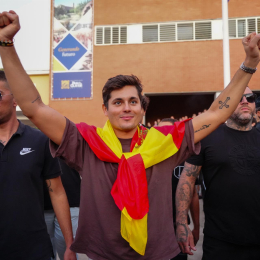
Vito Quiles, sought and captured after months of controversies, complaints, and unfulfilled summons

The activist assures that the measure responds to a campaign of complaints driven by the Government's circle, while different reports indicate that the order would be related to open judicial proceedings and unheeded summons.

1 minute

fotonoticia 20260528142211 1920

fotonoticia 20260528142211 1920

Add DEMÓCRATA to Google

Ask FREN

Published

1 minute

Most read

The EDA TV collaborator has publicly denounced the existence of a court order for his arrest, a circumstance he has attributed to a supposed offensive promoted by people linked to the Government's circle. The news denunciation has been disseminated by Quiles himself through his social networks, where he has assured that the judicial action is part of a strategy to silence voices critical of the Executive:

The National Police cannot locate Vito Quiles

The controversy erupted after several media outlets reported that agents of the National Police went to the premises of the channel where the communicator works to execute an arrest warrant, without managing to locate him at that time. 

In his version of events, Quiles maintains that the judicial decision comes after months of complaints filed by people close to the political circle of Pedro Sánchez and after several media episodes starring his encounters with figures close to the Government. The activist considers that there is a partisan use of judicial mechanisms against those who carry out political oversight work.

The situation adds a new chapter to the long chain of confrontations between Quiles and various institutions. In recent months, the communicator has been involved in several conflicts related to his reporting activity in the Congress of Deputies, where he has temporarily lost his accreditation after different incidents recorded in parliamentary headquarters.
 

More key points, information and questions with FREN

AI-GENERATED CONTENT

What is the current procedural status of the arrest warrant against Vito Quiles and what are the next judicial steps?

Currently, the arrest warrant against Vito Quiles is in the phase of active search and capture, issued by the investigating court after several failed attempts to summon and locate him. The Police and other security forces have the order to arrest him and immediately bring him before the court as soon as he is found. This situation is framed in a context of multiple open cases against him and public accusations by Quiles himself of being a victim of a “mass complaint campaign.” The next steps essentially involve his arrest, appearance before the investigating judge, and the possible adoption of precautionary measures depending on the risk of flight and recidivism.

Current procedural status: search and capture order

According to various judicial reports, Vito Quiles is in a situation of search and capture ordered by the court investigating several proceedings against him. The measure was adopted after it was confirmed that he has repeatedly evaded judicial summonses and requirements in cases related to alleged disobedience, incidents in parliamentary headquarters, and confrontations with people close to the Government, which leads the court to consider that he is not cooperating with the Administration of Justice (Diariosocialista report).

A failed attempt to notify and locate him at his home has been reported, which reinforced the perception of his elusive whereabouts and justified the activation of the arrest warrant (La Razón). At the same time, it is noted that Quiles has five open cases, although neither he nor his defense have publicly specified to which of those cases the current arrest warrant is exactly linked (El Plural).

His circle is spreading that this is not an isolated “media conflict,” but a situation with significant criminal consequences, insisting that he faces a possible prison sentence if the proceedings advance (Spanish Revolution, on Facebook), (JotaPov Noticias, on Facebook).

Difference with the 2024 order in Seville

It is relevant to distinguish the current 2026 situation from a precedent in 2024 in Seville. Then, a judge initially issued a resolution mentioning an “arrest warrant” against Quiles, but later rectified, clarifying that it was a search for whereabouts to summon him for alleged crimes of slander and libel, and that the reference to the arrest was an “error” (laSexta), (El Enclave).

That 2024 clarification is not repeated now: reports agree that in 2026 we are already talking about an effective search and capture order, with an express mandate for arrest and judicial presentation (Diariosocialista), (La Razón).

Public position of Vito Quiles and his defense

Quiles claims on his social networks that he is the target of a “mass complaint campaign” related to his heated encounter with Begoña Gómez, wife of the Prime Minister, and accuses the Government of using the judiciary to “persecute its rivals” (El Plural), (video on Instagram). He has also announced legal actions against Gómez for “false testimony and assault,” which would open a parallel judicial front, although there is no record yet of a substantive ruling on this point in the sources consulted.

His lawyer has described the police and judicial action as a “nonsense” and insisted that the situation could have been resolved through ordinary communication channels, although he will have to justify before the court the repeated absences of the investigated party in the various open cases (Diariosocialista).

Expected next judicial steps

According to the available information, the next moves are structured in several phases:

First, the device for his location and arrest by the Civil Guard, National Police, and other forces is maintained, with the objective of taking him directly to the investigating court (La Razón). As long as the absence persists, various sources emphasize that his procedural situation may worsen, because repeated disobedience and procedural rebellion are considered against the investigated party when agreeing on future precautionary measures (Diariosocialista), (El Plural).

Once arrested, Quiles would be brought before the judge, who must formalize the charges in the specific case motivating the order and hear both the Prosecutor's Office and the defense. At that time, possible precautionary measures would be considered (from release on charges to provisional imprisonment) depending on the risk of flight, destruction of evidence, and recidivism, usual parameters in Spanish criminal practice explicitly mentioned in recent procedures followed by the courts, such as the so-called “Koldo case” against Santos Cerdán (Demócrata analysis), (Supreme Court ruling keys).

Up to today, July 1, 2026, there is no record in the sources consulted that Quiles has already been arrested or that this appearance has taken place, so the procedure is in that critical phase of search and capture prior to any substantive decision.

What are the legal powers of the Prime Minister regarding the actions of the National Police and judicial orders?

The issue you raise – the legal powers of the Prime Minister over the actions of the National Police and judicial orders – is strictly legal-constitutional and would require detailing specific norms (Constitution, organic laws of security forces and bodies, procedural laws, etc.). However, with the information available in the sources I currently handle, I do not have that level of normative detail to explain precisely and rigorously article by article what the Prime Minister can or cannot do in those areas. To avoid providing incomplete or inaccurate data, I cannot technically describe the specific powers nor cite specific norms. What I can do, however, is explain what kind of political and regulatory issues related to this topic I can reliably address and how I could help if we had a more concrete reference (a law, a case, a parliamentary debate, etc.).

Areas where I can help you reliably

As an assistant specialized in politics and regulatory current affairs in Spain, I am mainly oriented to:

First, tracking normative and parliamentary developments. For example, if there were a reform of the Law on State Security Forces and Bodies, the Government Law, or norms affecting the relationship between the executive power, the National Police, and the judiciary, I could:

– Explain the political and regulatory content of the reform based on official documents (explanatory statements, articles modified, etc.).
– Indicate in which phase of the legislative procedure it is (public consultation, draft before the Council of Ministers, bill in Congress, votes, publication in the BOE, etc.).
– Summarize the positions of the parties for or against as expressed in parliamentary debates and votes.

Secondly, explain the political dimension and parliamentary oversight of these issues. That is:

– How questions to the Government about actions of the National Police or compliance with judicial resolutions are formulated in Congress.
– What kind of motions, non-legislative proposals, or investigative commissions can be raised when discussing whether the Government has respected or not the judges’ decisions or the limits of its powers in security matters.
– How the separation of powers and the Government’s submission to the law and judicial control are politically debated, based on official interventions by the groups.

What I cannot do with the current sources

What I cannot do, with the sources currently available, is a comprehensive legal-technical reconstruction of the Prime Minister’s powers in the abstract, such as:

– Precisely enumerate what he can directly order the National Police to do and what must be channeled through the Ministry of the Interior, indicating specific articles.
– Detail, with specific normative basis, how his role is articulated in states of alarm, exception, or siege, nor what operational instruction margin he has in those scenarios.
– Break down the legal regime of compliance with judicial orders by the Government, nor the formal relations between the Prime Minister, the Ministry of Justice, the General Council of the Judiciary, and the jurisdictional bodies.
– Affirm that the Prime Minister can or cannot perform a specific act (for example, “order to annul” a judicial resolution) without citing legal texts and jurisprudence that I currently do not have in the consulted sources.

Offering that kind of detail without clear backing in documents accessible from the tools I use would pose a high risk of inaccuracy, and by design I must avoid any information that I cannot support with explicit sources.

How we can narrow the query to be useful

If you are interested in this topic from the political and institutional perspective, I can help you to:

– Analyze concrete current cases in which it has been questioned whether the Government has pressured the National Police or disregarded a judicial mandate, provided there are news, parliamentary debates, or recent public documents about it.
– Explain how different parties interpret and politically use the argument of separation of powers and respect for judges when criticizing the Prime Minister’s actions.
– Contextualize the parliamentary debates that occur (or have occurred) about legal reforms affecting the relationship between Police, Government, and judiciary.

If you can specify your question towards a norm (for example, a specific law you want to discuss), a parliamentary initiative, or a specific political case, I will be able to give you a much more precise answer within my specialization in Spanish politics and current affairs.

What requirements must be met for the Congress of Deputies to withdraw or reinstate a journalist's press accreditation?

The withdrawal or reinstatement of a press accreditation in the Congress is not a discretionary decision without rules: it is regulated by Article 98 of the Congress Rules and by an internal regulation approved by the Board that classifies minor, serious, and very serious infractions and sets sanctions ranging from warnings to definitive revocation of the credential. The competent body is always the Board of the Congress, which acts after a sanctioning procedure conducted according to the principles of sanctioning law and with a prior report from the new Parliamentary Communication Advisory Council. Withdrawal is usually based on behaviors such as unauthorized recordings, access to restricted areas, interruption of press conferences, or conduct that seriously harms the Chamber’s activity; reinstatement, on the other hand, occurs upon expiration of the suspension period or through a new request once the disqualification period has expired. All this must respect the right to truthful information and the proper functioning of the Chamber, in accordance with the framework of the Congress Rules and its internal development.

Regulatory framework and competent body

The starting point is Article 98 of the Congress Rules, which entrusts the Board with regulating the procedure for granting and renewing credentials of media representatives, setting requirements “considering the right to truthful information and the proper functioning of the Chamber” and taking into account previous violations of the article itself and the Board’s guidelines for renewal (Congress Rules, specific development in consolidated text). On this basis, an internal regulation was approved that specifies infractions and sanctions and creates the Parliamentary Communication Advisory Council, as detailed by several parliamentary reports from El Demócrata and elDiario.es.

Therefore:
– The Board of the Congress decides to grant, suspend, withdraw, and, if applicable, allow the recovery of press credentials.
– The Parliamentary Communication Advisory Council issues a report in sanctioning procedures but does not decide; its operating rules are also set by the Board, according to what is provided in Article 98 itself, developed in the Chamber’s internal agreements (development agreement of art. 98).

Causes for withdrawing or suspending accreditation

Classified infractions

The internal regulation distinguishes between minor, serious, and very serious infractions, following the scheme reported by, among others, El Demócrata and elDiario.es:

Minor: omitting information required in the credential application or accessing common-use areas outside those designated for the press without authorization. Sanctioned with a warning and, if applicable, suspension of the credential for up to 10 working days.
Serious: among others, including false information in the application; recording images or audio without authorization or outside authorized spaces; accessing offices or meeting areas without permission; interrupting press conferences; disobeying instructions from Chamber staff; publishing images obtained against regulations. Sanctioned with suspension of the credential from 10 days to 3 months.
Very serious: serious disrespect or insults and slanders; recordings with hidden devices or in offices and areas reserved for groups; unauthorized recordings that violate privacy or contain personal data; and repeat offenses of serious infractions. Sanctioned with suspension of the credential from 3 months to 5 years or even definitive revocation.

Additionally, if an infraction is manifested in an unsigned publication, the regulation provides that all credentials linked to the media may be suspended between six months and three years, as developed in the information from El Demócrata.

Procedure, guarantees, and appeals

The sanctioning procedure “shall be governed by what is established by the Chamber’s Board” and must comply with the principles of sanctioning law (legality, presumption of innocence, hearing, proportionality), according to the internal regulation itself and parliamentary reports from El Demócrata. The ordinary scheme is:

1) Initiation: following an incident or complaint (for example, from the Parliamentary Journalists Association, parliamentary groups, or Chamber services), the Board opens a file, often after a report from the Communication Directorate or the General Secretariat, as seen in the cases of “ultra agitators” described by El Demócrata and elDiario.es.
2) Investigation and hearing: the Board appoints an investigating person. The affected journalist must be notified, know the alleged facts, and have a period for allegations; the Parliamentary Communication Advisory Council has 15 days to issue a report.
3) Resolution: the Board decides the sanction with reasons (warning, suspension for a specific period, or definitive withdrawal), adjusting the response to the severity of the conduct.
4) Appeal: the Rules do not create a specific internal appeal, but the Board’s decisions are appealable before the competent jurisdiction, according to the general framework of control of acts of constitutional bodies.

Reinstatement of accreditation

There is no autonomous figure of “reinstatement” different from the sanctioning logic itself. In practice:

– If the sanction is a temporary suspension, the credential is reactivated when the period set in the Board’s agreement expires, unless otherwise provided.
– If a long-term withdrawal or suspension of all credentials of a media outlet has been agreed, once the period ends the journalist or the media can submit a new accreditation request; the Board will assess whether the causes that motivated the sanction have ceased, taking into account the history of infractions, as allowed by Article 98.
– If the Board, after allegations or a possible judicial appeal, revokes its decision, the accreditation is reinstated before the expiration of the period.

In parallel to this internal regime, the Congress maintains a system of occasional accreditations managed by its Press Department (press section), while other institutions such as the Government (Moncloa) or the Senate (Senate) have their own systems, although the specific sanctioning logic described here is unique to the Congress of Deputies.

For a broader context on the political and professional debate that led to this regulation, analyses from El Demócrata, El Demócrata (analysis), RTVE, Cuadernos de Periodistas, as well as the processing documents available in the BOCG and Board agreements accessible from the Congress initiative search engine (search engine, publications) can be consulted.

Play

Test your knowledge with FREN!

How much do you know about this topic? Answer the following 3 questions.

What did Vito Quiles declare about the origin of the court order for his arrest?

Question 1 of 3

Where did the National Police try to locate Vito Quiles to execute the arrest warrant?

Question 2 of 3

What consequence did Vito Quiles face due to his involvement in several incidents in the Congress of Deputies?

Question 3 of 3

Hola, soy Fren. ¿Cómo te ayudo?