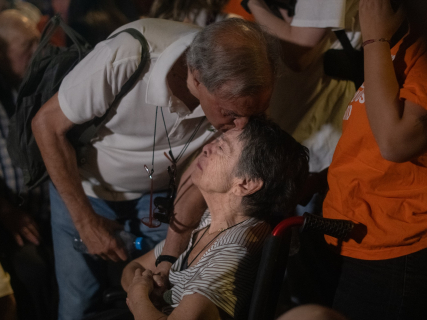
Demonstration for Maricarmen today in Madrid: time, route, and departure from the Puerta del Sol

The protest on Saturday, September 26, will start at 18:30 and will march through the center to the Congress. The Tenants' Union demands measures to prevent new evictions without housing alternatives.

2 minutes

desahucio mari carmen

desahucio mari carmen

Add DEMÓCRATA to Google

Ask FREN

Published

Last updated

2 minutes

Most read

The demonstration for Maricarmen in Madrid is called for this Saturday, September 26, at 18:30 at the Puerta del Sol. The mobilization, organized by the Tenants' Union, will be held under the slogan "Not one more Maricarmen" and will conclude around the Congress of Deputies.

The call comes three days after the eviction of the 87-year-old woman from the Retiro home where she had lived for more than seven decades. Maricarmen herself has encouraged participation in the protest through a message disseminated after the eviction.

What time it starts and where it departs from

The announced meeting point is the Puerta del Sol and the start time is 18:30.

This is the call for Saturday afternoon. It should not be confused with other demonstrations planned for the morning in Madrid, which have their own schedules and routes.

There is also no confirmed end time in the consulted call: it will depend on the development of the march.

What is the announced route

From Sol, the demonstration will continue along Alcalá street to Cibeles. It will then advance along the Paseo del Prado towards Neptuno and the area of the Plaza de las Cortes, to finish in front of the Congress, according to the route published by El País.

The itinerary connects three institutional headquarters: the Community of Madrid, in Sol; the City Hall, in Cibeles, and the Congress. The mobilization thus presents its demands to different levels of public responsibility.

What the mobilization demands

The Tenants' Union links the protest to Maricarmen's case, but raises a broader claim about access to and permanence in housing.

The call demands accountability for what happened and measures to prevent similar situations. The slogan uses the name of the Retiro neighbor as a reference for other homes facing the loss of their residence.

In her message on Friday, Maricarmen thanked for the support received and asked that other people continue to defend their homes. Her intervention kept open the collective dimension of a case that had acquired wide public repercussion.

What to check before traveling

The announced route may undergo operational adjustments. Before attending, it is advisable to review the mobility and transport notices corresponding to Saturday afternoon, avoiding using as a reference cuts planned for other marches.

The call detailed here is that of Madrid. The protests held in other cities during the previous days should not be automatically presented as mobilizations called for this September 26 as well.

More key points, information and questions with FREN

AI-GENERATED CONTENT

What legal or parliamentary procedures are necessary to approve new protection measures against evictions in Spain?

In Spain, new protection measures against evictions (suspension of evictions, additional guarantees for vulnerable households, extraordinary contract extensions, etc.) can be approved through different legal channels. Each requires specific procedures and majorities, and is conditioned by the distribution of powers between the State and autonomous communities.

1. Approval through law (ordinary or organic)

The most stable way to strengthen anti-eviction protection is the approval or reform of a law by the Cortes Generales, as has been done with the Law 12/2023, on the right to housing or the Law 1/2013, on the protection of mortgage debtors.

  • Initiative: the Government presents a bill, or a parliamentary group, an autonomous community, or a popular legislative initiative registers a proposed law.
  • Qualification and consideration: the Board of the Chamber admits the proposal for processing and the Plenary decides whether to "take into consideration" the proposal or hold a total debate on the bill.
  • Committee work: the competent committee (for example, Housing) processes amendments to the articles, may create a technical subcommittee, and approves a report.
  • Congress Plenary: debate on the report and live amendments, and voting article by article or in blocks. For ordinary laws, a simple majority suffices; organic laws (if they affect the core of fundamental rights) require an absolute majority in the final overall vote.
  • Senate: the Upper Chamber can approve, veto, or amend the text. The Congress can override the veto by absolute or simple majority, depending on the deadlines, and decides ultimately on the amendments.
  • Sanction, promulgation, and publication: the King sanctions the law, the Government promulgates it, and it is published in the BOE. From that moment, for example, the Civil Procedure Law or the Urban Leases Law are modified to change deadlines, requirements, or cases of eviction suspension.

In practice, many recent anti-eviction reforms (strengthening procedural guarantees, requiring prior communications to social services, introducing admissibility requirements for eviction claims by large holders) have been processed this way or through accompanying laws, such as the 2023 Housing Law.

2. Urgent measures via royal decree-law

Many of the moratoriums and suspensions of evictions have been approved by royal decree-laws of the Government (for example, royal decree-laws 11/2020, 37/2020, 8/2021, or 1/2024, which extends the suspension of evictions for vulnerable households). The procedure is different:

  • Approval in the Council of Ministers of a royal decree-law, citing "extraordinary and urgent necessity" (art. 86 CE). It comes into force upon publication in the BOE.
  • Validation in the Congress: within a maximum of 30 days, the Plenary must vote whether to validate or repeal it. A simple majority suffices. If rejected, the norm lapses, which is rare but possible.
  • Possible processing as a bill: the Congress may simultaneously agree that the decree-law be processed as a bill under the urgent procedure, opening a cycle of amendments to refine the protection regime (suspension deadlines, definition of vulnerability, compensations to owners, etc.).

These decree-laws cannot regulate matters reserved for organic law nor exceed state competences over autonomous ones, and are subject to Constitutional Court control, which has annulled or qualified autonomous and state norms when they invade state procedural legislation or excessively define the essential content of property rights.

3. Regulatory development (royal decrees and orders)

Once the legal framework is set, many operational measures are specified by regulatory norms of the central Government or competent ministries:

  • Royal decrees that develop laws (for example, Royal Decree 401/2021 on compensations to owners affected by eviction suspensions).
  • Ministerial orders that regulate rental aid programs, temporary financing aids, or access criteria for vulnerable tenants, linked to anti-eviction decree-laws.

These regulations are approved by the Council of Ministers (royal decrees) or by the ministry, after internal processing (reports, sometimes public consultation) and publication in the BOE. They cannot create new limitations on rights beyond what the law allows, but can specify procedures, forms, access requirements for aids, and compensation mechanisms.

4. Role of autonomous communities and municipalities

Protection against evictions also rests on territorial competences:

  • The State regulates civil and procedural legislation (eviction procedures, eviction, mortgage enforcement) and the basic conditions of equality in the right to housing.
  • Autonomous communities have competences in housing, urban planning, and social services, with their own housing laws, public housing stock, rental aids, rehousing plans, and mortgage mediation. Some autonomous norms directly affecting eviction processes have been reviewed by the Constitutional Court when invading state procedural legislation.
  • Municipalities intervene through social services, emergency housing allocation, registration, and, in some cases, participation in mediation networks or anti-eviction protocols.

In practice, for a vulnerable family to benefit from the suspension of an eviction, two levels usually concur: the state norm (law or decree-law) that provides for the suspension or conditions the procedure, and the action of autonomous or municipal social services, which certify vulnerability and, if applicable, offer housing alternatives.

In summary, approving new protection measures against evictions requires first deciding the instrument (law or decree-law, with their majorities and parliamentary phases), respecting the material limits (fundamental rights, distribution of competences, and constitutional control), and then articulating the regulatory and territorial deployment that makes guarantees effective on the ground.

Could you explain in more detail how an anti-eviction royal decree-law is processed in practice from its approval by the Council of Ministers until its validation in the Congress? What exact leeway do autonomous communities have to approve their own housing laws that include anti-eviction measures without invading state competences? What have the main eviction moratoriums approved since 2012 consisted of, and how have their requirements and beneficiaries changed?

What are the competencies of the Congress of Deputies regarding housing and social protection?

The Congress of Deputies does not have its own "material competences" in housing or social protection like a ministry or an autonomous community, but it plays a central role because it is the legislative and political control chamber of the State. Everything the State does in these areas (basic laws, budgets, major plans, and state benefits) passes, one way or another, through the Congress.

a) Legislative and control competences at the state level

In housing and social protection matters, the Congress mainly exercises its general competences of:

  • Legislative function: processes and approves laws affecting housing and social protection. It does so through:
    • Bills sent by the Government (for example, housing laws, urban leases, dependency, social services, etc.).
    • Proposed laws presented by parliamentary groups, deputies, Senate, autonomous assemblies, or popular legislative initiative. If approved, they have the same rank as bills.
  • Political impetus function: through instruments that do not create rights directly but guide Government action:
    • Non-legislative motions (PNL) in Plenary or committee, urging the Government to adopt measures (for example, expand rental aids, strengthen social housing stock, or improve certain social benefits).
    • Motions and resolutions that set political positions on the orientation of housing and social protection policies.
  • Government control function: the Congress controls the Executive's actions in these policies through:
    • Oral questions in Plenary and committees to the competent ministers (housing, social rights, inclusion, etc.).
    • Written questions, where deputies request detailed information on programs, budget execution, territorial distribution criteria, etc.
    • Appearances of ministers and senior officials before committees to explain plans, results, or regulatory changes.
    • Interpellations and motions of censure or confidence, in cases of serious conflict over social or housing policy orientation.

In summary, the Congress decides the state normative framework and politically oversees how the Government designs and executes those policies.

b) Relationship with autonomous and local competences

Housing and social services are largely competences assumed by autonomous communities, and municipalities manage a very relevant part (local public housing, proximity social services, primary social care, etc.). The Congress acts on this distribution of competences in three main ways:

  • Approving basic state legislation that sets common principles and limits for all autonomous communities (for example, framework rules on urban leases, basic equality conditions in access to benefits, general criteria for coordination of social services).
  • Reforming organic or basic laws when modifying the scope of autonomous competences or the State–CCAA coordination regime in housing and social protection.
  • Supervising territorial action through questions, appearances, and information requests examining how the Government cooperates with communities and municipalities, how funds are territorialized, and how autonomous competences are respected.

Therefore, the Congress does not directly manage housing or social services, but determines the legal and political framework in which autonomous communities and local entities operate, and oversees how the Government articulates that multilevel cooperation.

c) Budgetary capacity and public policy orientation

A key area is the budgetary competence. The Congress:

  • Debates and approves the General State Budget Law, which sets:
    • Credits for state housing plans (rental aids, rehabilitation, public stock, etc.).
    • State economic benefits linked to social protection (for example, supplements, inclusion programs, state emergency aids, etc.).
    • Funds transferred to autonomous communities and local corporations conditioned to housing and social services policies.
  • Can introduce budget amendments that increase, reduce, or redirect housing and social protection items, within constitutional and budgetary stability limits.
  • Controls budget execution through questions and appearances about program execution degree, aid granting criteria, and evaluation of results.

Additionally, through resolutions, PNLs, and committee agreements, the Congress sets political orientation lines on which housing policy model (more focused on rental, rehabilitation, social housing, etc.) and social protection (for example, strengthening minimum incomes, family support, fighting exclusion) the Government should prioritize.

Overall, the Congress of Deputies is the state decision core on the normative framework, budget, and political orientation of housing and social protection, in permanent interaction with the executive competences of Government, autonomous communities, and local entities.

Could you explain with concrete examples how the Congress has recently influenced housing policy? What control instruments can a deputy use to oversee the Government's spending on social protection? How are the Congress's decisions coordinated with the competences of autonomous communities in social services?

What legal requirements currently exist to proceed with the eviction of an elderly person in Spain?

In Spain, there is currently no general prohibition on evicting an elderly person solely for being over 65 years old. What does exist is a set of procedural requirements and reinforced guarantees in evictions of habitual residence, with special protection when the affected person is in a vulnerable situation, a category in which many elderly people usually fit.

1. Basic legal framework
  • Civil Procedure Law (LEC, Law 1/2000): regulates the eviction procedure (summary eviction trial), execution, and eviction. Key articles include 250, 437, 440, 441, 549, and 703.
  • Urban Leases Law (LAU, Law 29/1994): sets the causes for contract termination (non-payment, expiration of term, breaches, etc.) and thus when the landlord can proceed with eviction.
  • Law 12/2023, on the right to housing (text in BOE): introduces important modifications to the LEC to reinforce guarantees in evictions of habitual residence in vulnerable situations and, particularly, when the claimant is a large holder.
  • Additionally, several royal decree-laws issued since 2020 have established and extended extraordinary protection measures against evictions of vulnerable persons. Many of these measures were linked to the pandemic and specific situations, and have been adjusted or absorbed by Law 12/2023.
2. Causes and eviction procedure

To evict an elderly tenant of habitual residence, the same legal causes as for any tenant must concur:

  • Non-payment of rent or similar amounts (water, electricity, property tax passed on, etc.).
  • Expiration of the legal or agreed lease term without renewal.
  • Other serious breaches of the contract provided in the LAU.

These causes are exercised through a summary eviction trial (art. 250 LEC), with a claim that may include rent claims (arts. 437 and 438 LEC). The LEC provides for:

  • Payment demand and summons to hearing (art. 440 LEC), warning that if the defendant does not appear, eviction may be declared without further proceedings.
  • Possibility to stop the eviction by paying all owed in the first procedure, with nuances (art. 22.4 LEC).
  • Judgment or decree that, if the claim is upheld, sets the exact eviction date and orders payment of rents until possession is delivered (arts. 549 and 703 LEC).
3. Reinforced protection in vulnerability situations

Law 12/2023 has significantly reinforced the guarantees in habitual residence evictions:

  • The system of communication to Administrations and social services is expanded and improved when possible vulnerability is detected in an eviction procedure (modifications to the LEC through the fifth final provision of Law 12/2023).
  • Formal obstacles are removed, such as the requirement of express consent of the affected person for the judicial body to forward their situation to social services.
  • If social services find economic or social vulnerability, the judge may order the suspension of eviction for up to:
    • 2 months when the claimant is a natural person.
    • 4 months when the claimant is a legal entity.
    These deadlines improve the previous ones (1 and 3 months).
  • It is not an automatic halt: the court must make a weighted and proportional assessment of the specific case, considering the social report.

The law does not set an age threshold (65 years) as an automatic criterion, but it is common that elderly people, especially with low incomes, are classified as vulnerable households, which activates these additional guarantees.

4. Additional requirements when the claimant is a large holder

Law 12/2023 focuses particularly on evictions promoted by large housing holders (a criterion defined by the law itself, usually based on a minimum number of properties owned).

  • Admissibility requirements for the claim are imposed when it concerns habitual residence and the occupant may be vulnerable, reinforcing the need to prove certain aspects (information, prior communications, etc.).
  • A prior conciliation or mediation procedure is introduced in cases of large holder + habitual residence + economic vulnerability, aimed at facilitating solutions of rehousing, social rent, or other measures before eviction.
5. Territorial differences and real practice

Alongside this state framework, several autonomous communities have approved their own housing and housing emergency norms, which may add more guarantees (mediation services, rehousing priorities, etc.). Also, in practice, social services usually give very high priority to elderly people, especially if they live alone, have dependency, or very low incomes.

In sum, it is legally possible to evict an elderly person, but:

  • There must be a clear legal cause (non-payment, contract end, or other provided cause).
  • The procedure must strictly respect the procedural guarantees of the LEC.
  • If the elderly person is in a vulnerable situation and the dwelling is their habitual residence, the communication mechanisms to social services, vulnerability reports, and possible eviction suspensions must be activated, especially against large holders.

Play

Test your knowledge with FREN!

How much do you know about this topic? Answer the following 3 questions.

What is the starting point and time of the demonstration for Maricarmen in Madrid?

Question 1 of 3

What is the slogan under which the demonstration organized by the Tenants' Union is held?

Question 2 of 3

Where does the demonstration end according to the announced route?

Question 3 of 3