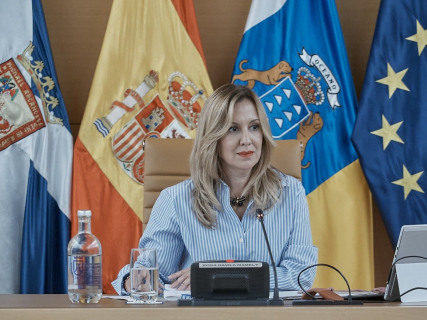

The president of the Cabildo of Tenerife, Rosa Dávila, has officially requested of the Government delegate in the Canary Islands the creation of a Permanent Security Board in light of the recent increase in the arrival of migrants to the islands, in order to strengthen coordination between all the administrations involved.
In the letter sent to the representative of the central Executive, and disseminated by the Cabildo in an information note, Dávila warns that there is a migration surge "with an intensity and dimensions unprecedented" and considers it "essential to immediately reinforce the coordination mechanisms between the different administrations".
The island president indicates that, from the local and island sphere, "the lack of sufficiently fluid and up-to-date information is being detected regarding the migration situation, the evolution of arrivals, the resources made available and the actions that are being carried out." This shortcoming "makes it difficult to plan services, the ability to respond, and the proper coordination of public resources".
Therefore, Rosa Dávila proposes the activation of a Permanent Security Board while the current increase in arrivals continues, as a "stable space for coordination, monitoring and information exchange" between the General State Administration, the Government of the Canary Islands, the island cabildos and town councils, with the participation of the Security Forces and Corps when appropriate.
Among the functions she proposes for this body, the president includes having updated data on the evolution of arrivals; having information on the reception, care, transfer and accommodation arrangements, as well as on the available resources and the needs detected; coordinating the actions of the different administrations, always respecting their competences; and anticipating possible scenarios and requirements to guarantee an orderly and effective response.
A shared space for institutional coordination
Dávila specifies that the initiative "is not about duplicating structures or interfering with the competences of any administration," but rather "about having a shared work space that allows us to address an extraordinary situation with the coordination, information and institutional responsibility that it requires".
Along the same lines, it emphasizes that the scale of the migratory phenomenon "requires that all administrations work with common information, coordinated criteria, and the ability to anticipate." In addition, it stresses that the island and local institutions "we need to know what is happening and what forecasts are being handled in order to be able to adequately meet our responsibilities."
For all the above, the president of the Cabildo calls for a meeting to be convened as soon as possible in order to establish this permanent coordination mechanism and to close the details of how it functions.
Finally, Dávila appeals to cooperation between institutions, which he considers "essential to face this challenge," and to the obligation that all administrations be "up to the circumstances."