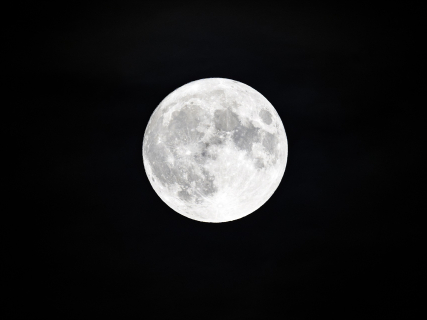

The beaver supermoon has left one of the most striking astronomical sights of the month of November. Earth’s natural satellite has risen over the sky of Rome (Italy) with an apparent size and brightness greater than usual, a phenomenon that could also be observed from other points on the planet, such as Dubai, New York and various Spanish cities.
According to the astronomical calendar of the National Geographic Institute (IGN), the full moon reached its maximum illumination phase last Tuesday, November 24, at 15:53 (Spanish peninsular time), although the phenomenon could also be appreciated during the following nights.
That of November is the first of a sequence of three consecutive supermoons that can be observed between the end of 2026 and the beginning of 2027. The next one will coincide with Christmas Eve and will be the largest full moon of the year.
What is a supermoon and why does it happen
The Moon’s orbit around Earth is not completely circular, but elliptical. This causes the distance between the two celestial bodies to vary throughout the month.
Supermoon is the name given to the phenomenon that occurs when the full moon phase coincides with the satellite’s proximity to perigee, the point in its orbit closest to Earth. By contrast, the point of maximum distance is called apogee.
According to what NASA explains, under these conditions the Moon can appear up to 14% larger and 30% brighter than a full moon located at the farthest point of its orbit.
The sense of size can be even greater when the satellite appears near the horizon. This is the so-called lunar illusion, an optical effect that makes us perceive the Moon as larger than it seems when it is high in the sky.
Why is it called the beaver moon
The name "beaver moon" comes from North American traditions used to identify the different full moons of the year depending on natural events and seasonal changes.
Its name refers to the time when beavers finish preparing their shelters and build up food reserves to face the arrival of winter. It is also historically associated with the season when these animals are hunted before the rivers and wetlands froze.
The full moon of November receives this name every year, regardless of whether it coincides with a supermoon or not.
When will the next supermoon be seen in Spain
It will be necessary to wait less than a month to enjoy this astronomical phenomenon again. The next supermoon will take place on Thursday 24 December 2026, coinciding with Christmas Eve, and it will reach its full phase at 02:28 hours, according to the calendar of the Instituto Geográfico Nacional.
Traditionally known as the "cold moon", it will be the full moon with the largest apparent size of all 2026. The next will arrive on 22 January 2027, completing a sequence of three consecutive supermoons.
There will be no need to use telescopes, binoculars, or other astronomical instruments to observe them. It will be enough to have a clear sky and, preferably, to look for a place with low light pollution and good visibility of the horizon.
Before the last supermoon of the year arrives, the December astronomical calendar will offer another standout appointment: the Gemínidas, one of the most intense meteor showers of the year.