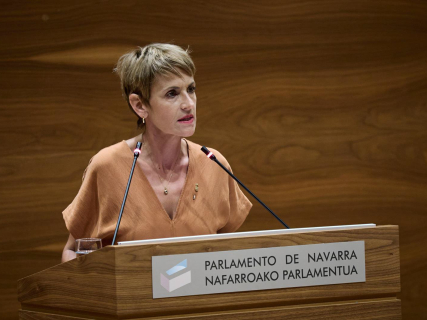

The Central Electoral Board (JEC) has rejected the appeal filed by Unión del Pueblo Navarro (UPN) against the decision of the Electoral Board of Navarre to not open a disciplinary file against the president of the regional government, María Chivite, for attending the ceremony to lay the first stone of the Bioma Center at the University of Navarre, held on 23 October of last year.
In the ruling, communicated this Thursday, the Central Electoral Board supports the criterion of the Electoral Board of Navarre and concludes that there are no indications of an infringement of the prohibitions set out in Articles 50,2 and 50,3 of the Organic Law of the General Electoral Regime (LOREG), as sources from the Navarre Executive have indicated.
The decision bases its pronouncement on different elements. On the one hand, it emphasizes the private nature of the event, promoted by the University of Navarre, with no involvement or financial contribution from the regional government. Likewise, it points out that the president did not give any institutional speech about the management of the Executive and did not make references to her actions or results.
The JEC also considers that it was not a public works or services inauguration, since the Bioma Center belongs to a private entity. Similarly, it believes that the note published on the institutional portal of the Government of Navarre was limited to informing about the president’s official schedule.
From the regional Executive, they have stated that "this ruling is not an isolated event; it is added to a sequence of UPN initiatives against the president and other members of the Government of Navarre that have been rejected by the electoral bodies". "In just under two weeks, UPN has seen its attempts to prevent María Chivite’s institutional trip to Peru and Argentina rejected, to open a disciplinary file against the vice president and minister Begoña Alfaro for presenting a housing survey and, now, to sanction the president herself for her participation in the Bioma Center event. In the case of the trip, the Electoral Board had to rule on two occasions to confirm that there were no grounds to prevent it," they have pointed out.
From the Executive they have stated that "the opposition has every right to scrutinize the Government's actions, but it also has the responsibility to act with rigor and seriousness". "It is not possible to turn every institutional activity into a complaint, every political disagreement into a supposed illegality, and every action by the Government into a battle before the electoral bodies", they have said.
Along the same lines, the Government has considered that "Navarra needs a demanding opposition, one that brings proposals and alternatives, not an opposition settled in permanent judicialization and in the search for headlines through complaints that subsequently do not find support in the competent bodies".
The Government has stressed that "the decision of the Central Electoral Board once again makes clear that María Chivite's actions at the Centro Bioma event complied with electoral regulations and that there were no grounds to open a disciplinary file".
The agreement is final in the administrative channel, although it is possible to file a contentious-administrative appeal with the Supreme Court within two months from its notification.