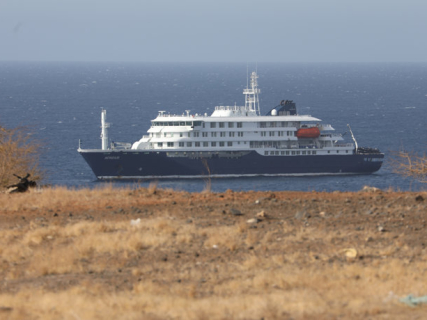

The future of the expedition cruise ship MV Hondius, affected by a hantavirus outbreak in waters near Cape Verde, remains uncertain as medical evacuations of infected passengers proceed. The Dutch government has confirmed it will host three affected individuals, transferred by medical flights from the area, while the rest of the passengers remain on board awaiting new health and logistical decisions.
In parallel, the company Oceanwide Expeditions, operator of the vessel, has insisted that its plan continues to be to head for the Canary Islands once the evacuations are completed, with a navigation horizon of about three days to Gran Canaria or Tenerife.
This very afternoon, a team of epidemiologists from the World Health Organization (WHO) was scheduled to conduct an assessment on board the ship anchored in Cape Verde, with the aim of determining the next steps to be taken. The mission seeks to ascertain the condition of the 147 people remaining on the cruise ship, including 14 Spaniards —five from Catalonia, three from Madrid, one from Galicia, and one from Valencia— who, in principle, are in good health.
Evacuations underway and international coordination
The transfer operations are being supported by medicalized aircraft, including a plane from the company Luxembourg Air Rescue, specialized in health repatriations. In total, the evacuation of two patients with symptoms and a third person, a close contact, is planned, in an operation coordinated from Praia airport, in Cape Verde.
Canaries dismiss ship's stopover
Faced with the shipping company's intention, Spanish authorities have shown their rejection of the cruise ship making a stop in the Canary Islands. The president of the regional government, Fernando Clavijo, was blunt in stating that, according to the latest information available, "it is absolutely ruled out" that the MV Hondius will call at the islands.
Clavijo has defended that the priority must be the immediate healthcare of those affected and the subsequent disinfection of the ship in its flag port, avoiding risks to the population.