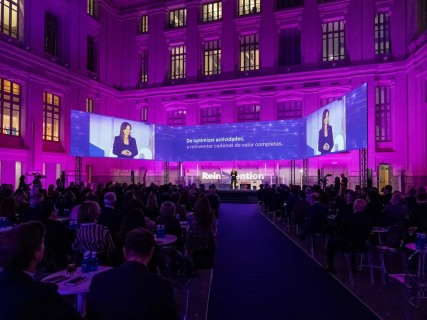

Accenture has brought together more than 300 CEOs and senior executives from the country’s leading companies and institutions at its annual event, the Accenture Reinvention Summit. In this edition, the central focus has been how organizations can reinvent themselves to grow, raise their productivity, and compete in a context of major disruption driven by Artificial Intelligence, with the challenge of translating their technological commitment into real business results.
According to the latest edition of Accenture’s "Pulse of Change," almost three out of every four Spanish executives (74%) expect to increase their investment in artificial intelligence over the next twelve months. However, only 5% is redesigning its end-to-end processes with AI as the key element.
The President and CEO of Accenture in Spain and Portugal, Mercedes Oblanca, has emphasized that the combination of geopolitical, economic, energy, technological, and social changes requires responses that go beyond mere incremental improvement. "Reinventing oneself does not mean changing everything. It means knowing what we must transform and on which strengths we must continue building," she said.
To move forward in that ability to reinvent, she argued for the need to move from optimizing isolated activities to transforming entire value chains and translating technological innovation into productivity, resilience, and profitable growth. In this sense, she identified five areas that must evolve in a coordinated way: value creation for customers, operating models and value chains, the technology architecture, the organization of work and human capabilities, and the conversion of productivity into innovation and business expansion. "Reinvention stops being a project when it becomes a permanent capability of the organization," she pointed out.
Accenture is applying these same principles to its own transformation, adjusting its strategy and operating model, deploying AI at scale, redefining work and talent management, and reinvesting productivity improvements into new opportunities for growth and value creation.
TECHNOLOGY AND COMPETITIVENESS
For its part, Accenture's CEO for Europe, the Middle East and Africa, Mauro Macchi, has defended that technological sovereignty is essential, but he has warned that it should not be achieved at the cost of losing competitiveness. "All companies have access to the same artificial intelligence models, so the difference lies in how they use them. Europe and Spain have a unique advantage: their sector experience, the quality of their industrial data, and their deep knowledge of products and production systems," he said.
To capitalize on that advantage, he insisted that CEOs must "commit to reinvention and not just to adopting AI" and integrate artificial intelligence into financial planning, so that each initiative has a budget, an objective and an expected impact on the profit and loss account, as well as prioritizing people as much as technology.
The institutional opening was handled by the Mayor of Madrid, José Luis Martínez-Almeida, who has set out the role of public-private collaboration in consolidating Madrid as a reference digital capital.
The event also included the participation of six executives from sectors such as tourism, energy, health, banking or fashion. Under the title "Capturing real value through reinvention," the CEO of Amadeus, Luis Maroto; the President of BP Spain, Olvido Moraleda; the CEO of Grifols, Nacho Abia; the CEO of Iberdrola Renovables, Julio Castro; the CEO of Kutxabank, Eduardo Ruiz de Gordejuela; and the President and CEO of Tendam, Jaume Miquel, have shared the challenges facing their industries, the decisions they are making to transform their companies, and the role that artificial intelligence and talent play in these processes.
The meeting concluded with the intervention of Zack Kass, the former head of "Go-to-Market" at OpenAI and global advisor in artificial intelligence, who analyzed how to take advantage of this technology to open up new opportunities and make the work more human and meaningful, as well as the decisions that leaders will have to make about what to automate and where to preserve human judgment and capabilities.