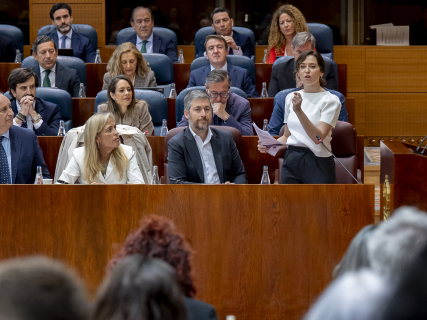


On her visit to Brussels and the European institutions and, in statements to Demócrata, the president of the Community of Madrid, Isabel Díaz Ayuso, has asked this Friday the European Commission's Commissioner for Agriculture and Food, Christophe Hansen, to strengthen border controls on imported agri-food products to protect the agricultural sector of the European Union (EU) countries.
Díaz Ayuso has framed this meeting within the need for "the Madrid countryside and the regions not to be left out of these decisions", underlining that the Commission representative has shown "his firm commitment to everything that has to do with the sector".
On this institutional trip, the head of the regional Executive has conveyed "the voice of the Madrid countryside" to European institutions, and has given examples such as Madrid oil - which already has a Designation of Origin from the European Union -, Chinchón fine garlic, Aranjuez strawberries, or Madrid honeys, "increasingly recognized," she added, in the meeting held in Brussels, where she also defended the interests of the Madrid agricultural sector, highlighting the inequality of opportunities suffered by Spanish agricultural professionals and their difficulties in survival or competitiveness.
Mercosur from May 1st
The agreement with Mercosur, which will come into force on May 1st, will mean the reciprocal and gradual elimination of more than 90% of tariffs between Europe and the countries of the Southern Common Market (MERCOSUR). However, sources from the Community of Madrid point out, this situation may leave Spanish agriculture at a disadvantage, if it is relegated with more bureaucracy, obstacles, and demands, so it is necessary to ensure that the products that enter have the same requirements as those of the EU.
Free trade opens a market of 700 million potential clients for Madrid professionals, and the elimination of tariffs results in a price drop for food for national consumption. But this opening also poses a challenge, because it facilitates the entry of products that compete with local ones, such as beef from countries like Brazil or Argentina, major powers in this sector.
Therefore, the Community of Madrid proposes that products arriving in the EU be subject to the same requirements and demands, in aspects such as health control, animal welfare, respect for the environment, traceability, or the use of pesticides.
Likewise, it warns of the need for constant monitoring of the possible impact of imports on the work of farmers and ranchers, recalling the importance of safeguarding the EU's food self-sufficiency.
Madrid's Measures
Anticipating this situation, the regional Executive has proposed a package of measures aimed at Madrid professionals and, aimed at favoring generational replacement that guarantees their profitability, such as the Primary Sector Dynamization Plan, endowed with 148 million euros for five years (2025/29.
In the same way, it has created the regional Agri-food Cluster, a common space in which the primary sector and the agri-food industry work together to boost economic activity and innovation.
Regarding the Common Agricultural Policy, Díaz Ayuso has demanded that for the 2028/34 period its funding be increased, avoiding cuts like those of the 2023/27 period in the European Agricultural Guarantee Fund (-3%) and the European Agricultural Fund for Rural Development (-6%).
Appropriate financing
In his opinion, it will be necessary to maintain both pillars and respect their uniqueness, without integrating these subsidies into an amalgam that includes funding of various kinds, as would happen with the new European Fund for Economic, Territorial and Social Cohesion, Agriculture and Rural Areas, Fisheries and the Sea, Prosperity and Security.
In short -defends Díaz Ayuso-, "the CAP must reorient its policies to place farmers and ranchers at the center and ensure food for citizens at reasonable prices. And, to do this -she adds- it is necessary to continue supporting the sector and promote a real simplification of the administrative burden and taxes, which hinder the survival of the self-employed and diminish the attractiveness of this profession for new generations".
Agriculture and livestock farming, in addition to the agri-food industry, have always been strategic sectors of the Community of Madrid. These represent 3.7% of the regional Gross Domestic Product, 12.5 billion euros, employing 200,000 people and with a potential market of 7 million consumers in Madrid.