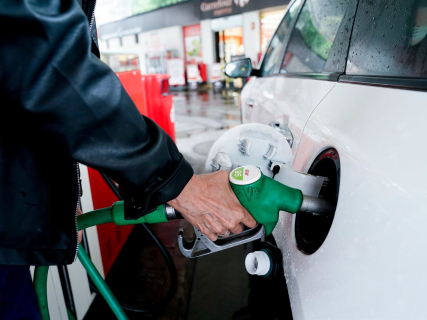

The price of gasoline has now chained seven consecutive weeks of declines and has a cut of 16.3% since the end of September, placing it at levels not seen since July.
According to the EU Oil Bulletin, collected by Europa Press, the average price per liter of gasoline has fallen 3.7% in the last seven days, standing at 1.624 euros.
This retreat, which puts the fuel at its lowest point since the penultimate week of July, consolidates the impact of the tax relief put in place by the Government, which has raised again the discount to "20 cents" from the "five cents" in force until October 1.
As for diesel, the average price per liter, which was already receiving a "20 cents" per liter aid since early September, has fallen 2.18% compared with the previous week, to 1.837 euros. This is its lowest level since the second week of September, after two straight weeks of declines.
The aid designed by the Executive for fuels within the third package of measures against the impact of the conflict in the Middle East — within the scope of the Hydrocarbons Tax — set a discount of "20 cents" per liter for gasoline and diesel starting in October, of "13 cents" in November and of "6 cents" in December, with an automatic safeguard clause if crude remains expensive.
This tax relief scheme will remain in effect until the end of the year, since the recent evolution of prices has made it possible to keep activated the automatic extension mechanism contemplated by the Government.
Despite the drop, filling up the tank is still soaring
With the references from this week’s EU Oil Bulletin, filling a typical 55-liter diesel tank costs 101.03 euros, that is, about 22.66 euros more than a year ago, when the amount was around 78.37 euros.
In the case of gasoline vehicles, refueling a standard 55-liter tank now involves an approximate expense of 89.32 euros, which means paying 8.09 euros more than twelve months ago, when the cost was 81.23 euros.
The increase recorded, especially during the summer months and after the outbreak of the conflict in Iran, led both fuels to move closer to the summer highs of 2022. In July of that year, gasoline reached 2.141 euros and diesel 2.1 euros per liter.
However, since the end of September a clear downward correction has been observed. Gasoline has become cheaper by already more than 16% over this period, while diesel accumulates a decline of more than 7%.
The final price of fuels is determined by various elements: its specific quotation—independent of that of oil—, the evolution of the crude barrel, the tax burden, the cost of raw materials and logistics, as well as the gross margins of the companies.
In addition, movements in the oil quotation are not reflected immediately at the pump, but are passed on with a certain time lag.
Spain maintains prices below the European average
With current values, the liter of 95 unleaded gasoline in Spain continues to be below the average of the European Union, set at 1,829 euros, and also below the eurozone average, where it reaches 1,910 euros.
In the case of diesel, the price in Spain likewise remains lower than that of the EU, which stands at 2,049 euros per liter, and that of the euro area, where it is 2,104 euros.