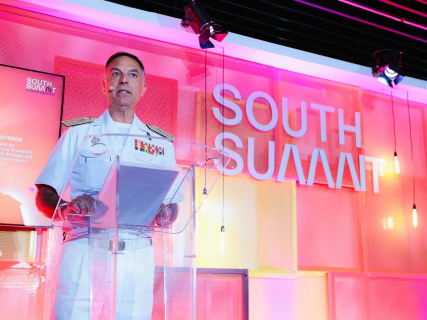

NATO, Airbus, Hispasat, the Ministry of Defense, various 'startups' and international investment funds have addressed this Wednesday the future of European technological defense at the opening of the 15th edition of South Summit in Madrid, an event co-organized by IE University.
The event turns the capital into a global benchmark in artificial intelligence and technological defense from today, thanks to a specific 'Defense & AI' vertical that focuses on the role of AI and 'dual use' and 'deep tech' technologies within Europe's technological, business, and security strategy.
Under the slogan 'Technology, Security and Strategic Autonomy', the event has brought together representatives from institutions, large corporations, 'startups' and global investors, along with the Ministry of Defense, with the aim of studying how to strengthen critical capabilities on the continent in an increasingly unstable geopolitical scenario.
The vertical began with the intervention of the COO of DIANA, NATO's innovation accelerator, Jyoti Hirani-Driver, in a dialogue where she highlighted how the Atlantic Alliance promotes cooperation with startups and 'dual use' technologies in fields such as artificial intelligence, 'space tech', 'quantum', energy, cybersecurity and technological resilience.
"What the wars in Ukraine and Iran have shown us is that technological adaptation is not an abstract term, but a necessity," Hirani-Driver stated.
The DIANA executive also emphasized that "the EU is beginning to wake up in defense matters. On the one hand, we are taking more risks in investments, and above all, we are no longer working as 32 different ecosystems, but as one."
Later, the conversation 'Europe's Defense Industry: Built to Last or Built to Lead?' with the president of Airbus, Amparo Moraleda, focused the debate on the role of the European defense industry in a context of technological acceleration, strong international competition, and the need to consolidate its own capabilities.
Moraleda delved into the sector's challenges in evolving from an approach of mere resistance to one of technological and industrial leadership. "One of the big problems we face is that approximately 80% of European defense spending ends up outside of Europe. We need to spend more, spend better, and spend within Europe," she indicated.
During the first day of South Summit Madrid 2026, the strategic relevance of space infrastructure for the security and competitiveness of the European bloc was also highlighted.
In the session 'The Orbital Advantage: Space as Europe's Strategic Infrastructure', the president of Hispasat, Pedro Duque, explained how satellite communications, connectivity, Earth observation, and orbital capabilities have become essential elements for the defense, technological autonomy, and resilience of the Old Continent.
"Dependence on space capabilities becomes even more evident in conflict contexts. The war in Ukraine has highlighted the extent to which communications, observation, and intelligence depend on space," Duque stressed.
Likewise, the session 'Spain's Two-Speed Defense Tech Bet' analyzed the current situation of the Spanish technological defense ecosystem, with the participation of the co-founder and CTO of Arquetipo, Miguel Acosta.
"Defensive sovereignty is not just a matter of capability, but of having the technology and knowing what you want to do with it. To achieve this, all facilities must be provided for 'startups'. Often, bureaucratic problems for entrepreneurs hinder that sovereignty," Acosta underlined.
The program continued with the panel 'Building in the Gray Zone: Founders on Defense Tech's Real Frontier', focused on the practical difficulties of building 'defense tech' companies in Europe.
The co-founder and COO of FOSSA Systems, Vicente González; the co-founder and CEO of Kreios Space, Adrián Senar, and the CEO and founder of Inventia Kinetics, José Antonio García Gallego, agreed on the profound change that the defensive ecosystem has undergone in recent years, highlighting the role of Diana as an accelerator.
Innovation and its geopolitical impact
The geopolitical dimension of innovation also had a significant weight on the agenda through the session 'Geopolitical Foresight for Ecosystem Strategy'.
The co-founder and partner of PROfounders Capital, Sean Seton-Rogers, and the director of HavocAI, Tim Chrisman, examined how international tensions, economic security, supply chains, and technological resilience are influencing investment criteria and the strategy of innovative ecosystems.
The day has ended with the session 'Dual Use, Double Impact: Accelerating Autonomy', dedicated to dual-use technologies with applications that are both civil and strategic.
In this space, Fiona Wong, an expert in strategic technologies and new industrial capabilities linked to defense and technological resilience, and Thomas Tanghe, a specialist in critical technologies and strategic innovation applied to autonomy and security, have studied how these solutions can accelerate European autonomy and generate effects beyond the strictly military sphere.