
The rating agency S&P Global has placed Nvidia’s 'AA' solvency rating under negative watch, which opens the door to a possible downgrade of the note in the short term, after the latest developments surrounding the company have generated "doubts about the effectiveness of the management and corporate governance framework" of the maker of next-generation microprocessors, in particular regarding the independence of its board of directors and the risk associated with the "key man" figure.
The inclusion of Nvidia’s rating in the agency’s credit watchlist implies that a downgrade of the company’s rating could be decided "within the next 90 days" if it is concluded that deficiencies persist in its management and governance structure. In this context, S&P Global notes that, in principle, any cut would be limited to one notch, unless investigations or new information lead to the belief that Nvidia’s reputation or future business prospects have suffered a relevant deterioration.
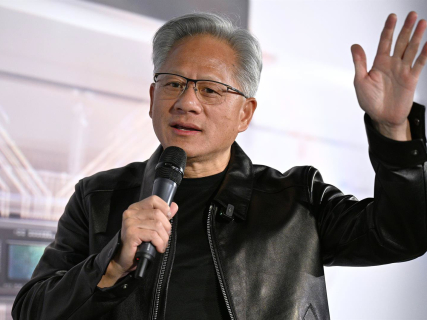
In its report, S&P Global points out that information about Jensen Huang, restored this Monday as CEO of Nvidia just eleven days after his resignation, along with doubts about possible violations of export control rules, "have revealed vulnerabilities in Nvidia’s management and corporate governance framework," especially with regard to the configuration, composition, and performance of its board of directors.
Thus, the rating firm considers that the prolonged tenure of some directors "could have compromised their independence," while warning that the multinational’s corporate governance practices may not have evolved at the same pace as Nvidia’s rapid growth or its role as a leading global technology actor.
At the same time, challenges linked to the high exposure of the U.S. group to China also raise questions about the way it manages geopolitical risk and about the strength of its internal controls.
"While Nvidia's direction has generated significant benefits for its shareholders for decades, weak executive oversight and a lack of succession planning have raised doubts about the risk associated with reliance on a key person," says S&P, which believes that the CEO's departure and subsequent return do not entirely clear up the uncertainties about how the board oversees compliance with the code of conduct for senior executives.
On the other hand, although Nvidia's competitive position, technological leadership, and financial profile have not been affected for now, S&P Global warns that a tightening of export controls could weigh on its growth expectations in the future. It also warns that if it were determined that export control rules were evaded or violated, or that prior information about its exposure to China and nearby markets was misleading or incomplete, this would negatively affect its assessment of Nvidia's credit quality.
S&P Global's warning comes just a few days after Moody's downgraded the outlook associated with the 'Aa1' rating of Nvidia's unsecured senior debt from positive to stable following Jensen Huang's resignation as CEO on November 12 of last year, a decision that the agency itself confirmed yesterday, underscoring that the return of the executive of Taiwanese origin reduces immediate uncertainty, but "does not fully resolve uncertainties related to governance and regulation."
Along these lines, Moody's considers that Huang's return provides greater visibility into business continuity in execution, the product strategy, and Nvidia's relationships with its partner ecosystem, as well as eliminating the execution risk linked to a potential prolonged search for an external chief executive officer and to possible review of strategy and financial policies by a new top executive.
However, the agency insists that doubts remain regarding governance and regulation, since Nvidia's board decided to reinstate Huang less than two weeks after his resignation, while the independent investigation continues to remain open and its findings are still unknown.
"Nvidia remains exposed to risks related to key figures, given the company's significant reliance on the leadership of its chief executive officer, in addition to broader concerns about corporate governance," Moody's recalls, which points out that more structured succession planning and more robust independent oversight would help reduce some of these risks.
Despite the reincorporation of Jensen Huang as Nvidia's top executive on Monday, the executive will have to appear on December 3 before the United States Senate Committee on Banking, Housing, and Urban Affairs at a public hearing titled "Protecting the United States' Advantage in AI: Oversight of U.S. Export Controls."
Before that appointment, Huang and Nvidia's general counsel, Tim Teter, will testify before the House Select Committee on China, the House Intelligence Committee, and the House Foreign Affairs Committee, whose sessions will be transcribed on December 1 and 2.
In addition, California Attorney General Rob Bonta confirmed yesterday that he will keep his investigation into Nvidia open despite Jensen Huang's return to the executive leadership, even after U.S. Attorney General Todd Blanche described the company as a "good corporate citizen" following the intervention of U.S. President Donald Trump with the board of the multinational to bring Huang back.