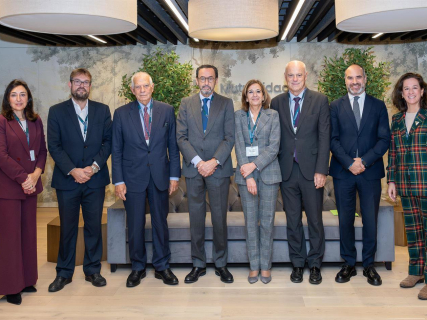

In a global context marked by the fragmentation of the world order, the increase in tensions between economic blocs, and high uncertainty, the European Union (EU) is facing its economic future by relying on the mobilization of savings towards investment, long-term planning, and the advancement of artificial intelligence (AI).
These ideas have focused the seventh Economic-Insurance Meeting organized by Mutualidad, held under the slogan "Europe in transformation: economy, geopolitics and future insurance", which has brought together specialists, institutional officials, and professionals from the sector to analyze the challenges and opportunities that will condition the evolution of the insurance industry.
"Insurance is called upon to play a decisive role in building a more resilient, inclusive and sustainable society. This meeting precisely reflects that calling to generate knowledge, promote dialogue, and contribute to a sector prepared to anticipate the challenges of the future and continue creating value for people and for society", has stated the president of Grupo Mutualidad, Enrique Sanz Fernández-Lomana.
During his address, Josep Borrell, former Minister of Foreign Affairs and former High Representative of the European Union for Foreign Affairs and Security Policy, has provided a broad overview of the current geopolitical landscape and of how its growing tensions impact the economy of the continent.
In a keynote speech with a strong strategic character, Borrell delved into the breaking of the world order, the rise of frictions between major economic blocs, and the challenge of reinforcing European strategic autonomy in an increasingly competitive and unstable scenario.
The former High Representative has underscored the connection between China's structural surplus, the United States’ consumption above its productive capacity, and European savings that is not allocated to finance its own economy. To conclude, Borrell emphasized the urgency for Europe to regain the ability to "negotiate with a single voice".
Next, the economist, former Secretary of State for the Economy (2009-2011) and president of the European Banking Authority (EBA), José Manuel Campa, has examined the strength of the European financial system in an environment of high volatility, focusing on the role of long-term savings and the Union of Savings and Investment.
On this line, Campa has highlighted the importance of channeling the savings of European citizens toward productive investment projects and of advancing the integration of the single market in order to reduce financial fragmentation and raise the competitiveness of the EU economy.
Major challenges for the next decade
In the subsequent debate, both experts have addressed some of the major challenges that will shape the coming years: the financing of European security and defense, the loss of competitiveness vis-à-vis the United States and China, the role of capital markets in activating private savings, and Europe’s ability to maintain its weight in an increasingly fragmented international environment.
Under the title "Organizations in the face of global risks and transformations", the subsequent roundtable brought together specialists from different areas to examine the forces that are transforming the economy and society, as well as the capabilities that organizations must develop in order to remain competitive and resilient.
The panel included the president of the Instituto de Actuarios Españoles and general director of Mutualidad, Fernando Ariza; the strategic consultancy in AI and Digital Transformation for law firms, Eva Bruch; the expert in Sustainability and founder of Women Action Sustainability, Mónica Chao, and the principal researcher of Real Instituto Elcano and professor at IE School of Politics, Economics and Global Affairs, Miguel Otero.
The roundtable has analyzed the role of boards of directors in identifying and managing geopolitical and technological risks, from the growing international fragmentation to the possibility that a computer failure could stop an organization’s activity entirely.
The discussion has also extended to data protection, the need for human oversight in the use of artificial intelligence, European autonomy in defense matters, adaptation to climate change, and the application of ESG criteria. In the demographic sphere, the aging of the population, the intergenerational pact, and the savings and coverage needs of the different generations have been studied.
The closing of the event was handled by the General Deputy Director of the Inspection Department of the Directorate General of Insurance and Pension Funds (DGSFP), Carolina Lameiro, who has placed emphasis on the major challenges that will shape the future of insurance: strengthening the resilience of the sector through prudent risk management; responding to demographic challenges; taking advantage of the opportunities of digital transformation; reducing insurance gaps to expand protection for individuals and businesses, and strengthening customer protection and fair treatment.
An event aligned with sustainability
Commitment to sustainability has been evident in the design and holding of the event. The VII Encuentro Económico-Asegurador is included within the scope of Mutualidad’s Sustainable Events Management System, certified under the international standard ISO 20121:2024.
This certification supports the incorporation of environmental, social, and good governance criteria in all phases of planning and implementation of the event, from optimizing resources and reducing negative impacts to promoting accessibility, inclusion, and the creation of social value.
Mutualidad has stated that with this seventh edition, the Encuentro Económico-Asegurador has reaffirmed "its role as a reference platform for the exchange of ideas and the drive for initiatives that contribute to building a more innovative, resilient sector prepared to respond to the needs of citizens in an increasingly changing environment".