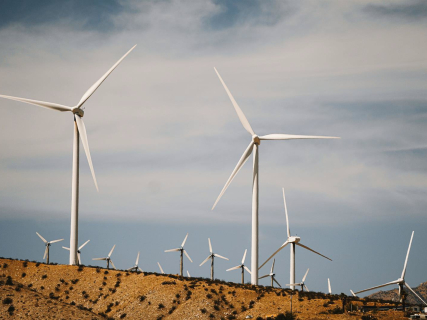

The Ministry for Ecological Transition and the Demographic Challenge has launched the public hearing procedure for the proposed order that will make it possible to convene access capacity tenders at nodes of the transport network intended for new wind technology installations. The consultation period will remain open until next December 22, as the department headed by Sara Aagesen reported.
The aim of this measure is to move toward the power targets set out in the Integrated National Energy and Climate Plan 2023-2030 (PNIEC), while at the same time maximizing the positive socioeconomic return and minimizing the impact on the natural environment.
Wind energy closed 2025 with an installed capacity of 33.3 gigawatts (GW), after several years of growth that were more moderate than that of photovoltaics, and it still remains at a distance from the 62 GW set in the PNIEC for the end of the decade.
To speed up the deployment of this technology, the Ministry proposes organizing tenders through which access capacity, expressed in megawatts (MW), will be awarded at those nodes of the grid that have been reserved specifically for this purpose.
Without prejudice to the fact that analogous procedures may be activated in the future for other renewable technologies, these first calls will be aimed only at wind projects, both with associated storage and without it.
Through this route, the Government intends to increase the volume and stability of the renewable generation that is integrated into the system, strengthening the sustainability and economic efficiency of the electricity system through a more optimal use of available resources.
Requirements and award criteria
To resolve the awards in the list of nodes that will be included in each call, the proposed order provides for the application of temporary and socioeconomic and environmental impact criteria in the territories where the plants will be implemented, with special attention to the areas affected by the demographic challenge.
Among the aspects that may be assessed are the availability of the Environmental Impact Statement, the impact of the installation and its evacuation infrastructure, the scheduled date for the start of production, the storage capacity measured in hours, voltage control, or self-consumption.
Likewise, the use generated in the area, the participation of local investors, the reinvestment of income in the same area, and the strengthening of the European industrial chain linked to this technology may be weighted.
With the aim of ensuring the actual fulfillment of the commitments undertaken, the order provides that participants must provide two types of additional guarantees to those required in the ordinary course when granting the right of access and connection to the grid.
On the one hand, voluntary guarantees associated with the commitment to early electricity injection are envisaged, the amount of which will be equivalent to 25% of the production obtained before the deadline set to complete the processing of the installation.
On the other hand, mandatory guarantees of 40 euros per kilowatt (kW) installed are established, intended to back environmental, socio-economic, and revitalization commitments in areas facing demographic challenges, with a system of proportional penalties to the degree of noncompliance in both cases.